What This Actually Covers
Most "resources for women in food" roundups read like they were copy-pasted from a generic marketing blog. Links to generic entrepreneurship sites. Nothing about actually running a truck.
This is not that. You are running (or about to run) a food truck. You work a commissary at 5 AM, a generator at noon, a health inspector at 2 PM. You also happen to be a woman in an industry that still defaults to male voices in the loudest rooms.
Below are the resources that actually help female food truck operators: real grant programs, real mentorship pipelines, real communities, and the honest truth about how to build your network when the default is not built around you.
Women-Led Food Trucks Already Making It Work
Before the resources, proof it is happening. A small sample of women-owned trucks operating right now across different markets:
- Eloisa's Kitchen (Dallas, TX) - Eloisa Schessler runs the truck with her daughter as sous chef and creative director. Parked at Klyde Warren Park.
- Sweet Sipz (Amarillo, TX) - Darcy Marvin operates both a truck and trailer in West Texas.
- La Chaparrita's Munch Truck (Los Angeles, CA) - Jennifer Ramirez runs a daily multi-stop lunch route through Bel-Air.
- Bel-Fries (New York, NY) - Annalee Schlossberg built a Belgian fries + artisanal sauce concept into a New York mainstay.
- Makina Cafe (New York, NY) - Eden serves Ethiopian dishes from her childhood.
- Candy Zoo (New York, NY) - three moms co-founded this dessert truck in 2022.
- Kinky Taco (New York, NY) - Akeelah fuses her mother's Louisiana and father's Texas cooking.
Two organizations actively highlight women-owned operators with searchable directories: the New York Food Truck Association's Best Woman-Owned Food Trucks list and FTALA's Best Women-Owned Food Trucks LA. Start there if you want operators to follow, imitate, or reach out to in your market.
Communities
What to Look for in a General Food Truck Community
There is no major online community exclusively for female food truck operators. The communities that serve women operators best are the ones with active moderation, clear reporting tools, and a culture of respect - and those qualities vary group by group, not platform by platform.
Before you invest time in any group, check three things: whether the rules are posted and enforced, whether there is a visible way to report harassment and whether admins respond to it, and whether women operators are already posting and being answered with respect. Regional Facebook groups tied to a local association tend to do better on all three, because the admins are operators who know the members personally. If a group fails the test, leave it. There is no shortage of others.
Local Associations
Many regional food truck associations are led by or heavily involve women operators. Check your local association for women-focused subgroups, mentorship pairings, or events.
Women-Focused Business Communities
While not food-truck-specific, these communities provide valuable peer support:
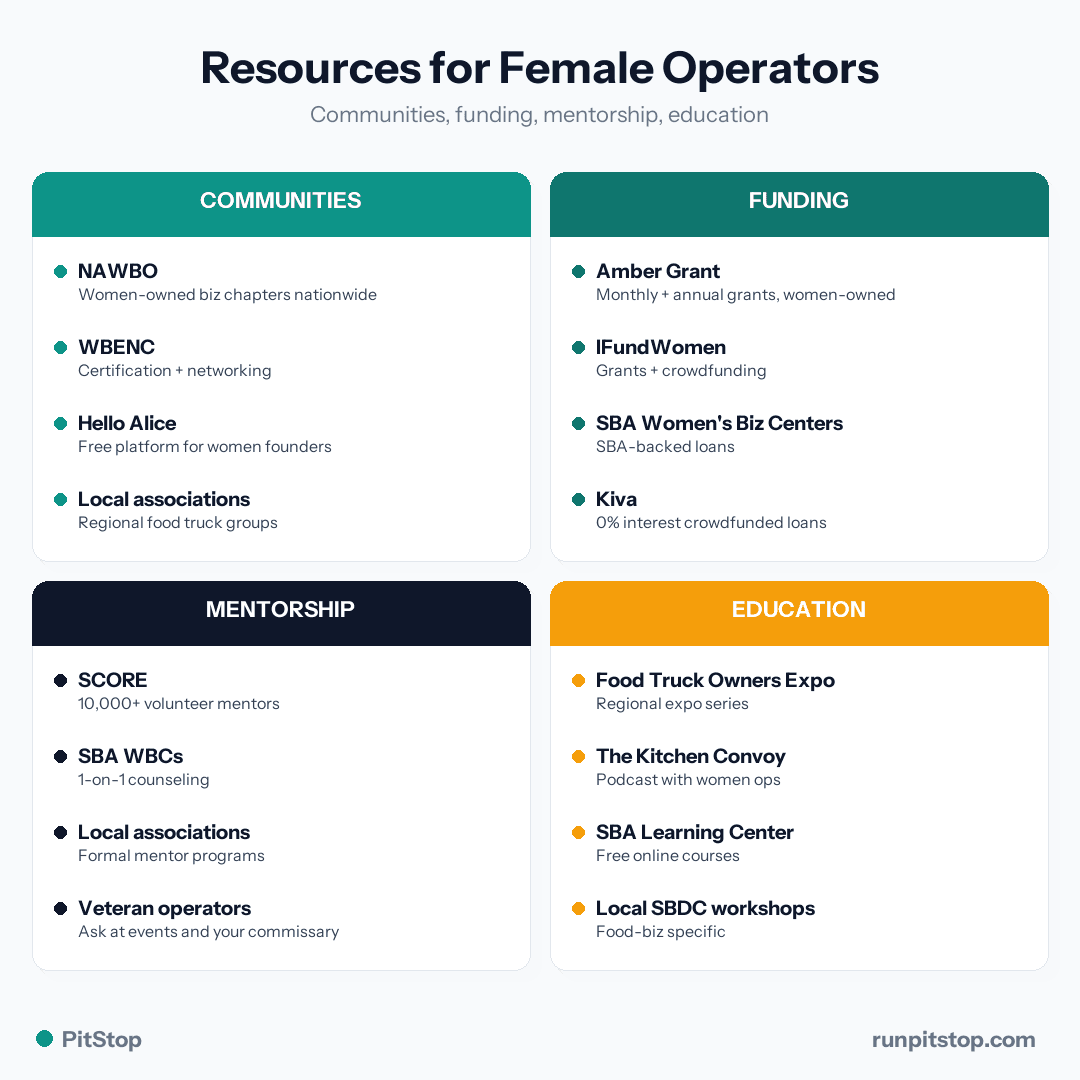
- National Association of Women Business Owners (NAWBO) - chapters in most major cities, networking events, advocacy
- Women's Business Enterprise National Council (WBENC) - certification and networking for women-owned businesses
- Hello Alice - free platform connecting women entrepreneurs with resources, grants, and community
Grants and Funding
Women-owned food businesses have access to several funding sources. Award amounts change from year to year, so confirm the current figure on each program's own site before you build it into a budget:
Grants
Amber Grant - A monthly grant to women-owned businesses, with an additional annual grand prize drawn from the monthly winners. Application is straightforward and open to food trucks.
IFundWomen - Grant programs and crowdfunding platform specifically for women-led businesses. Check for food and beverage specific grants.
FedEx Small Business Grant - Not women-specific but historically awards to diverse businesses including food trucks. One of the larger grand prizes in the small-business grant space.
Local grants - Many cities and states have women-owned small business grants. Your local Small Business Development Center (SBDC) maintains current listings.
Loans and Capital
SBA Women's Business Centers - Free consulting and connections to SBA-backed loans with favorable terms for women-owned businesses. 100+ centers across the U.S.
Community Development Financial Institutions (CDFIs) - Mission-driven lenders that prioritize underserved entrepreneurs including women. Often more accessible than traditional banks for food truck financing.
Kiva - Crowdfunded small-business loans at no interest, with a strong track record with food businesses. Check the current loan cap on their site.
Mentorship
SCORE
Free mentorship from experienced entrepreneurs, including food service veterans. SCORE has 10,000+ volunteer mentors and offers both in-person and virtual mentoring. Ask specifically for a mentor with food service or mobile food experience.
SBA Women's Business Centers
Beyond loans, WBCs offer free one-on-one counseling, training programs, and connections to other women business owners. The mentorship is ongoing, not one-time.
Food Truck Associations
Some associations run formal mentorship programs. Gulf to Bay Food Truck Association in Tampa Bay is one example. Even without formal programs, associations connect you with experienced operators who are often willing to mentor informally.
Informal Mentors in Your Market
Mentorship does not require a program. The women-owned truck directories above, your association's member list, and your regional group are all ways to identify experienced women operators in your market. A direct, specific message - what you are building, what you are stuck on, and whether they would take a 20-minute call - gets a yes more often than you would expect.
Education and Training
Food Truck Specific
Food Truck Owners Expo - A regional food truck expo series (Austin hosted in August 2026; check the expo's site for the next stop). Sessions cover operations, marketing, finances, and networking.
Podcasts with women operators:
- The Kitchen Convoy - Interviews with food entrepreneurs who built careers outside traditional kitchens
- Food Truck Beast - Interviews with operators across backgrounds and experience levels
Business Fundamentals
SBA Learning Center - Free online courses covering business plans, financing, marketing, and management.
Local SBDC workshops - Free or low-cost workshops on food business topics including food safety, permitting, and financial management. Many are offered in multiple languages.
Building Your Network
The most practical advice we can offer: do not wait for a women-specific food truck community to appear. Build your network within the communities that exist, and be intentional about connecting with other women operators when you find them.
At events: Introduce yourself to every female operator you see working an event. The connection is instant because you share both the industry experience and the specific experience of being a woman in it.
In online communities: When you see another woman operator posting in a Facebook group or on Reddit, reach out directly. A simple "Hey, I am also a female operator in [state], would love to connect" opens doors.
Through associations: Ask your local food truck association about other women members. Most association leaders are happy to make introductions.
At commissaries: Your commissary kitchen is a natural networking space. If you are prepping alongside another woman operator, that is a conversation waiting to happen.
The Bigger Picture
Most of the food truck industry is independent operators. That means every operator - regardless of gender - is largely figuring it out alone. The ones who succeed build networks, find mentors, and connect with peers who understand their challenges.
For women operators, that means using the general resources available to all operators AND actively seeking out the women-specific resources, grants, and connections that exist. Both matter.
Your perspective as a female operator is not a footnote in the food truck industry. It is an increasingly significant part of it. Find your people, build your network, and do not let anyone make you feel like you are crashing someone else's party. You belong here.
When you sit down with a grant application or a lender, bring real numbers: the food truck startup costs guide breaks down what the first year actually costs, line by line.