You Just Bought a Truck and You Do Not Know Anyone
Maybe you came from a restaurant kitchen. Maybe you came from a completely different industry. Either way, you are standing at the beginning of a food truck career and your professional network in this space is zero.
That is a problem, because the operators who survive year one are overwhelmingly the ones who build connections with other operators. Not for the warm feelings - for the practical intel that keeps you from making expensive mistakes.
This guide is for the operator starting from scratch.
Why This Is Not Optional
Let us be direct about what a network of operators actually gives you:
Money saved. A single tip about which commissary is overcharging, which event organizer does not pay out, or which permit shortcut is legit can save you thousands.
Money earned. Operators who cannot take a catering gig refer it to people they trust. That only happens if people know you and trust you.
Survival intel. Industry estimates suggest roughly 30-40% of food trucks close within the first three years (about 60% survive), and that number is not random. Operators struggle because they do not know what they do not know. A network fills that gap faster than going it alone.
Mental health. Running a food truck solo is isolating. Having people who understand the 3 AM alarms, the 120-degree truck interiors, and the stress of slow weeks makes the difference between pushing through and burning out.
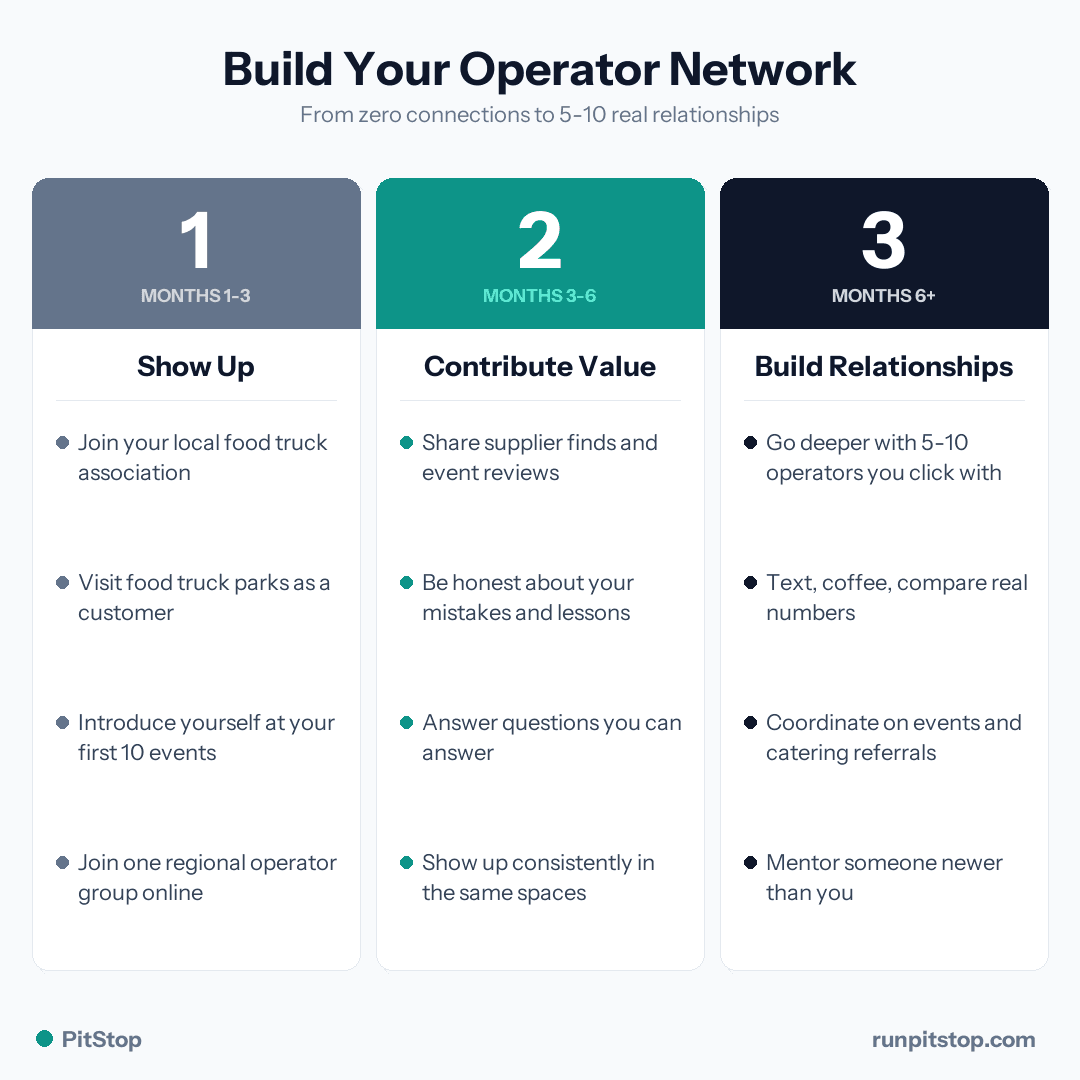
Phase 1: Show Up (Months 1-3)
Join Your Local Food Truck Association
Search "[your city] food truck association." If one exists, join immediately. The membership fee pays for itself within weeks through event leads, mentorship, and permit guidance alone.
Associations are the fastest shortcut to a local network because they are designed for exactly this purpose.
Visit Food Truck Parks as a Customer
Before your truck is even operational, go buy food from other trucks. Introduce yourself. "Hey, I am opening a [cuisine] truck in [area] - just wanted to meet some of the operators around here." That is it. No pitch. No ask. Just be a human.
Food truck operators respect people who show up and show interest. You are not competing yet. You are a future colleague.
Work Your First Events
Your first 10-15 events are not just about revenue. They are about meeting the operators parked next to you. Say hello. Ask how the event has been for them. Swap numbers. These low-pressure interactions during a shared experience build rapport faster than any networking event.
Get Active Online
Find the regional Facebook group for your market - ideally the one tied to your local association - and request to join. Start by reading and absorbing. Then ask a genuine question. Then answer someone else's question when you can. Contribute before you ask. Reddit's r/foodtrucks and r/smallbusiness are fine for general questions, but the local group is where the people you will actually meet are.
Phase 2: Contribute Value (Months 3-6)
This is where most operators stall. They join groups, attend a few events, and wait for the network to come to them. It does not work that way.
Share What You Learn
Did you find a supplier with great prices? Share it. Worked an event that surprised you? Post a review. Figured out a permit shortcut? Tell someone.
The food truck world runs on reciprocity. The operators who share knowledge freely build reputations as people worth knowing. The ones who hoard information get nothing back.
Be Honest About Your Mistakes
This might be counterintuitive, but the food truck community respects vulnerability when it comes with a lesson. "I lost money on this event because I did not check the projected attendance - here is what I would do differently" earns more respect than pretending everything is perfect.
Veterans especially respond to new operators who are honest about what went wrong. It signals you are serious about learning, not just performing success.
Answer Questions You Can Answer
You do not need to be a veteran to help people. If you just went through the permitting process in your city, you know more about it than someone who is about to start. Share that knowledge. Answering questions in your regional group or at the commissary makes you someone other operators remember - and remembered is how referrals start.
Phase 3: Build Real Relationships (Months 6+)
Go Deeper With a Few People
You do not need 100 connections. You need 5-10 operators you can actually call when something goes wrong. Identify the operators you click with - similar market, similar stage, compatible personalities - and invest in those relationships.
Text them outside of group conversations. Meet up for coffee. Compare numbers. The deep relationships are where the real value lives.
Create a Local Crew
Some of the strongest food truck networks are informal groups of 3-5 operators who coordinate:
- They share event intel and warn each other about bad gigs
- They refer catering jobs to each other
- They share a commissary and split costs
- They cover each other's events during emergencies
- They keep each other sane during slow season
This rarely happens inside a big group. It happens through direct relationships built over time, and a private group text or small Discord server is plenty to keep it running.
Mentor Someone Newer Than You
Once you have 6+ months under your belt, you know more than the person who is starting today. Help them the way someone (hopefully) helped you. Mentorship builds the strongest professional bonds in this industry, and the food truck world has a genuine culture of paying it forward.
The Online Component
In-person connections are irreplaceable, but online groups extend your network beyond your immediate geography and keep conversations going between events.
A regional Facebook group tied to your association is usually the best starting point; a national group is fine as long as you know what you are using it for. Before you invest time in any group, check:
- Local context - are the members actually in your state and city?
- Real people - can you click through to a truck page and see who you are talking to?
- A way to go direct - can you take a conversation private when it matters?
- Pinned knowledge - does the group keep its recurring answers somewhere findable?
- Active moderation - is spam and scam content removed?
Whatever you pick, the group is the entry point, not the destination - the goal is a handful of operators whose numbers are in your phone.
The Bottom Line
The U.S. food truck industry runs to tens of thousands of active operators. The vast majority are independents figuring it out alone. The ones who build real connections with other operators earn more, fail less, and burn out slower.
You do not need to be an extrovert. You do not need to work a room. You just need to show up, contribute value, be honest, and invest in a handful of real relationships.
Start today. Your future self - exhausted, stressed, and wondering if this was the right call - will be glad you did.
If you are still in the planning phase, the food truck startup costs guide gives you the numbers to bring to those first conversations.