Let Us Save You Some Time
You are going to Google "food truck community" and find a lot of generic listicles that tell you to "network" and "build relationships" without pointing you anywhere useful.
This is not that article.
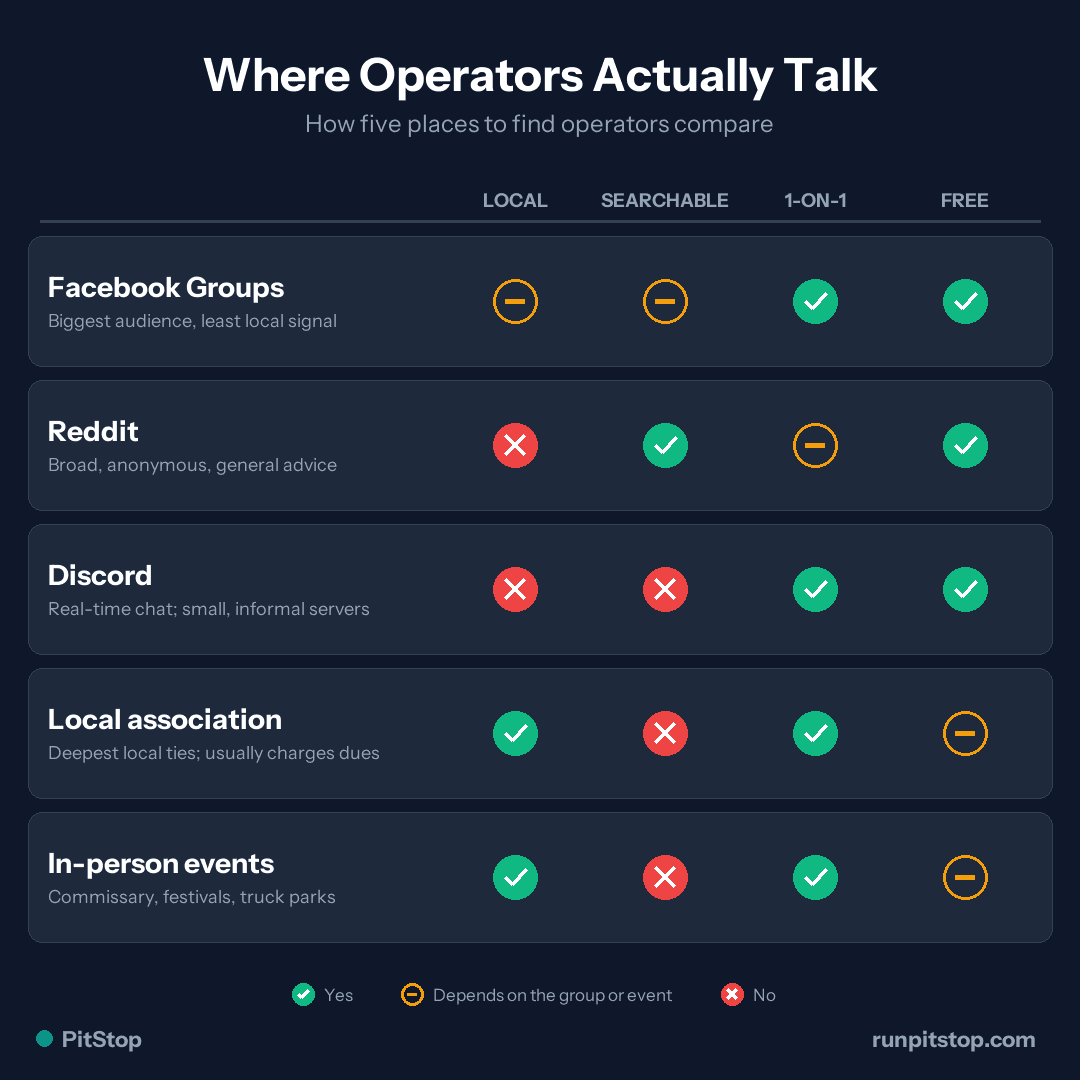
We went through every online community, forum, Facebook group, and platform where food truck operators actually hang out, plus the offline networks that most roundups skip. We are telling you what each one is good for and where it falls short. No affiliate links, no rankings based on who paid us.
The Quick Verdict
If you want one answer: most food truck operators end up in Facebook groups because that is where the people are, and the ones who get the most out of it pair those groups with a local food truck association and the operators they meet at their commissary and at events. No single place does everything. The useful move is knowing what each one is for.
Now here is the full breakdown.
Facebook Groups
National Groups
There are several large national food truck groups on Facebook, plus a wide mix of mid-sized and niche ones - including groups built around specific regions, cuisines, and communities of operators. They are where the most people are, and you can get real help in them. What each one is like varies, so join a couple, watch how they run for a week, and keep the ones that fit how you operate.
Regional Groups
This is where Facebook shines. Groups tied to your local food truck association (Gulf to Bay in Tampa, NYFTA in New York, Nashville Food Truck Association, and many others) tend to have strong signal because the members know each other personally. Event leads, commissary recommendations, health department updates - the local stuff that affects your daily operations.
The catch: you have to find the right regional group for your area, and activity varies a lot from one to the next.
Where Facebook Falls Short
Facebook groups are genuinely useful. But they were built for social networking, not for running a professional community, and a few structural limits show up no matter which group you are in:
Posts get buried. Facebook's algorithm decides what you see, not chronology. A time-sensitive event lead or health department warning can slip out of view quickly. There is no way to filter by state, by topic, or by "questions that nobody answered yet."
Scams are escalating. In 2025, the Wisconsin Department of Agriculture, Trade and Consumer Protection (DATCP) issued formal consumer warnings about scammers infiltrating food truck vendor groups with fake event bookings requesting fees via CashApp and Venmo. Similar reports have surfaced in operator groups across the country.
Pitches mix in with the help. Because the groups are open, course and coaching pitches show up alongside genuine advice, and it is not always obvious which is which.
Knowledge does not accumulate. Great advice gets posted once and is hard to find again. There is no way to mark an answer as "this actually worked," and search inside a group is hit or miss.
Facebook groups are free, big, and genuinely useful. They are just not designed for searchable, organized, local-first support - so pair them with a local association and a few direct relationships for that part.
r/foodtrucks
It exists, and it is a smaller community. Posts are mostly from aspiring owners asking broad startup questions ("Is a food truck worth it?"), and replies come from whoever happens to be scrolling.
r/smallbusiness and r/entrepreneur
You will find occasional food truck threads in broader business subreddits. Some good financial discussions, but no food-truck-specific context. Nobody there knows what your local health department is like or which events in your city are worth the vendor fee.
The Reddit Trade-Off
Reddit is anonymous. That makes people candid, which is valuable, but it also means you have no way to tell whether the person giving you permit advice has ever held a permit. There is no local context and no operator profiles, and upvotes measure agreement more than local accuracy.
Useful for browsing general small business strategy, equipment research, and honest reality checks. Less useful as your primary source of local operating advice.
Dedicated Forums
FoodTruck.forum
A purpose-built forum covering permits, menus, equipment, and general discussion. The idea is a good one, and the community is small, so day-to-day activity is light. It works as an occasional reference more than a place to get a fast answer.
Mobile Cuisine
Mobile Cuisine is one of the older food truck resource sites, and the articles themselves are useful. It is a reading resource rather than a discussion board, so search it for background and take your live questions elsewhere.
FoodTruckr
Blog and podcast, strong on long-form content. Their "50 Owners Speak Out" article is a much-cited piece, which tells you something: operators are hungry for peer voices. What it does not offer is a live, interactive space to trade those voices day to day.
Discord
There is no major food truck operator Discord server. A few small ones exist with activity that comes and goes. Discord is great for real-time chat but weak for searchable knowledge. Conversations scroll by and are hard to recover, so finding "what commissary should I use in Orlando" from a thread three weeks ago is tough.
If someone builds a thriving food truck Discord, it will need active moderation and pinned resources to be useful. Until then, Discord works best as a private group chat for a small crew of operators who already know each other.
Food Truck Associations
Regional and state food truck associations (Gulf to Bay Food Truck Association in Florida, Washington State Food Truck Association, NYFTA in New York, etc.) offer some of the best in-person networking and mentorship. Many run events, advocate for operators with local government, and maintain standards around vendor fees and event quality.
A real example: the Washington State Food Truck Association publicly refuses to promote events with "excessively high vendor fees or unreasonable vendor requirements." That is the kind of operator advocacy individual trucks cannot do alone.
The limitation: their digital presence is usually just a Facebook page. They are geographically bound. And their mentorship programs require physical proximity. If you are not in their metro area, you will get less out of them.
The Food Truck Owners Expo runs one or two regional shows a year (Austin hosted in August 2026; check the expo's site for the next date), and it is worth attending if one lands near you. In-person shows are great, and they pair well with the groups you can reach any day of the week.
Industry Podcasts and YouTube
Food Truck Beast and The Kitchen Convoy are solid for education and motivation. They interview real operators and share practical advice.
But they are content, not community. You listen. You do not participate. You cannot ask follow-up questions or get advice on your specific situation.
Great supplements. Not a replacement for talking to other operators.
Your Commissary and Your Local Association
The two most underrated "communities" in this business are not online at all.
Your commissary kitchen. You are prepping alongside other operators at 5 AM, several days a week. They know which events in your city pay out, which inspector is thorough, and which supplier just raised prices. Nobody in a national Facebook group can tell you that. Start conversations. Ask what they are working this weekend. The commissary is the closest thing this industry has to a break room.
Your local association. Membership usually comes with a member directory, a private group, meetups, and a direct line to the people who negotiate with the city on your behalf. If your market has one, it is the fastest way to go from "I know nobody" to "I know the ten operators who matter."
Events and food truck parks. The trucks parked next to you at a festival are working the same market, the same organizers, and the same season. Say hello, swap numbers, and compare notes on the organizer afterward. Those relationships outlast any group thread.
If you are in an area without an active association, the commissary and the event circuit still work, and a regional Facebook group can fill in the gaps between them.
The Recommended Stack
You do not need to be in all of these. Here is what actually works:
| Need | Best Option |
|---|---|
| Local event leads | Regional Facebook group + local association |
| Operator Q&A | Your commissary + regional Facebook group |
| Equipment research | Reddit + YouTube |
| Industry education | Podcasts (Food Truck Beast, Kitchen Convoy) |
| Direct operator connections | Local association events + food truck parks |
| Permit and regulation updates | Local association + state permit guides |
So What Should You Actually Join?
Here is the honest recommendation:
The U.S. food truck industry runs to tens of thousands of active operators, and the vast majority are independents running their businesses without institutional support. The right network is not a nice-to-have. It is how you avoid the mistakes that close an estimated 30-40% of trucks within their first three years.
Wherever you end up asking your questions, the permit answers are already written down: the 50-state food truck permit guides cover requirements, fees, and timelines for every state.