You Already Know This
You posted a question at 6 AM before your prep shift. By the time you checked your phone at 2 PM, it had a couple of replies and had slipped down the feed under newer posts, including a few promotions.
That is a normal Facebook group experience for food truck operators in 2026, and it is worth understanding why it happens before deciding how much to lean on these groups.
The Problem Is Not the People
Let us be clear: the operators in food truck Facebook groups are real people trying to help each other. The limits come from the platform. Facebook was built for social networking, not for running a professional community for an industry that needs searchable answers, local context, and time-sensitive information.
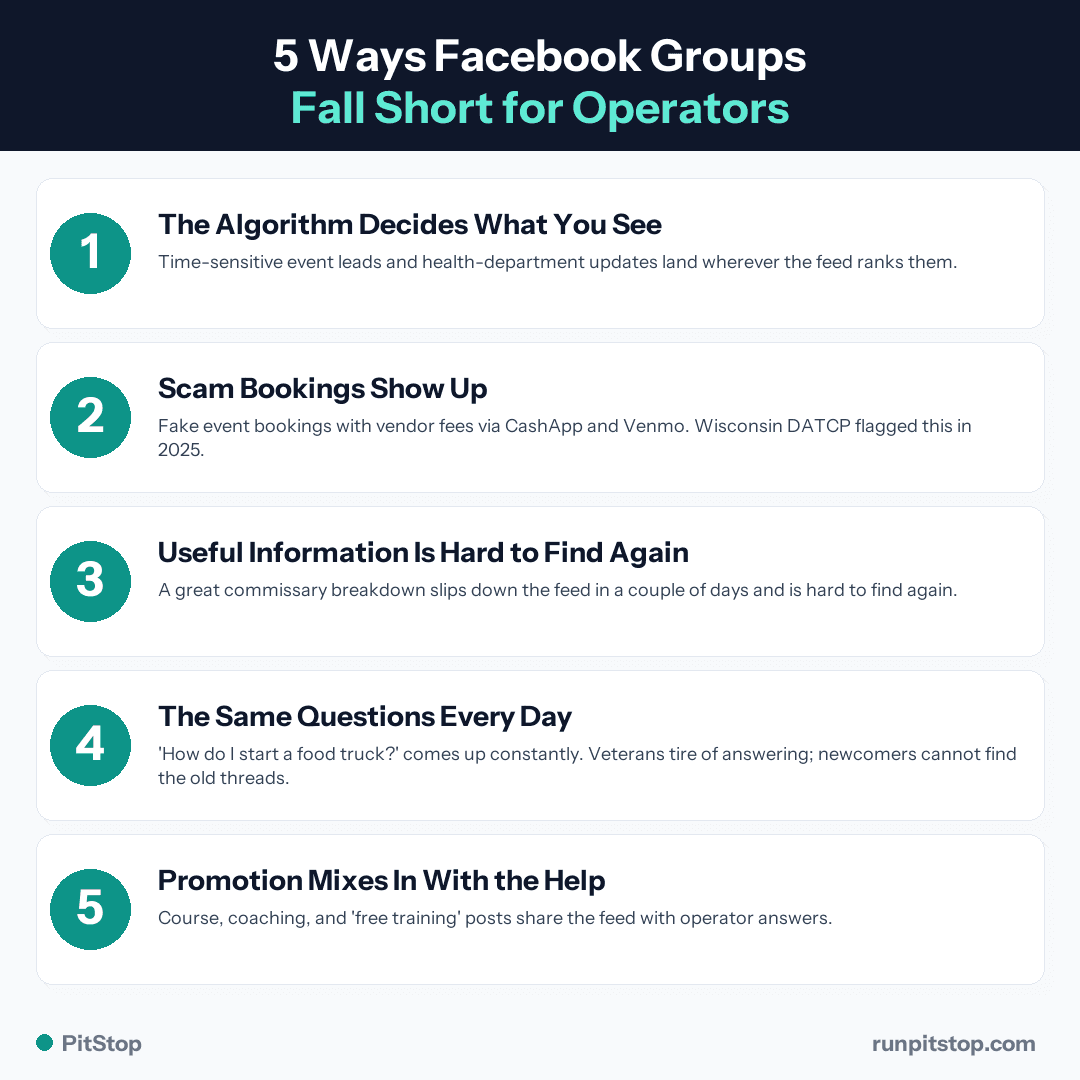
Five Ways Facebook Groups Fall Short
1. The Algorithm Decides What You See
Facebook does not show posts chronologically. It shows you what it thinks will keep you scrolling. That means a viral meme about Gordon Ramsay can get pushed to the top while a post about your city changing its permit requirements reaches a fraction of the group.
For food truck operators, timing matters. A last-minute event opening, a health department update, a warning about a scam event organizer - this information has a shelf life of hours, not days. Facebook's algorithm treats it the same as a photo of someone's truck wrap.
2. Scammers Have Figured Out the Groups
In 2025, the Wisconsin Department of Agriculture, Trade and Consumer Protection issued formal consumer warnings about scammers infiltrating food truck vendor groups with fake "fan event" bookings. The scam is simple: post a professional-looking event flyer, collect vendor fees via CashApp or Venmo, disappear.
This is not a Wisconsin problem. It is happening in food truck groups across the country, and group reporting tools are often too slow to stop it before operators lose money.
3. Useful Information Is Hard to Find Again
Someone shares their commissary setup with photos and a cost breakdown. It gets dozens of likes and comments. Two days later it is buried in the feed, and unless you saved it, it is hard to find again.
Facebook groups have no shared bookmarking that works across members, no way to pin community knowledge beyond a handful of featured posts, and no way to tag posts by topic, state, or experience level. Every useful thread eventually becomes hard to surface.
4. The Same Questions Every Day
"How do I start a food truck?" comes up constantly in the big groups. The answers are always the same. The veterans get tired of answering. The newcomers never find the previous answers because group search is unreliable.
This is a structural issue. Facebook groups have no FAQ, no accepted-answer system, no way to surface existing answers to repeated questions. So the same cycle repeats, wearing down the experienced members who could provide the most value.
5. Promotion Mixes In With the Help
Food truck consulting is a real and often valuable industry. The catch in an open group is structural: helpful advice and promotional posts sit side by side, and it is not always obvious which is which.
Moderation in most groups is a volunteer job. Admins are operators themselves - they are on the truck, not monitoring posts all day. So the mix is hard to keep sorted, no matter how good the intentions.
How to Get More Out of the Groups You Are In
You cannot change how Facebook works, but you can change how you use it:
Turn on notifications for your regional group only. Let the national groups be background reading. Your local group is where the time-sensitive posts that actually affect you show up.
Save the posts worth keeping. Facebook's Save feature works for your own account. When someone posts a commissary breakdown or an event review, save it and copy the useful part into a notes app. Your own notes are the searchable knowledge base the group does not have.
Check the Featured and Files sections. Well-run groups pin their rules, recurring answers, and vetted event lists there. It is the closest thing to an FAQ most groups have.
Verify before you trust. Click through to the poster's profile and truck page before acting on advice or paying anyone. An operator with a real truck, real photos, and a history in the group is a different source than a week-old account.
Search with specific words. Group search works better with "Hillsborough commissary" than with "commissary." Add your city or county.
Take the important questions offline. If you need a real answer about a permit, a health inspection, or an organizer, ask your local association or the operators at your commissary. They know your market and will tell you directly.
What to Do About It
We are not telling you to leave Facebook groups. Some of them - especially regional ones tied to local food truck associations - provide real value for event leads and local news.
But if you are relying on Facebook groups as your only support network, you are building on a platform that was not designed for the way you work.
Here is a better setup:
For local event leads and news: Stay in your best regional Facebook group.
For operator-to-operator Q&A and mentorship: Your local food truck association and the operators you prep next to at your commissary. They know your market, and you know who you are talking to.
For general industry reading: Mobile Cuisine and FoodTruckr publish good articles. Read them for perspective.
For the questions with stable answers: Permits, fees, timelines, and startup costs do not change hour to hour. A written guide you can search beats a feed you have to scroll. Start with the state-by-state permit guides and keep the group for the things that only a local operator can tell you.