The Loneliest Job in Food
Here is something nobody puts in the "how to start a food truck" guides: this is an isolating business.
You are in a metal box for 12 hours. Your crew, if you have one, is 1-2 people. You do not have coworkers in the break room. You do not have a manager to escalate problems to. When the generator dies mid-service or a health inspector shows up with questions you were not expecting, it is just you.
Research on workplace loneliness has repeatedly found that more than half of American workers report feeling lonely (Cigna U.S. Loneliness Index, 2020). For food truck operators working solo or near-solo, the isolation is almost certainly worse. The grind is real, and doing it alone makes it harder.
Finding other operators in your area is not networking fluff. It is one of the most practical things you can do for your business and your sanity.
Why Local Connections Matter More Than You Think
Commissary Intel
Commissary costs vary widely by market, and the difference between a great commissary and a terrible one is not something you find on Google - it is something another operator tells you. Who has availability, who is clean, who nickels and dimes you, who has the best cold storage.
Event Intel
Which events in your city actually pay out? Which organizers are professional? Which ones charge steep vendor fees and draw no crowd? This information is worth real money every year, and it only comes from operators who have worked those events.
Permit Navigation
Permit requirements are intensely local. Talking to an operator who just went through the process in your city is worth more than reading ten blog articles (including this one). They know which inspector is thorough, which office is slow, and what the unwritten rules are.
Backup and Referrals
Operators who know each other cover for each other. Catering gig you cannot take? Refer it to someone you trust. Need a last-minute crew member? Call another operator. Equipment breaks and you need a generator for tomorrow? Somebody has one.
Mental Health
Having people who understand what you are going through is not a luxury. When you are working your fifth 14-hour day and questioning every decision you made to get here, a conversation with someone who has been there changes your entire headspace.
How to Find Operators Near You
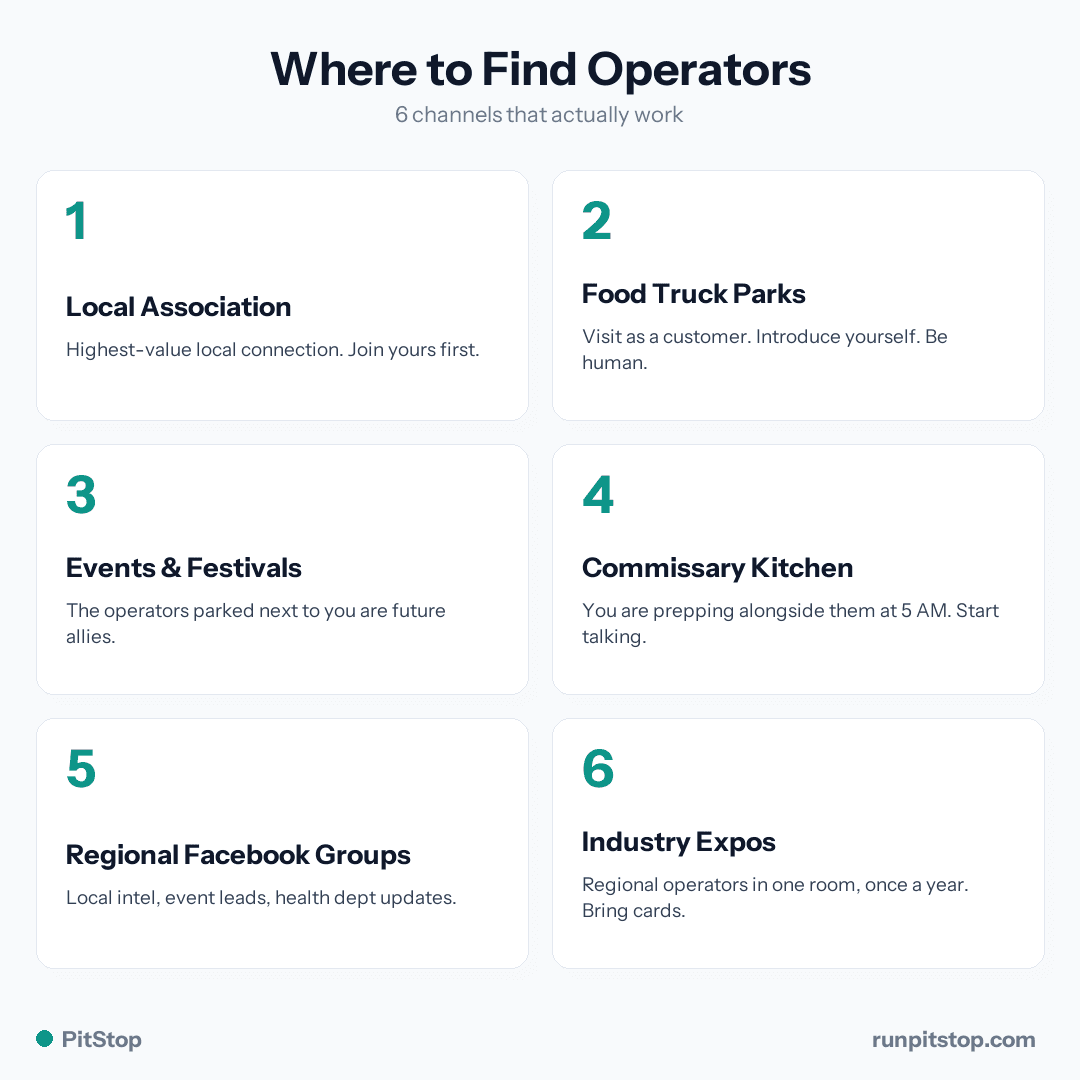
1. Your Local Food Truck Association
This is the highest-value connection you can make. Food truck associations exist in most major metros and many states:
- Gulf to Bay Food Truck Association (Tampa Bay, FL)
- Washington State Food Truck Association
- New York Food Truck Association (NYFTA)
- Nashville Food Truck Association
- And many more across the country
They run events, provide mentorship, advocate with local government on permit issues, and maintain standards around vendor fees. Membership is usually affordable and pays for itself through the connections and event leads.
How to find yours: Search "[your city] food truck association" or "[your state] mobile food vendor association." If one does not exist in your area, that itself tells you something about the opportunity to build local community.
2. Food Truck Parks and Pods
If your city has food truck parks (permanent or semi-permanent lots where multiple trucks operate), spend time there. Even if you do not have a spot in the park, visit as a customer and introduce yourself to operators. Food truck parks create natural community because the same operators work alongside each other regularly.
3. Events and Festivals
Working events alongside other trucks is the organic way connections happen. Show up professional, be friendly to the trucks around you, and swap contact info. The operators you meet at events become your network for event intel, referrals, and support.
4. Shared Commissary Kitchens
Your commissary is a built-in networking space. You are prepping alongside other operators. Start conversations. The commissary community is one of the most underrated networking opportunities in the business.
5. Regional Facebook Groups
Search for "[your city] food truck" groups on Facebook. Regional groups tied to local associations tend to be the most useful. They share event leads, health department updates, and commissary recommendations specific to your area.
6. Industry Expos and Trade Shows
The Food Truck Owners Expo runs one or two regional shows a year (Austin hosted in August 2026). A show like that puts a few hundred operators, builders, and suppliers in one room for a day or two, and the hallway conversations are usually worth more than the sessions.
This is especially useful if you are in an area without a strong local association, or if you want connections beyond your immediate metro. Go with a short list of people you want to meet - the operators from your state, the builder you are considering, the commissary operators who exhibit - and follow up within the week.
How to Build Real Relationships (Not Just Connections)
Finding operators is step one. Building relationships that actually help your business takes more:
Share first. The food truck world runs on reciprocity. Share an event lead before you ask for one. Warn someone about a bad organizer. Recommend your commissary. The operators who give value get value back.
Show up consistently. One conversation does not build a relationship. Be present - at association events, in your regional group, at the same events and commissaries. Consistency builds trust.
Be real about your numbers. Operators who share real financial data - what an event actually paid out, what their food cost percentage is, what their commissary costs - build deep trust fast. Revenue transparency is rare and valuable in this industry.
Help the new operators. You were new once. The veteran operators who helped you did not have to. Pay it forward. Answer the question you have heard 100 times because the person asking it has never heard the answer.
The Independent-Operator Reality
The vast majority of food trucks are independent operations. That means most operators are figuring it out largely on their own. The ones who survive and thrive are overwhelmingly the ones who build connections with other operators.
Your competition is not the truck parked next to you. Your competition is a failure rate where roughly 30-40% close within the first three years (about 60% survive). And the single best defense against that is a network of operators who share knowledge, opportunities, and support.
Start building that network today.
And when the next operator you meet tells you which events pay out, run the numbers yourself before you book: the food truck profit calculator shows what an event has to bring in after fees, food cost, and labor.