Total Startup Cost: $50,000 to $250,000
That range is not a cop-out. A used truck with basic equipment in a low-regulation market can launch for under $60,000. A custom-built truck with a full commercial kitchen, professional wrap, and all permits in a major metro can run $200,000+.
This guide breaks down every cost category with real numbers so you can build an accurate budget for your specific situation. No hand-waving. No "it depends" without telling you what it depends on.
Cost ranges by category (2026)
Ranges below are PitStop estimates from operator quotes and vendor pricing; the verified agency fees are in the fee table above.
| Cost Category | Typical Range |
|---|---|
| Used turn-key truck | $20,000-$80,000 |
| New custom-built truck | $80,000-$200,000 |
| Vehicle conversion path | $25,000-$105,000 |
| Commercial kitchen equipment | $10,000-$30,000 |
| Fire suppression (Ansul + hood) | $3,000-$6,000 |
| Generator | $3,000-$8,000 |
| Permits + licenses (year 1) | $1,000-$5,000 |
| Insurance (year 1, paid upfront) | $2,000-$5,000 |
| Working capital (90-day reserve) | $15,000-$30,000 |
| Total startup, lean | $50,000-$80,000 |
| Total startup, mid-range | $80,000-$150,000 |
| Total startup, premium build | $150,000-$250,000 |
The Truck: $20,000 to $200,000
This is your biggest line item. You have three main options.
Option 1: Buy a Used, Already-Built Food Truck
- Cost: $20,000 - $80,000
- Pros: Lowest upfront cost, fastest to launch, equipment often included
- Cons: Unknown maintenance history, may need repairs, equipment may be outdated
- Where to find them: UsedVending.com, Roaming Hunger Marketplace, Craigslist, Facebook Marketplace, local restaurant equipment auctions
A solid used truck in the $40,000-$60,000 range is the sweet spot for most first-time operators. At that price you get a truck with working cooking equipment, a generator, and basic plumbing. Budget an additional $5,000-$10,000 for repairs and upgrades.
Option 2: Buy a New, Custom-Built Food Truck
- Cost: $80,000 - $200,000
- Build time: 8-16 weeks
- Pros: Everything is new, built to your exact specs, full warranty
- Cons: Highest cost, longest time to launch
Custom builds start around $80,000 for a basic setup and scale quickly. A fully equipped 20-foot truck with a commercial hood system, multiple cooking stations, and premium finishes runs $150,000-$200,000. Get quotes from at least three builders and check references.
Option 3: Convert a Used Vehicle
- Vehicle cost: $5,000 - $25,000 (used step van, cargo van, or trailer)
- Conversion cost: $20,000 - $80,000
- Total: $25,000 - $105,000
- Pros: More control over layout, can be cheaper than a pre-built truck
- Cons: Requires project management, permits may be delayed until build is complete
This is the DIY route. You buy a used step van (like a former FedEx or UPS truck) and have it converted. The conversion cost depends heavily on your equipment list and local labor rates. Expect 4-12 weeks for the build.
Kitchen Equipment: $10,000 to $30,000
If your truck does not come fully equipped - or if you need to replace aging equipment - here is what the core kitchen costs.
| Equipment | Cost Range |
|---|---|
| Commercial griddle (36") | $1,500 - $3,500 |
| Deep fryer (double) | $800 - $2,500 |
| Commercial refrigerator | $1,500 - $4,000 |
| Steam table / hot holding | $500 - $1,500 |
| Prep tables (stainless) | $300 - $800 each |
| Three-compartment sink | $500 - $1,200 |
| Handwash sink | $200 - $500 |
| Hood/ventilation system | $2,000 - $5,000 |
| Fire suppression (Ansul) | $3,000 - $6,000 |
| Generator (if not built in) | $3,000 - $8,000 |
| Smallwares (pans, utensils, containers) | $1,000 - $2,500 |
Total kitchen equipment: $10,000 - $30,000
If you buy a used truck with equipment included, you may only need $2,000-$5,000 in upgrades and replacements. If you are building from scratch, budget at the higher end.
Permits and Licenses: $1,000 to $5,000
Permit costs vary dramatically by city and state. Here is a general breakdown.
| Permit/License | Cost Range |
|---|---|
| Business license | $50 - $500 |
| DBA / Fictitious name filing | $10 - $100 |
| State health license | See the fee table under the byline (Texas $309-$1,376 by unit type; Florida $50 + $347/yr) |
| Mobile food vendor permit | $100 - $500 |
| Fire department inspection | $50 - $300 |
| Sales tax permit | $0 - $25 |
| Food handler certifications (all staff) | $10 - $15 each |
| Food manager certification | $80 - $180 |
| Parking/vending permits (city-specific) | $100 - $1,000 |
Total permits and licenses (first year): $1,000 - $5,000
Some cities require separate permits for each location you operate. If you are working 5 different markets, that could mean 5 separate vending permits. Check your local requirements carefully.
Insurance: $2,000 to $5,000 Per Year
Food truck insurance is not optional. Event organizers and commissaries require proof of insurance before they book you, some city vending permits ask for it, and most organizers require $1,000,000 in general liability coverage.
| Coverage Type | Annual Cost |
|---|---|
| General liability ($1M/$2M) | $1,000 - $2,500 |
| Commercial auto | $1,200 - $3,000 |
| Workers compensation (if employees) | $500 - $2,000 |
| Property/equipment coverage | $300 - $800 |
Get food truck insurance
General liability is what most events require. Get a quote in a few minutes.
Get a quoteAffiliate partner. PitStop may earn a commission at no extra cost to you. How this works
Total insurance (first year): $2,000 - $5,000
Get quotes from insurers that specialize in food trucks. FLIP (Food Liability Insurance Program) and Insure My Food Truck are common providers. Your rate depends on your truck value, menu (deep fryers = higher premiums), location, and driving record.
Insurance and COI: what the application actually asks for
Here is the part most cost guides get wrong: the permit application usually does not ask for insurance at all.
- Statutory minimum for the health license: none in the two biggest food truck states. The Texas DSHS mobile food vendor application and the Florida DBPR MFDV application, both checked September 14, 2026 (DSHS, DBPR), list fees, plans, photos, and commissary paperwork - not a liability policy. No federal rule sets a food truck liability minimum either. The limits come from the people you sell through: event organizers, commissaries, food truck parks, breweries, and landlords write $1 million per occurrence / $2 million aggregate into their vendor agreements, and a few city vending permits (not health permits) ask for proof of coverage. So the "required" number is whatever your first organizer's contract says.
- The truck is a motor vehicle, and that part is required by law. Every state's financial-responsibility statute applies the moment the truck is on the road. Florida's, for example, requires at least $10,000 of property damage liability per crash (F.S. 324.022, checked September 11, 2026). A personal auto policy excludes commercial use, so budget commercial auto in the business's name from day one.
- COI turnaround. A certificate of insurance is issued by your agent from a bound policy, naming the organizer as certificate holder and, when the contract asks, as additional insured. Once the policy is active, expect a COI within a business day or two; binding the policy itself is what takes a week or more, so get quotes during the build, not the week of your first festival.
- What moves the premium: fryers and open flame versus cold or prepackaged menus, truck value and age, miles driven and driver records, employee headcount (workers' compensation), the limits your organizers demand, and prior claims. Quote in the entity's legal name so the COI matches your license and contracts; LLC vs sole proprietorship covers that decision if you have not made it yet.
Commissary Kitchen: Priced by the Kitchen
Many jurisdictions require food trucks to operate out of an approved commissary kitchen. This is where you prep food, store inventory, clean equipment, and park overnight. No health department publishes a rent; each kitchen sets its own, and four things move it:
- Access model: a monthly membership versus hourly prep-only access
- Storage: shared shelving versus dedicated dry, cold, or walk-in space
- Hookups: potable water fill, gray-water and grease disposal, electric for the truck's fridge
- Parking: fenced overnight truck parking, usually the biggest single add-on
A dedicated food truck commissary costs the most and fits best; a shared commercial kitchen sits in the middle; a restaurant, brewery, or church kitchen that will sign the agreement is usually the cheapest lawful option, with the trade-off that its own service comes first. Get two written quotes on the same access schedule, ask each kitchen what the health department needs on the agreement, and budget three months of the quote you choose. The commissary kitchen guide walks through what to ask.
Initial Inventory and Supplies: $1,000 to $3,000
Your first food order and disposable supplies to get through the first 1-2 weeks of operation.
| Category | Cost Range |
|---|---|
| Initial food inventory | $500 - $1,500 |
| Disposable containers, napkins, utensils | $200 - $500 |
| Cleaning supplies | $100 - $300 |
| Paper goods (receipts, menus, signage) | $100 - $300 |
| Propane (initial fill) | $50 - $150 |
Total initial inventory: $1,000 - $3,000
After launch, your food costs become a percentage of revenue (typically 30-35%), not a fixed cost.
Branding and Truck Wrap: $2,000 to $5,000
Your truck is a moving billboard. A professional wrap is one of the highest-ROI investments you will make.
| Item | Cost Range |
|---|---|
| Logo design | $200 - $1,000 |
| Full truck wrap (design + print + install) | $2,000 - $5,000 |
| Menu boards | $100 - $500 |
| Business cards | $30 - $100 |
| Website (basic) | $0 - $500 |
Total branding: $2,000 - $5,000
Do not skip the wrap. An unwrapped truck looks unprofessional and misses hundreds of daily impressions. A full wrap on a 16-20 foot truck typically costs $2,500-$4,000 for design, print, and installation.
POS System: $0 to $100 Per Month
You need a way to take payments. Most food trucks use mobile POS systems.
Swipe sideways for all columns
| System | Monthly Cost | Transaction Fee |
|---|---|---|
| Square | $0 | 2.6% + $0.10 |
| Clover Go | $0 - $15 | 2.3% - 2.6% + $0.10 |
| Toast Go | $0 - $69 | 2.49% - 2.99% + $0.15 |
| Stripe Terminal | $0 | 2.7% + $0.05 |
Hardware cost: $0 - $800 (card readers, tablets, receipt printers)
Square with the free magstripe reader is the most common starting point for food trucks. Upgrade to the contactless reader ($49) for tap-to-pay.
Total Startup Cost Breakdown
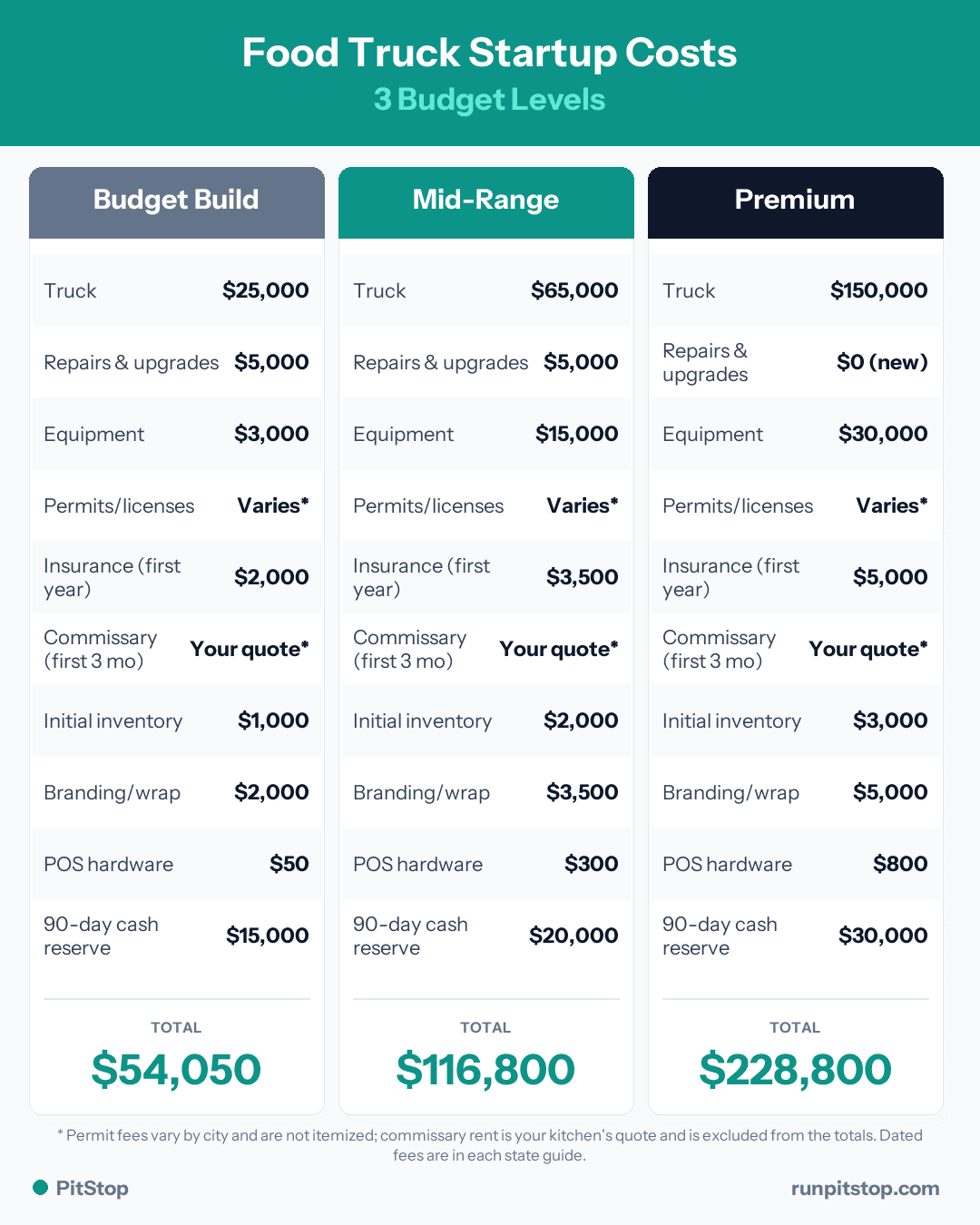
Here is the full picture at three budget levels.
Swipe sideways for all columns
| Category | Budget Build | Mid-Range | Premium |
|---|---|---|---|
| Truck | $25,000 | $65,000 | $150,000 |
| Used-truck repairs and upgrades | $5,000 | $5,000 | $0 (new build) |
| Equipment | $3,000 | $15,000 | $30,000 |
| Permits/licenses | $1,000 | $2,500 | $5,000 |
| Insurance (first year) | $2,000 | $3,500 | $5,000 |
| Commissary (first 3 months) | 3 × your quote | 3 × your quote | 3 × your quote |
| Initial inventory | $1,000 | $2,000 | $3,000 |
| Branding/wrap | $2,000 | $3,500 | $5,000 |
| POS hardware | $50 | $300 | $800 |
| Cash reserve (90-day operating reserve) | $15,000 | $20,000 | $30,000 |
| Total (before commissary) | $54,050 | $116,800 | $228,800 |
The cash reserve is critical. You need 90 days of operating expenses in the bank before you serve your first customer. Events take time to book, revenue ramps slowly, and unexpected repairs happen.
Financing Options
Most food truck operators use a combination of these.
SBA Microloans: $500 - $50,000 through SBA-approved intermediary lenders. Lower rates than commercial loans. Good for first-time business owners.
Equipment financing: The truck itself serves as collateral. Rates from 5-15% depending on credit. Terms of 3-7 years. Available through food truck-specific lenders.
Personal savings: The most common funding source. No interest, no approvals, no debt.
Business credit cards: Useful for smaller purchases (supplies, inventory). Dangerous for large expenses due to high interest rates.
Friends and family: Common but document everything. Use a formal loan agreement.
Rollover for Business Startups (ROBS): Use retirement funds (401k/IRA) to fund your business without early withdrawal penalties. Complex to set up - use a ROBS provider.
Finance your truck or equipment
Compare equipment and working-capital options, with a soft check to start.
See financing optionsAffiliate partner. PitStop may earn a commission at no extra cost to you. How this works
Timeline: Purchase to First Event
| Week | Milestone |
|---|---|
| 1-2 | Secure financing, begin truck search |
| 3-6 | Purchase truck, begin any needed repairs/build-out |
| 4-6 | Apply for business license, EIN, sales tax permit |
| 5-8 | Apply for health permits, schedule inspections |
| 6-8 | Get insurance quotes, secure coverage |
| 6-8 | Secure commissary agreement |
| 7-10 | Design and install truck wrap |
| 8-10 | Health inspection, fire inspection |
| 8-10 | Food handler and manager certifications |
| 9-12 | Menu finalization, initial inventory purchase |
| 10-12 | POS setup, test runs, first event booking |
Realistic timeline: 10-16 weeks from purchase to first paid event. Rushing this process leads to expensive mistakes.
Before you apply
Verify every fee in this guide with the issuing agency before you pay it; fee schedules change mid-year and the agency's own page is the only number that counts. Run your first few events through the per-event profit calculator, and start the paperwork 3–4 months before opening day: inspection slots, commissary letters and certifications take longer than the application itself.