Nobody Puts This in the Business Plan
You planned the menu. You planned the truck build. You planned the permits, the commissary, the first events. You did not plan for what it feels like to be alone in a 120-degree metal box at hour 11, questioning every decision that got you here.
Food truck burnout is not a soft topic. It is the reason operators quit. Not bad food, not bad locations - the grind breaks people. And the isolation makes it worse because there is nobody around who understands what you are going through.
This is not a motivational article about "following your passion." This is a practical look at what burnout actually looks like in this industry and what operators who have survived it did differently.
Important: If you are in crisis or having thoughts of self-harm, call or text 988 (the Suicide and Crisis Lifeline, available 24/7 in the U.S.). This article covers the everyday grind of operator burnout. If you are at the edge, please reach out now.
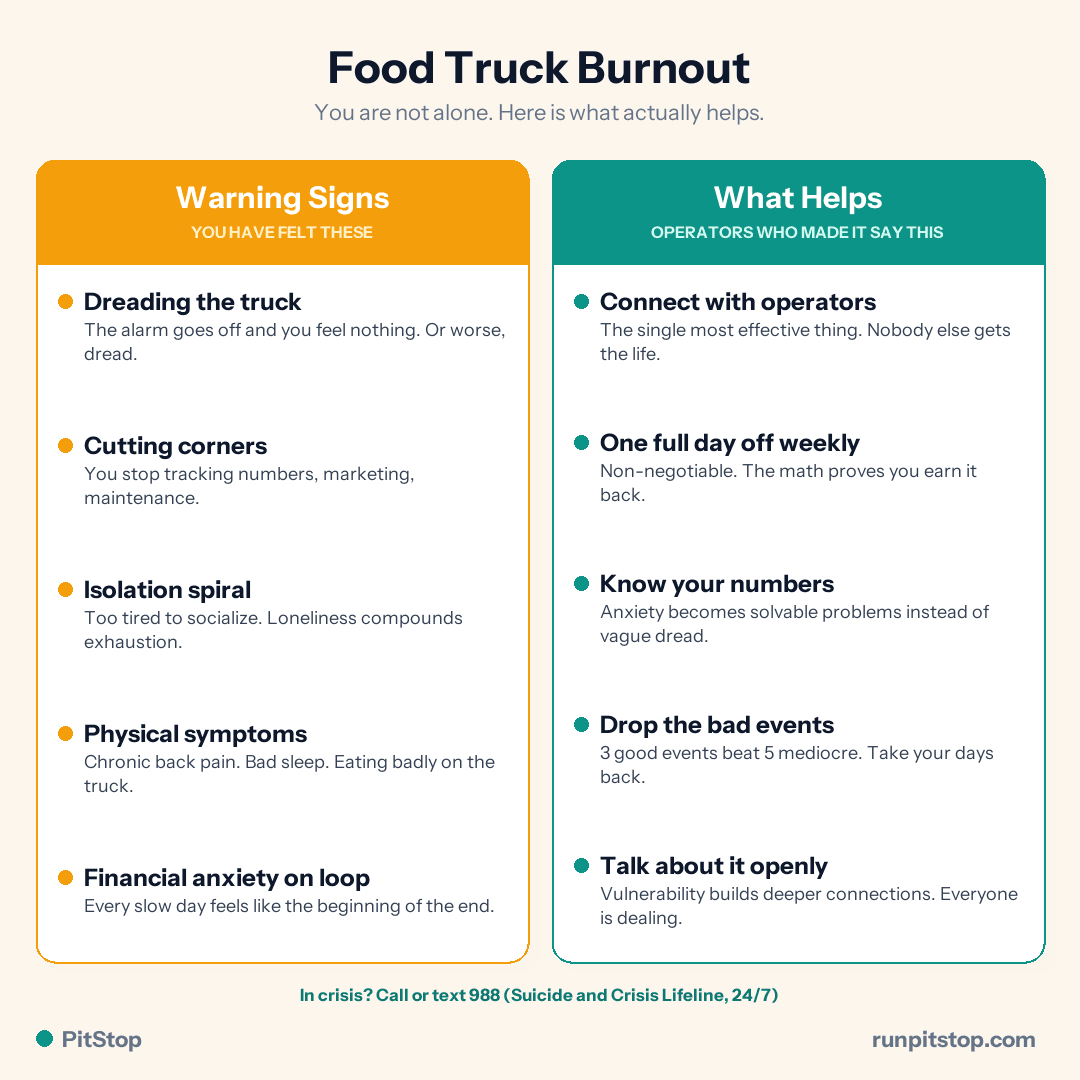
What Burnout Actually Looks Like
Burnout in the food truck world is not just "being tired." It shows up as:
Dreading the truck. You used to be excited to serve. Now the alarm goes off and you feel nothing. Or worse, dread.
Cutting corners. You stop tracking your numbers. You stop maintaining the truck on schedule. You stop marketing. The discipline that built the business erodes because you do not have the energy to sustain it.
Isolation spiral. You are too tired after service to socialize. You cancel plans. You stop reaching out to other operators. The loneliness compounds the exhaustion, which compounds the loneliness.
Physical symptoms. Chronic back pain. Bad sleep. Eating badly because you are around food all day but never eating properly. Operators describe working through illness because missing a day means missing revenue.
Financial anxiety on loop. Even when the numbers are okay, you cannot stop worrying. Every slow day feels like the beginning of the end. This is especially brutal for solo operators without someone to reality-check the anxiety against.
Why Food Trucks Burn People Out Faster
The Math Is Brutal
Average operating day: 10-14 hours (including prep, drive, service, and cleanup). Average operating week: 5-7 days during peak season. Average crew: 1-2 people including the owner.
That means the owner is the cook, the cashier, the driver, the dishwasher, the marketer, the accountant, and the manager. There is no delegation when you are the entire org chart.
The Truck Does Not Run Without You
Brick-and-mortar restaurants can hire a manager. Office businesses can work remotely. Food trucks are physically dependent on the operator. If you are not there, the truck does not open, and you do not make money. This creates a trap: you cannot take time off because every day off is lost revenue, but not taking time off accelerates burnout.
Temperature Is Not a Metaphor
Food trucks in summer regularly exceed 120 degrees inside, even with ventilation. The ventilation itself pulls cool air out if you are running AC. You are standing on your feet next to fryers and grills in a confined space for the entire service. The physical toll is real and cumulative.
The Income Roller Coaster
Monthly revenue fluctuates wildly based on weather, season, events, and random chance. A great week followed by a terrible week is normal, but it creates financial anxiety that never fully goes away. Operators describe never feeling financially safe, even when annual numbers are solid.
Nobody Gets It
Your friends and family see the fun parts. The cool truck, the food photos, the festivals. They do not see the 3 AM alarms, the health inspector stress, the event that charged a big vendor fee and brought fifty people, or the loneliness of prepping alone in a commissary kitchen at 5 AM.
When you try to vent, you get "but you are your own boss!" and "at least you love what you do!" Neither of which helps when you are running on four hours of sleep and your margins are 5%.
What Actually Helps
1. Connect With Other Operators
This is not soft advice. This is the single most effective thing operators describe doing to combat burnout. Having people who understand the life - who do not need you to explain why you are stressed - changes your ability to cope.
Where to find them:
- Local food truck associations - in-person connection with operators in your market, and often the only people who can tell you whether a bad month is you or the whole city
- Regional Facebook groups - the ones tied to your association are where operators in your market actually talk between events
- Commissary kitchens - you are prepping alongside other operators, talk to them
- Events - the operators parked next to you at a festival are the most natural connections you will make
The operators who burn out and quit are overwhelmingly the ones who tried to do it completely alone. The ones who survive describe their network of operator friends as essential, not optional.
2. Take One Day Off Per Week (Non-Negotiable)
This feels impossible, especially in the first year. Do it anyway. The revenue you lose from one day off is less than the revenue you lose when burnout makes you sloppy, slow, or causes a health issue that shuts you down for two weeks.
Block one day per week. No prep, no events, no social media for the truck. Just one day.
3. Know Your Numbers
A surprising amount of financial anxiety comes from not knowing your actual financial position. When you track revenue, costs, and profit per event, the anxiety shifts from "am I failing?" to "event X was bad, event Y was good, here is what I am doing about it."
Data does not eliminate stress. But it converts vague dread into specific, solvable problems. That is a fundamentally different headspace.
4. Drop the Bad Events
Operators describe a turning point when they stopped saying yes to every event and started being selective. Three good events per week at 40% margins beats five mediocre events at 20% margins, and you get two days back.
Use data to identify which events actually pay out and which ones cost you money after fees, food cost, and the toll on your body. Then cut the bad ones without guilt.
5. Set a Closing Time and Stick to It
"Just one more hour" becomes a habit that adds up. Set your service hours. When they are over, close. The marginal revenue from that extra hour is rarely worth the cumulative fatigue.
6. Talk About It
The food truck world respects honesty. Admitting that the grind is hard does not make you weak - it makes you credible. Operators who talk openly about burnout build deeper connections with other operators because everyone is dealing with it.
Say it out loud at the commissary. Bring it up at the association meetup. Post it in your regional group. Honest posts about the hard parts of the business tend to draw the most replies, because everyone reading has been there. That is what a real network looks like.
When Burnout Means Something Bigger
Sometimes burnout is a signal that the business fundamentals are broken, not just that you need a day off.
If your margins are consistently below 15%: The business model needs fixing. Raise prices, cut low-margin items, drop bad events. No amount of self-care fixes a business that is not profitable.
If you have been operating for 2+ years with no improvement: Something structural is wrong. Get an outside perspective - whether from a consultant, an experienced operator, a SCORE mentor, or by laying your situation out honestly to operators you trust and asking for feedback.
If the physical toll is causing health problems: This is not a willpower issue. If your body is breaking down, the business needs to change - different schedule, hire help, or reduce volume. No business is worth permanent health damage.
Failure Is Often About Burnout, Not Just Random
Estimates suggest roughly 30-40% of food trucks close within the first three years (so about 60% survive). The common narrative blames bad food or bad locations. The reality is more often: the operator burned out.
They stopped tracking numbers because they were exhausted. They stopped marketing because they had no energy. They stopped maintaining the truck because they could not face another task. They stopped reaching out to other operators because isolation made them withdraw.
Burnout is not something that happens after you fail. It is often what causes the failure.
Protect yourself against it like you would protect your truck against mechanical failure - with regular maintenance, early detection, and a support network you can call on when things go sideways.
Start with the numbers: the food truck profit calculator turns "am I failing?" into a per-event answer you can actually act on.