The Reddit Pitch
Reddit is supposed to be the front page of the internet. It has communities for everything. Someone will have answered your question. Just search.
That pitch works well for coding, gaming, and personal finance. For food truck operators it covers some needs but leaves a few gaps. Here is how to use each.
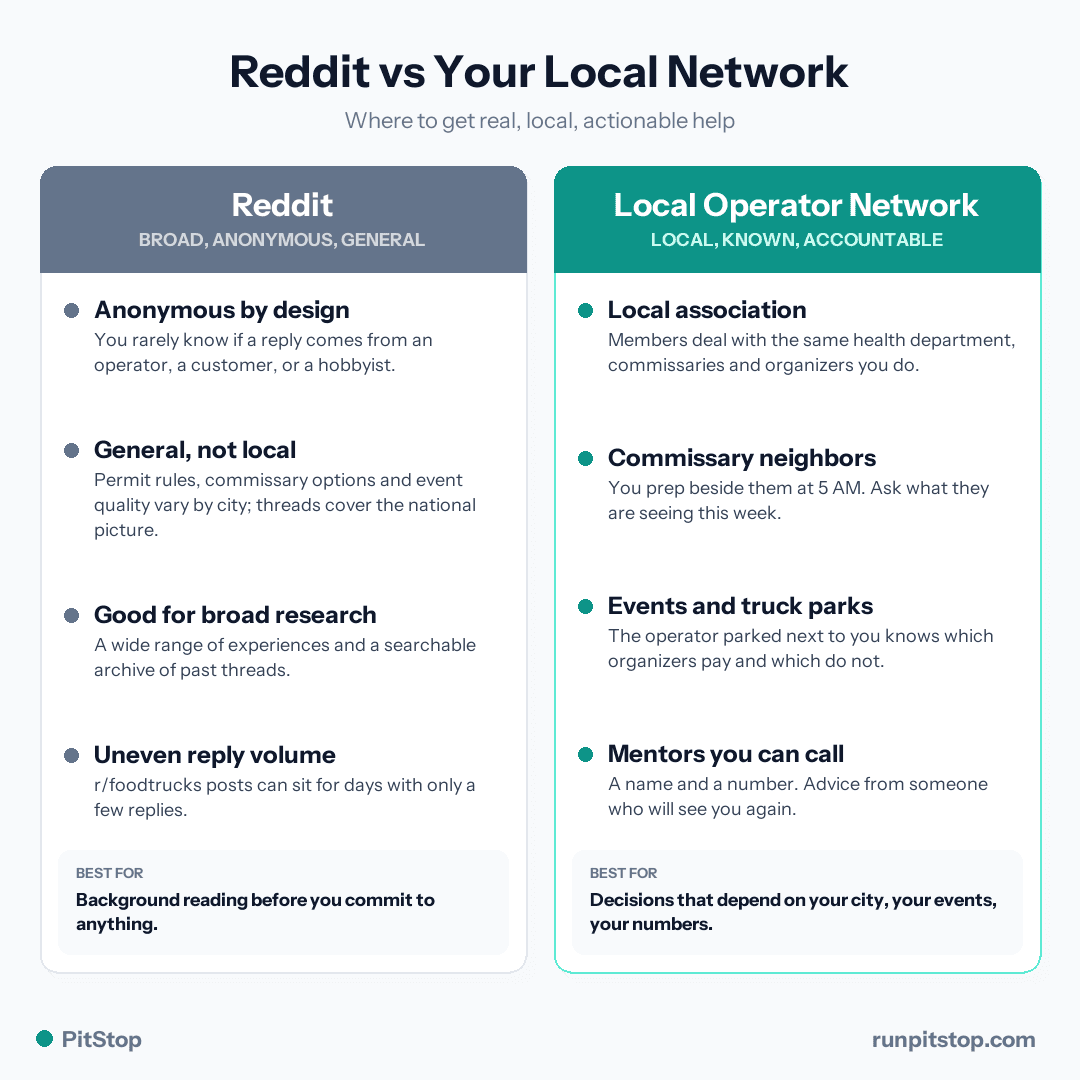
What You Will Find on Reddit
r/foodtrucks
The primary subreddit for food truck discussion. Posts fall into a few categories:
- "Is a food truck worth it?" (asked weekly)
- "How much does it cost to start?" (answered with wildly different numbers every time)
- Menu feedback requests with no follow-up
- Occasional equipment questions
- The rare detailed breakdown from an actual operator (these get upvoted heavily because they are scarce)
Replies come from whoever happens to be scrolling, so a thread might get a quick answer or sit for a while. Because it is a general-interest space rather than a roster of operators, you do not always know how much hands-on experience an answer comes from.
r/smallbusiness and r/entrepreneur
Broader business subreddits occasionally have food truck threads. The financial advice can be good ("track your food cost percentage" is universal), but nobody there knows whether your city's health department is reasonable or which events in your market are worth the vendor fee.
Food Truck Posts in City Subreddits
City subreddits are customer-facing, and that is how to use them. Announcing where you are parked this week, promoting an event you are working, and reading what locals say about your food are all worth the five minutes. Operator questions (commissaries, permits, event fees) get answered by customers guessing, so keep those for the operators in your market.
Three Things Reddit Cannot Give You (and Where to Get Them)
1. Knowing Who You Are Talking To
On a general forum, answers come from anonymous accounts, which is great for candor but makes it harder to weigh advice. A reply might come from a 10-year veteran who runs three trucks, or from someone newer to the topic, and there is no profile to tell them apart.
When someone tells you "you do not need a commissary in Texas," it helps to know whether that person actually operates in Texas. The operators at your commissary, in your local association, and parked next to you at events are people you can see, whose trucks you can visit, and whose track record you can ask about.
2. Local Context
Food truck operations are intensely local. Your permit requirements, your health department's inspection standards, your commissary options, your event landscape - none of this is universal. A post saying "never pay more than a few hundred dollars for an event" is meaningless without knowing your market.
Reddit is a national (global, really) platform with no way to filter by state or city. The most valuable food truck advice is hyper-local, and the people who have it are your local association, the regional Facebook group tied to it, and the operators who work your market.
3. Knowledge That Stays Findable
Forum threads tend to be one-and-done. Someone asks a great question, gets a great answer, and six months later someone asks it again while the earlier thread sits buried.
For the questions with stable answers - what permits you need, what they cost, how long they take, what a realistic startup budget looks like - a written guide you can search beats a thread you have to dig for. Keep your own notes from every good conversation, and lean on the state permit guides for the regulatory side.
When Reddit IS Useful
Be fair to Reddit - it does some things well:
General business mindset. r/smallbusiness has good threads on pricing psychology, customer service, and financial discipline that apply to any business including food trucks.
Equipment research. Reddit's search works reasonably well for specific equipment reviews and comparisons ("Henny Penny vs Frymaster" type threads).
Reality checks. The "is a food truck worth it?" threads, while repetitive, contain honest perspectives that balance the overly optimistic content on food truck blogs.
Anonymity for sensitive topics. If you want to ask about failing margins or considering shutting down, Reddit's anonymity can feel safer than asking in a group where everyone knows your truck name.
What Operators Actually Need
The pattern across operator groups and forums is consistent. Operators need:
People who get it. Not small business generalists. People who have dealt with a generator dying mid-service, a health inspector who does not understand mobile units, and the reality of 12-hour days in a metal box. Those people are at your commissary and at your association's next meetup.
Local intel. Which commissary in your city is worth the price. Which events actually pay out. What your state just changed about permit requirements. This is the information that directly affects your revenue, and it lives with the operators in your market.
Answers that stick around. When a question has a stable answer, it should be written down somewhere you can find again. That is what guides are for.
Real connections. The ability to call another operator directly, compare notes, maybe coordinate on events or share a commissary. That comes from showing up in person, not from usernames you will never interact with again.
The Better Setup
Use Reddit for: General business education, equipment research, anonymous venting.
Use your local network for: Everything that requires local context, verified experience, and real relationships. Your local association, your commissary, the regional Facebook group tied to your association, and the trucks parked next to you at events.
The U.S. food truck industry runs to tens of thousands of active trucks, and the vast majority are independent operators. You are not competing against each other as much as you are competing against the roughly 30-40% of trucks that close within their first three years. The operators who connect, share intel, and help each other are the ones who make it.
Before you ask "how much does it cost to start?" in any forum, read the food truck startup costs guide - it has the line items, so your question can be specific.