The Short Answer
There is no single large, central food truck Discord server. A few smaller ones exist, and they tend to work best for operators who already know each other.
If you came here hoping for a big directory of servers with invite links, here is an honest look at where Discord fits and where searchable, local answers live instead.
What Exists
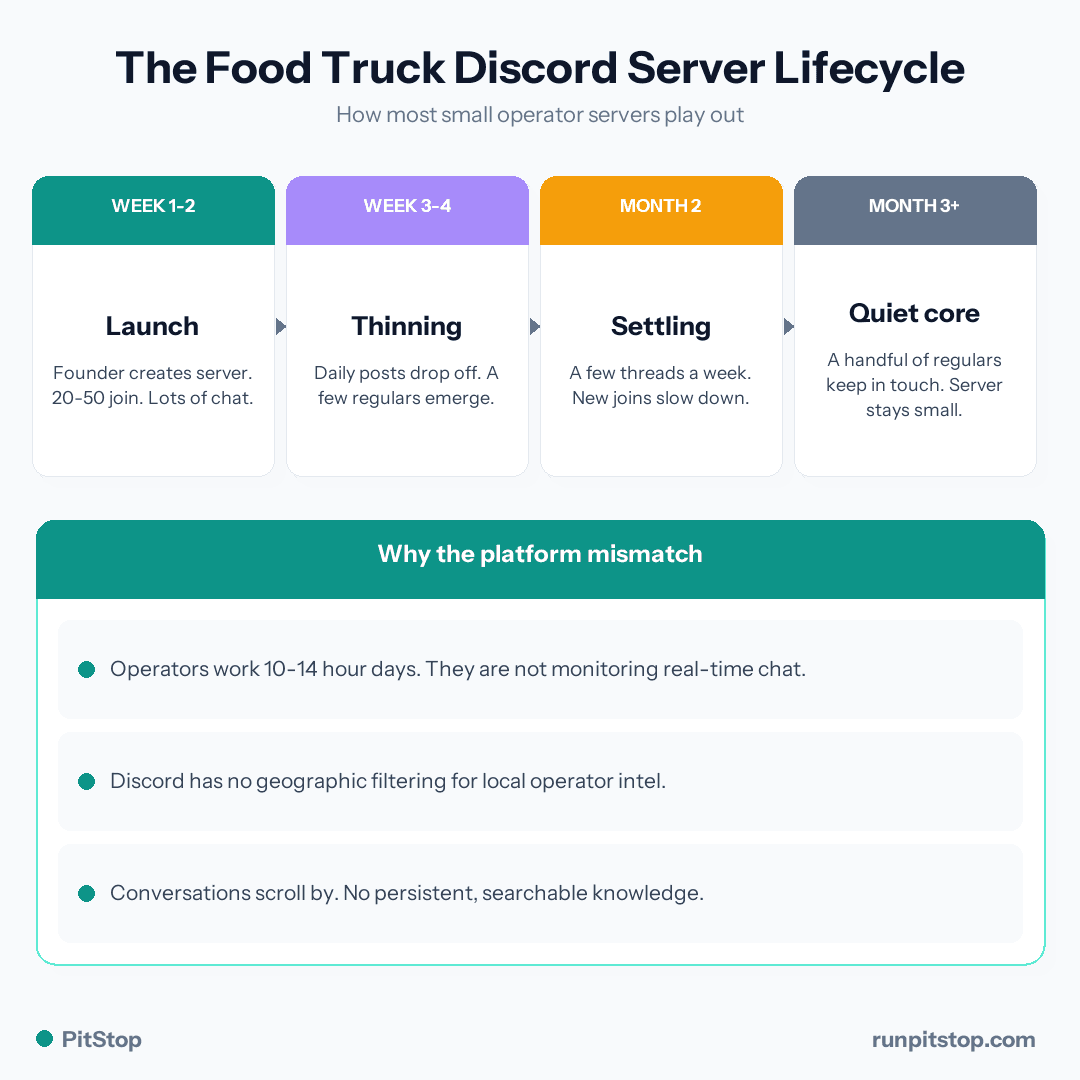
Small Discord servers for food truck operators pop up periodically. They tend to follow a predictable pattern:
This is not unique to food trucks. It is a common pattern for niche real-time chat communities. The platform works brilliantly for gaming, tech, and crypto communities where users are already on Discord all day. Food truck operators are on their trucks all day.
Why Discord Has Not Caught On for Food Trucks
Operators Are Not on Discord
The platforms do not line up. In our experience most operators are already on Facebook and Instagram because that is where their customers are, and Discord is one more app to check. Few operators are hanging out on Discord between prep, service, and cleanup.
Real-Time Chat Does Not Scale
Discord's strength is real-time conversation. But food truck operators work 10-14 hour days. They are not monitoring a chat channel during service. By the time they check Discord at the end of the day, the conversation has scrolled past. There is no way to catch up efficiently.
Compare this to a forum-style group where posts persist and remain findable weeks later. The format matters.
No Local Context
Discord has channels, not geographic filtering. You could create a #texas channel and a #florida channel, but that fragments an already small community into even smaller pieces. The server with 30 active members cannot afford to split them across 10 state channels.
Knowledge Does Not Accumulate
Someone shares a great commissary recommendation in Discord. Two days later, it has scrolled past 200 messages and is effectively gone. Discord's search works, but only if you know exactly what you are looking for. There is no structured Q&A, no accepted answers, no way to build a knowledge base over time.
When Discord Does Work
Discord is good for:
A small, tight crew. If you have 5-10 operator friends and you want a group chat for sharing event leads, venting, and coordinating, a private Discord server works great. Think of it as a group text with more features.
Live events. During a festival or expo, a Discord channel for attending operators could be useful for real-time coordination.
Audio conversations. Discord's voice channels let you hop into a call without scheduling a meeting. For operators who want to talk through a problem with someone, this is genuinely useful.
What Food Truck Operators Actually Need
The reason Discord has not caught on with food truck operators comes down to a mismatch between the platform and the use case. Here is what operators need, and where it actually lives:
Swipe sideways for all columns
| Need | Discord | Where It Actually Lives |
|---|---|---|
| Local operator intel | No geographic filtering | Your local association and its regional group |
| Searchable answers | Chat scrolls away | Written guides and pinned association resources |
| Async participation | Real-time focus | Forum-style groups where posts persist |
| New connections | Hard to find relevant people | Commissary kitchens, food truck parks, events |
| Private conversations | DMs exist but discovery is poor | Swap numbers in person, then text |
None of those is a single app. That is the point: the operators who feel well-connected in this industry are using two or three of these at once, with in-person relationships at the center.
If Someone Builds a Food Truck Discord
We are not anti-Discord. If someone builds a thriving food truck Discord server, that is good for the industry. More places for operators to connect is always better than fewer.
But it will need:
- Active moderation to keep conversations useful and on-topic
- Pinned resources in every channel to capture knowledge that would otherwise scroll away
- A critical mass of operators who are already on Discord (the chicken-and-egg problem)
- Clear purpose beyond "another place to chat" - a reason for an operator to open it alongside the groups they already use
In the meantime, the most reliable places to find operators are still the ones that fit the workday: the commissary, the event lot, the association meetup, and the regional group you check once at the end of service.
For the questions that a chat channel cannot hold onto - what permits you need, what they cost, and in what order - the state-by-state permit guides are written down and stay put.