Total Monthly Operating Cost: $6,000 to $19,000 Before Commissary
That is the range for a full-time food truck operation, not counting your original truck purchase or loan payments on the vehicle. A lean solo operation in a low-cost market can run under $8,000. A fully staffed truck in a major metro with a commissary lease and high event fees will approach $20,000.
This guide itemizes every recurring monthly expense with real dollar ranges, breaks down fixed vs. variable costs, and shows you how to calculate your cost per event and monthly breakeven.
Monthly Expense Breakdown
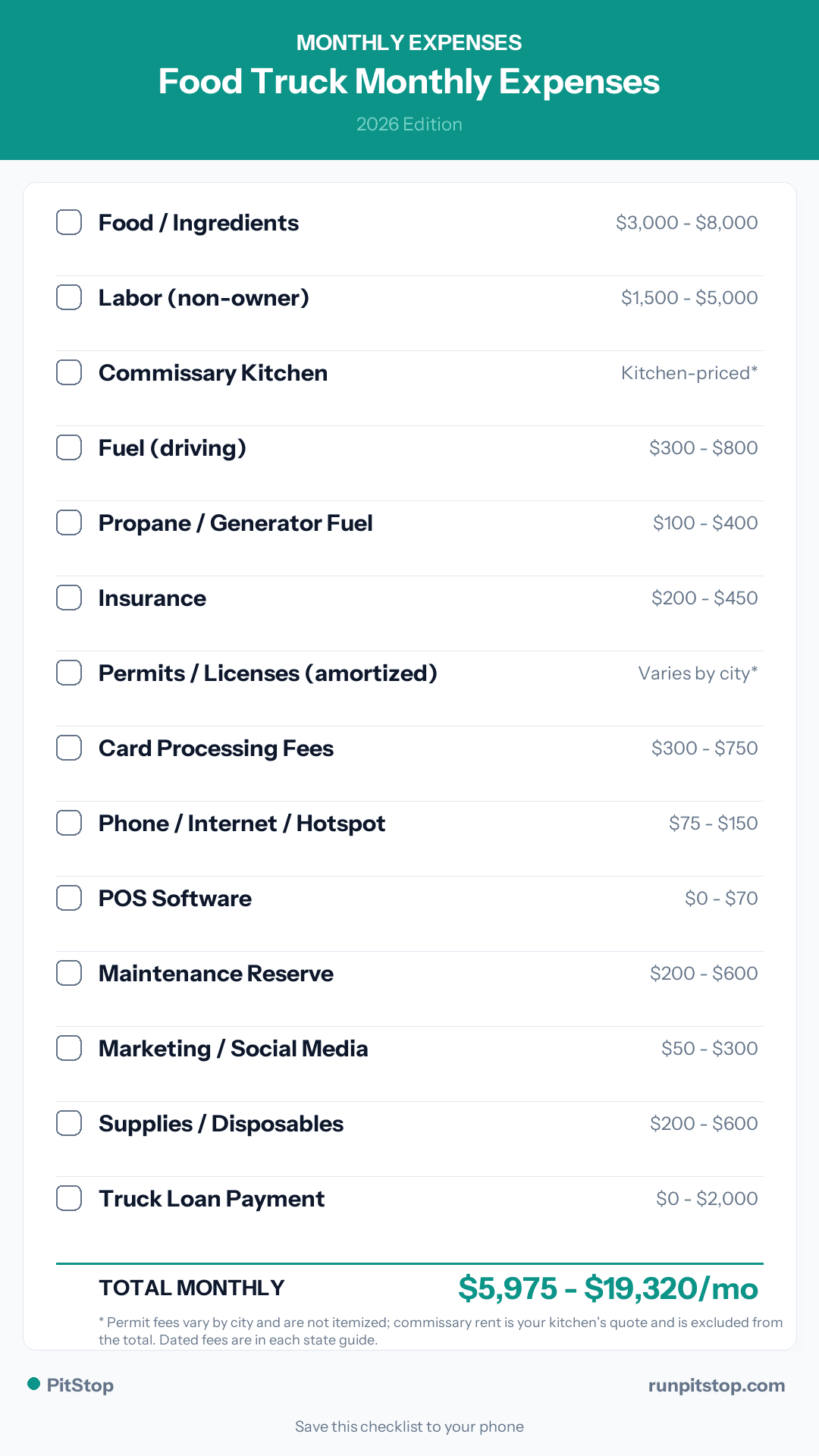
Swipe sideways for all columns
| Expense Category | Monthly Range | % of Revenue (at $25K/mo) | Notes |
|---|---|---|---|
| Food/ingredients | $3,000 - $8,000 | 30-35% | Variable - scales with revenue |
| Labor (non-owner) | $1,500 - $5,000 | 15-25% | Variable - depends on staff and hours |
| Commissary kitchen | Kitchen-priced; get two quotes | 2-6% | Fixed - monthly lease or access fee |
| Fuel (driving) | $300 - $800 | 2-4% | Semi-variable - depends on event distances |
| Propane/generator fuel | $100 - $400 | 1-2% | Variable - depends on cooking volume |
| Insurance | $200 - $450 | 1-2% | Fixed - monthly premium |
| Permits/licenses (amortized) | $50 - $200 | 0.5-1% | Fixed - annual costs divided by 12 |
| Credit card processing fees | $300 - $750 | 2.5-3% | Variable - percentage of card sales |
| Phone/internet/hotspot | $75 - $150 | 0.5% | Fixed |
| POS software | $0 - $70 | 0.3% | Fixed |
| Maintenance reserve | $200 - $600 | 1-3% | Fixed - set aside monthly |
| Marketing/social media | $50 - $300 | 0.5-2% | Semi-fixed |
| Supplies/disposables | $200 - $600 | 1-3% | Variable - cups, containers, napkins, gloves |
| Truck loan payment | $0 - $2,000 | 0-8% | Fixed - if financed |
| Total (before commissary) | $5,975 - $19,320 | 55-90% |
Your next steps
Most operators sort these out before their first event.
Finance your truck or equipment
Compare equipment and working-capital options, with a soft check to start.
See financing optionsGet food truck insurance
General liability is what most events require. Get a quote in a few minutes.
Get a quoteAffiliate partners: PitStop may earn a commission at no extra cost to you. How this works.
If your total monthly costs exceed 75% of revenue, your margins are too thin. Target 60-70% total costs to leave room for owner salary and business reserves.
Fixed vs. Variable Costs
Understanding this split is critical for planning.
Fixed costs stay the same regardless of how many events you work: commissary, insurance, permits, phone, loan payment, POS fees. For most trucks, fixed costs run $1,500-$4,500/month.
Variable costs scale with revenue and activity: food, labor, fuel, card fees, supplies. These typically run 45-65% of revenue.
Why this matters: your fixed costs are your floor. You pay them whether you work zero events or twenty. Every event needs to cover its variable costs PLUS contribute toward fixed costs and your salary.
Cost Per Event Analysis
Here is what it actually costs you to work a single event, before you earn a dollar.
| Cost Item | Per-Event Range |
|---|---|
| Food/ingredients (30% of revenue) | Scales with sales |
| Labor (2 staff x 8 hrs x $15/hr) | $240 |
| Fuel to event (avg 30 miles round trip) | $25 - $50 |
| Propane/generator | $15 - $40 |
| Event fee (if applicable) | $0 - $500 |
| Supplies/disposables | $30 - $75 |
| Credit card fees (2.6% of sales) | Scales with sales |
| Fixed cost allocation (monthly fixed / events) | $100 - $375 |
| Total non-food cost per event | $410 - $1,280 |
At a minimum, every event costs you $400-$500 before food cost - just in labor, fuel, supplies, and your share of monthly overhead. If your event revenue is $1,000 with 30% food cost, your food cost is $300, plus $400-$500 in other costs, leaving $200-$300 in profit. That is why $1,000 events are barely worth working and $2,000+ events are where the real money is.
The Minimum Viable Month
How many events do you need to break even?
Swipe sideways for all columns
| Monthly Fixed Costs | Avg Profit Per Event | Events to Break Even | Events to Pay Owner $5,000/mo |
|---|---|---|---|
| $2,000 | $400 | 5 | 18 |
| $2,000 | $700 | 3 | 10 |
| $3,500 | $400 | 9 | 22 |
| $3,500 | $700 | 5 | 13 |
| $5,000 | $400 | 13 | 26 |
| $5,000 | $700 | 8 | 15 |
If you need 15+ events per month to cover costs and pay yourself, your cost structure is too high or your per-event revenue is too low. Most sustainable operations break even in 5-8 events and pay the owner from events 9-16.
Seasonal Cost Variations
Your costs are not flat across the year.
Swipe sideways for all columns
| Season | Cost Factor | Impact |
|---|---|---|
| Summer | Higher propane use (generator AC), more spoilage risk | +10-15% on food/fuel costs |
| Winter | Fewer events = less variable cost, but fixed costs remain | Fixed costs become a larger % |
| Festival season | Higher event fees, more travel, more labor hours | +20-30% on per-event costs |
| Slow months | Commissary and insurance still due, minimal revenue | Cash reserves critical |
The operators who struggle most are those who do not adjust spending during slow months. If January revenue drops 40%, you need to cut variable costs - reduce prep quantities, work fewer events (only profitable ones), and consider temporary labor reductions.
5 Ways to Cut Operating Costs Without Cutting Quality
1. Negotiate Your Commissary Rate
Commissary kitchens have vacancy. If you are a reliable tenant who pays on time, negotiate a 6-month or 12-month rate; every dollar you take off the monthly quote is twelve off the year.
2. Buy Ingredients Strategically
Join a restaurant buying group or co-op for wholesale pricing. Buy non-perishables in bulk when prices dip. Switch protein suppliers annually - do not assume your current vendor has the best price. A 3% savings on $5,000/month in food cost is $1,800/year.
3. Reduce Generator Run Time
Switch to propane for cooking (more fuel-efficient than generator-powered electric) and use a smaller inverter generator for POS and lights. Generator fuel costs drop 30-50% with this setup.
4. Optimize Your Event Radius
Every mile costs you roughly $0.60-$0.80 when you factor in fuel, wear, and time. An event 50 miles away costs $60-$80 more than one 10 miles away. Over a year of 15 events/month, limiting your radius from 50 miles to 25 miles can save $5,000-$8,000 in travel costs.
5. Cross-Train Your Staff
Instead of hiring a separate cashier and cook, cross-train your team so you need fewer people per shift. Two employees who can do everything cost less than three specialists. At $15/hour over 160 hours/month, eliminating one part-time position saves $2,400/month.
See Exactly Where Your Money Goes
Operating costs are not a mystery unless you choose not to look. Every dollar you spend on food, labor, fuel, and fees is data that tells you whether your business is healthy or bleeding.
Use the per-event profit calculator to model your monthly operating costs and see your breakeven point. Then track actual costs per event with PitStop to spot waste and find savings.
Before you apply
Verify every fee in this guide with the issuing agency before you pay it; fee schedules change mid-year and the agency's own page is the only number that counts. Run your first few events through the per-event profit calculator, and start the paperwork 3–4 months before opening day: inspection slots, commissary letters and certifications take longer than the application itself.