The Evergreen State's Food Truck Scene
Washington State - led by Seattle - has one of the strongest food truck markets in the country. The Pacific Northwest's emphasis on local food, diverse cuisines, and outdoor culture makes it a natural fit for mobile food.
Washington's permitting system is handled primarily at the county level through local health jurisdictions, with the Washington State Department of Health (DOH) setting statewide food safety standards. The process is generally more straightforward than states like California or New York, but Seattle has its own layer of city-specific requirements.
Verify all fees and requirements with your local health jurisdiction and city government. This guide is a starting point, not legal advice.
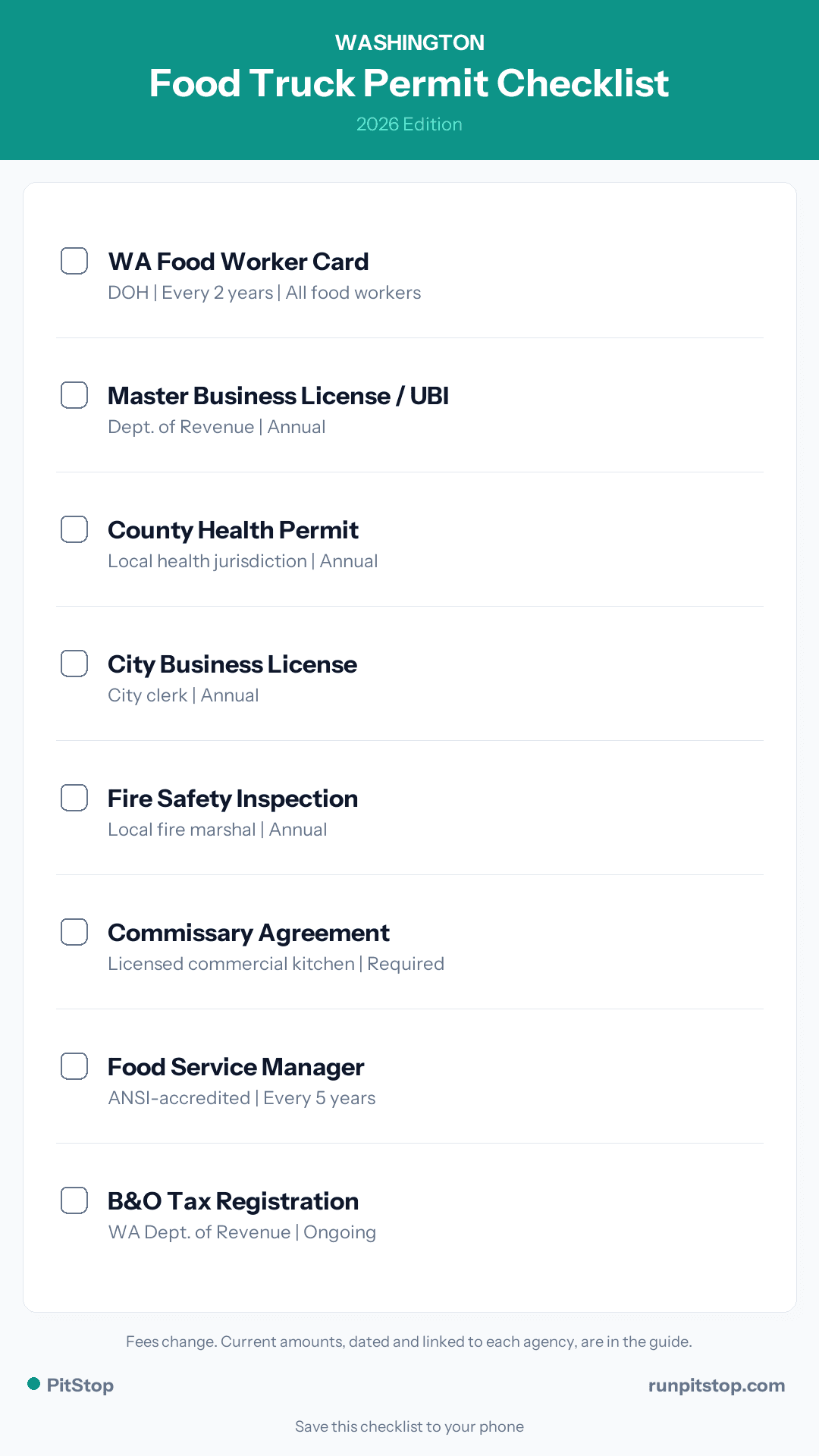
State-Level Requirements
1. Washington State Business License (UBI Number)
Every business in Washington needs a Unified Business Identifier (UBI) number and state business license:
Your next steps
Most operators sort these out before their first event.
Get food truck insurance
General liability is what most events require. Get a quote in a few minutes.
Get a quoteFinance your truck or equipment
Compare equipment and working-capital options, with a soft check to start.
See financing optionsAffiliate partners: PitStop may earn a commission at no extra cost to you. How this works.
- Where to apply: Washington State Department of Revenue - apply online through the Business Licensing Service (BLS) portal
- Cost: $90 initial fee (includes Master Business License)
- Renewal: Annual renewal required
- What it covers: State business license, tax registration, and any additional state agency endorsements
2. Washington State Food Worker Card
Washington requires all food workers to obtain a Washington State Food Worker Card from the Department of Health (DOH).
- Cost: $10
- Process: Complete a food safety training course and pass a test - available online through the DOH website
- Timeline: Must be obtained before handling food
- Renewal: Every 2 years (previously 3 years - Washington shortened the renewal period)
- Statewide recognition: Valid across all of Washington State
- Who needs it: Every person who handles, prepares, or serves food
This is one of the most accessible food handler programs in the country - it can be completed in about 2 hours online.
3. Sales Tax
Washington has no state income tax but does have sales tax:
- State sales tax: 6.5%
- Local additions: 1%–4% depending on jurisdiction (total typically 8%–10.5%)
- Prepared food: Taxable in Washington
- Registration: Included in your UBI/business license application
- Filing: Monthly, quarterly, or annually depending on volume - determined by Department of Revenue
4. Business Entity Registration
- LLC: File with the Washington Secretary of State - $200 filing fee online
- Sole Proprietorship: Covered by your Master Business License / UBI registration
- Federal EIN: Free from the IRS
5. County Health Permit (Food Establishment Permit)
Your local health jurisdiction (county health department) issues the food establishment permit for your mobile food unit. Washington has 35 local health jurisdictions - requirements and fees vary, but they all follow the Washington State Food Code (WAC 246-215).
General process:
- Plan review: Submit your truck layout, equipment list, menu, water supply, and waste water system
- Health inspection: Pass a pre-operational inspection before permit issuance
- Annual renewal: With re-inspection
- Fees: Typically $300–$800 annually, varying by jurisdiction and risk category
Important: Washington has a statewide reciprocity system for temporary food events. If you hold a valid food establishment permit from one county, other counties may accept it for temporary events (generally up to 21 days). However, for ongoing regular operation in another county, you typically need that county's permit. Verify reciprocity policies with the specific counties you plan to work in.
City-Specific Requirements
Seattle (King County)
Seattle is the state's largest food truck market and has a well-established permitting framework:
#### King County Health Permit
- Public Health - Seattle & King County issues mobile food unit permits
- Risk categories: Mobile food units are classified by risk level (based on food types and preparation methods), which determines permit fees
- Permit fees: Typically $400–$800+ annually depending on risk category - verify with Public Health - Seattle & King County
- Plan review fee: Additional fee for new permit applications - verify current amount
- Commissary: Required - must be a permitted food establishment
#### City of Seattle Business License
- Seattle business license tax - required for operating within Seattle city limits
- Apply through the City of Seattle Finance and Administrative Services Department
- Annual renewal required
- B&O tax: Washington cities collect Business & Occupation (B&O) tax instead of income tax. Seattle's B&O tax rate for retailing is 0.215% of gross revenue (verify current rate)
#### Seattle Operating Rules
- Mobile food vending is permitted on private property with property owner permission
- Street vending: Seattle has specific rules for operating in the public right-of-way. Permits through the Seattle Department of Transportation (SDOT) may be required for vending on city streets or sidewalks
- Food truck lots and pods: Several designated food truck areas operate around Seattle - Fremont, SoDo, and Capitol Hill are popular locations
- Special events: Separate temporary event permits may be required - coordinate with event organizers and King County Health
#### Seattle Fire Department
- Fire inspection required for trucks with cooking equipment
- Fire suppression system required for grease-producing equipment
- Seattle Fire Department conducts inspections - schedule in advance
Tacoma (Pierce County)
- Tacoma-Pierce County Health Department issues mobile food unit permits
- Plan review and health inspection required
- City of Tacoma Business License required - apply through the city
- Growing food truck scene, especially around the Brewery District and downtown
- Commissary agreement required
Spokane (Spokane Regional Health District)
- Spokane Regional Health District issues mobile food unit permits
- Plan review, inspection, and annual renewal
- City of Spokane Business License required
- Lower permit fees than Seattle - verify current rates with the health district
- Strong demand at events like Hoopfest and the Spokane County Fair
Bellevue / Eastside (King County)
- Covered under Public Health - Seattle & King County for health permits
- City of Bellevue Business License required separately
- Bellevue has specific zoning rules for food trucks - verify with the City of Bellevue Development Services Department
- Tech company campuses on the Eastside create strong weekday lunch demand
Olympia (Thurston County)
- Thurston County Public Health and Social Services issues mobile food unit permits
- City of Olympia Business License required
- State Capitol area and downtown events provide consistent demand
- Farmers markets are popular vending locations - separate vendor applications may apply
Vancouver (Clark County)
- Clark County Public Health issues mobile food unit permits
- City of Vancouver Business License required
- Cross-border operators: If you also operate in Portland, Oregon, you need separate permits from Multnomah County and Oregon - Washington permits do not transfer across state lines
Commissary Requirements
Washington counties generally require food trucks to operate from a permitted commissary:
- What qualifies: A licensed food establishment (commercial kitchen, restaurant, shared kitchen space) that has its own valid food establishment permit
- Commissary agreement: Must be on file with your local health jurisdiction as part of your permit application
- What you do at the commissary:
- Food preparation that cannot be done on the truck
- Equipment and vehicle cleaning
- Food and supply storage
- Waste water disposal
- Fresh water fill-up
Commissary costs:
- Seattle area: $500–$1,200/month depending on location and services
- Other cities: $200–$600/month
- Shared commercial kitchens (like those in SoDo and Georgetown) are popular with Seattle food truck operators and often more affordable than standalone arrangements
Fire Safety Requirements
General Requirements (All of Washington)
If your truck has cooking equipment:
- Fire suppression system: UL 300-listed commercial hood suppression system (Ansul or equivalent) required for grease-producing equipment (fryers, griddles, grills)
- Fire extinguisher: Class K for kitchen/grease fires; Class ABC for general fires
- Fire inspection: Conducted by your local fire marshal or fire authority before initial permit and annually thereafter
- Propane: Tanks must be properly secured in a ventilated compartment with accessible shut-off valves; comply with NFPA 58 and the Washington State Fire Code
- Ventilation: Proper exhaust ventilation required for all cooking equipment
Seattle Fire Department
- Seattle Fire has specific requirements for food trucks - schedule an inspection through the Seattle Fire Department, Fire Prevention Division
- Inspection required before you begin operating and annually thereafter
- Keep maintenance records for fire suppression systems on the truck
Cost Estimates
- Fire suppression system installation: $3,000–$6,000+
- Fire extinguishers: $50–$150 each
- Annual suppression maintenance: $200–$500
- Fire inspection fees: Vary by jurisdiction - typically $50–$200
Washington's Food Truck-Friendly Features
A few things make Washington particularly good for food truck operators:
- No state income tax - Operators keep more of their earnings (though B&O tax applies in most cities)
- Statewide food worker card - One card works everywhere in the state, unlike states where each county issues its own
- Event reciprocity - The statewide system for temporary events makes it easier to work festivals across counties
- Strong local food culture - Washington consumers actively seek out food trucks, especially at farmers markets and tech campus lunch spots
- Year-round demand in Seattle - Unlike some markets, Seattle's food truck scene stays active through winter (rain gear is more important than season)
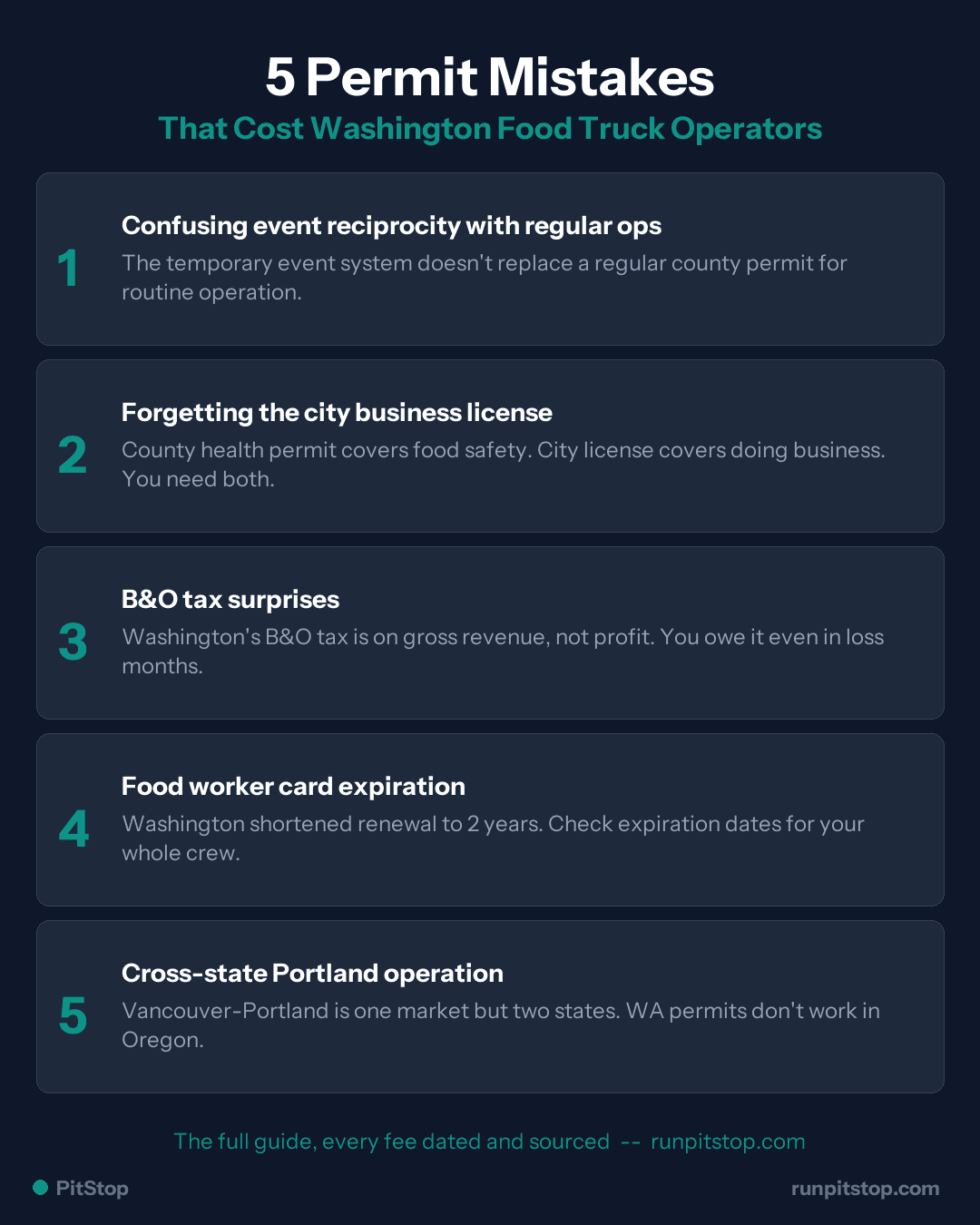
Common Pitfalls for Washington Operators
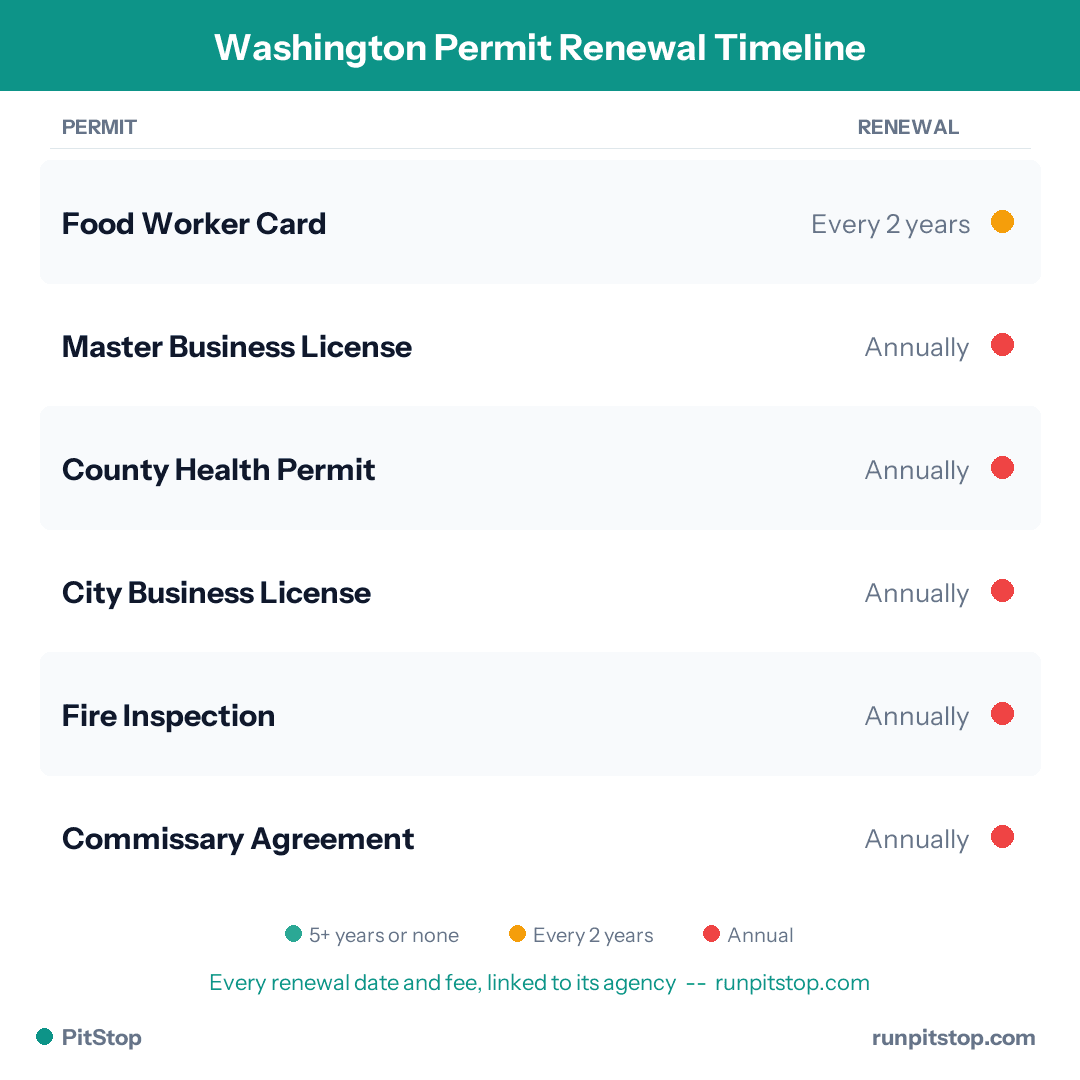
Renewal Timeline at a Glance
| Permit | Typical Renewal |
|---|---|
| Washington State Food Worker Card | Every 2 years |
| Master Business License / UBI | Annually |
| County Health Permit | Annually |
| City Business License | Annually |
| Fire Inspection | Annually |
| Commissary Agreement | Annually (or per contract) |
Before you apply
Verify every fee in this guide with the issuing agency before you pay it; fee schedules change mid-year and the agency's own page is the only number that counts. Run your first few events through the per-event profit calculator, and start the paperwork 3–4 months before opening day: inspection slots, commissary letters and certifications take longer than the application itself.