TL;DR: Texas Food Truck Permits in 2026
To operate a food truck in Texas in 2026 you need 5 things: a Texas Comptroller sales tax permit (free), the statewide DSHS mobile food vendor license ($309 to $1,376 due at application depending on unit type - in effect since July 1, 2026 under HB 2844, which also abolished city and county mobile food health permits), food handler cards for every employee and one Certified Food Manager (both provider-priced; see the fee table), a local fire inspection if you cook with propane or grease (Austin charges $222), and a commissary agreement (most cities still expect one locally even after HB 2844). Your first-year permit total depends on unit type and city; the fee table under the byline lists every state line with the day it was checked. Timeline from application to first day of service: 4-8 weeks.
Before You Serve a Single Taco
Texas is one of the most food-truck-friendly states in the country - and as of July 1, 2026 the paperwork got simpler. House Bill 2844 (the "Food Truck Freedom Bill") took full effect on July 1, 2026, creating a single statewide license and removing the state-level commissary requirement. This replaces the previous patchwork of city and county health permits. Starting from scratch? The step-by-step path is in how to start a food truck in Texas.
This guide covers what you need right now and what changed. We recommend verifying all fees and requirements directly with DSHS and your city - regulations change, and this guide is a starting point, not legal advice.
What changed July 1, 2026 — and what your city still controls
Updated September 8, 2026. House Bill 2844 (passed May 26, 2025) moved every Texas mobile food vendor onto one statewide license issued by the Texas Department of State Health Services. Before July 1, 2026 the state charged a flat $258 DSHS permit application and each city or county health department layered its own mobile food permit and fee on top; since July 1, 2026 the state license is the only health permit, and it is priced by what you do on board.
Your next steps
Most operators sort these out before their first event.
Get food truck insurance
General liability is what most events require. Get a quote in a few minutes.
Get a quoteFinance your truck or equipment
Compare equipment and working-capital options, with a soft check to start.
See financing optionsAffiliate partners: PitStop may earn a commission at no extra cost to you. How this works.
State license fees by unit type
Fees below were checked September 8, 2026 against the DSHS mobile food vendor page. Application and pre-licensing inspection fees are due together at submission, and DSHS notes that application fees include a Texas Online fee.
Swipe sideways for all columns
| Unit type | What it covers | Application fee | Pre-licensing inspection | Due at application |
|---|---|---|---|---|
| Type I | Prepackaged food only | $309 | None | $309 |
| Type II | Limited preparation | $618 | $400 | $1,018 |
| Type III | Full cooking | $876 | $500 | $1,376 |
Routine inspections after licensing run $400 (Type II) or $500 (Type III); Type I has no routine inspection fee. Complaint or compliance inspections are $300 (Type I), $400 (Type II), or $500 (Type III). Most cooking trucks are Type III, so budget $1,376 up front.
What cities and counties can no longer do
- Issue or require their own mobile food unit health permit
- Charge a mobile food health permit or inspection fee - Austin's old unrestricted permit ($239/yr plus a $158 application fee), Houston's, Dallas County's, and San Antonio Metro Health's mobile food permit fees were all abolished July 1, 2026
- Require a duplicate health inspection of a DSHS-licensed unit
What cities and counties still control
- Fire inspection and fire code - propane, hoods, suppression systems, and extinguishers are still inspected and charged locally (Austin Fire Department: $222/year)
- Zoning and parking - where you can set up, permitted sites, distance rules, hours, and noise ordinances
- Temporary event permits - festivals, markets, and street closures still need the city's event or right-of-way permit
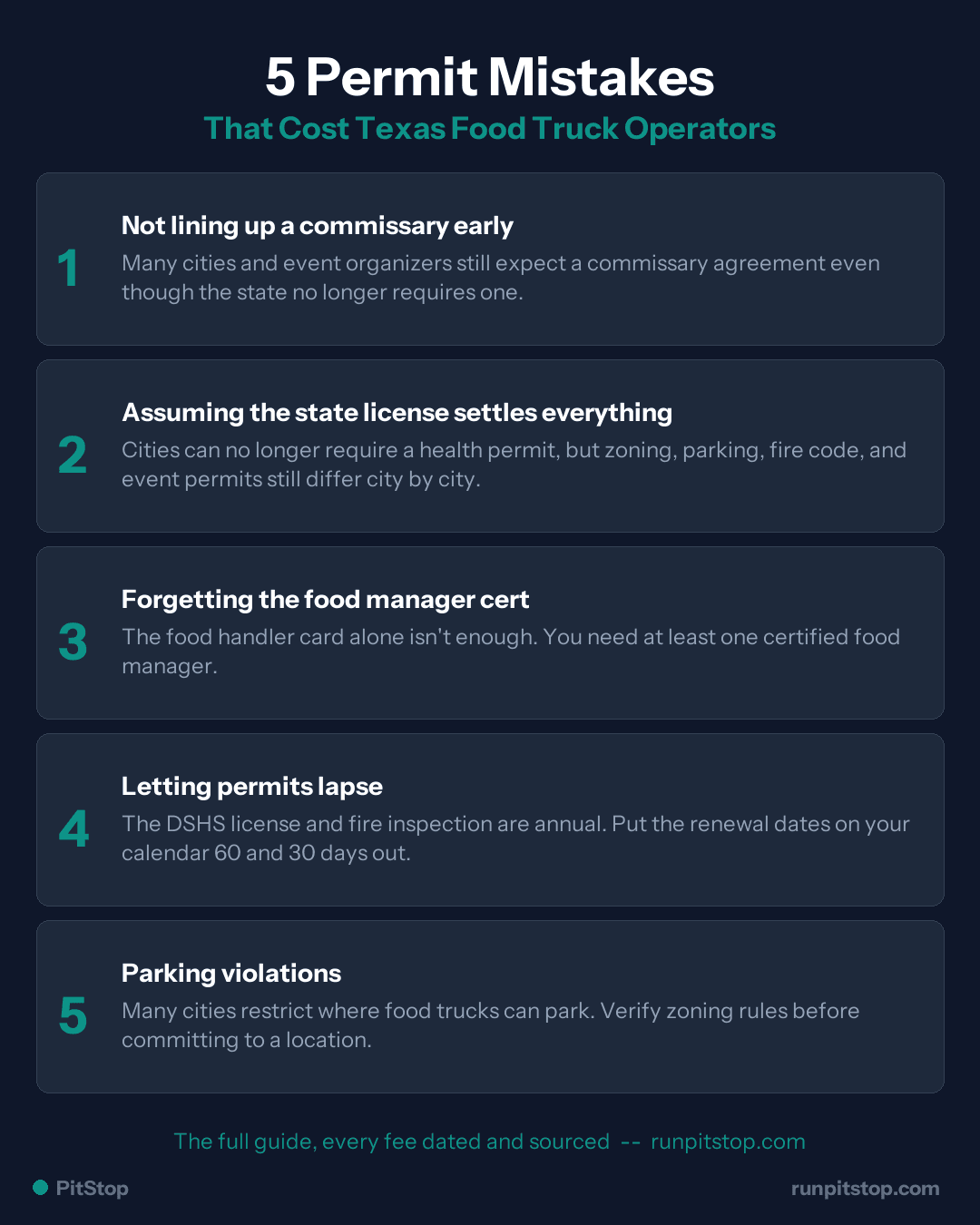
- Local commissary expectations - HB 2844 dropped the state-level commissary requirement, but many cities still expect an arrangement in practice; ask before you skip it
State-Level Requirements
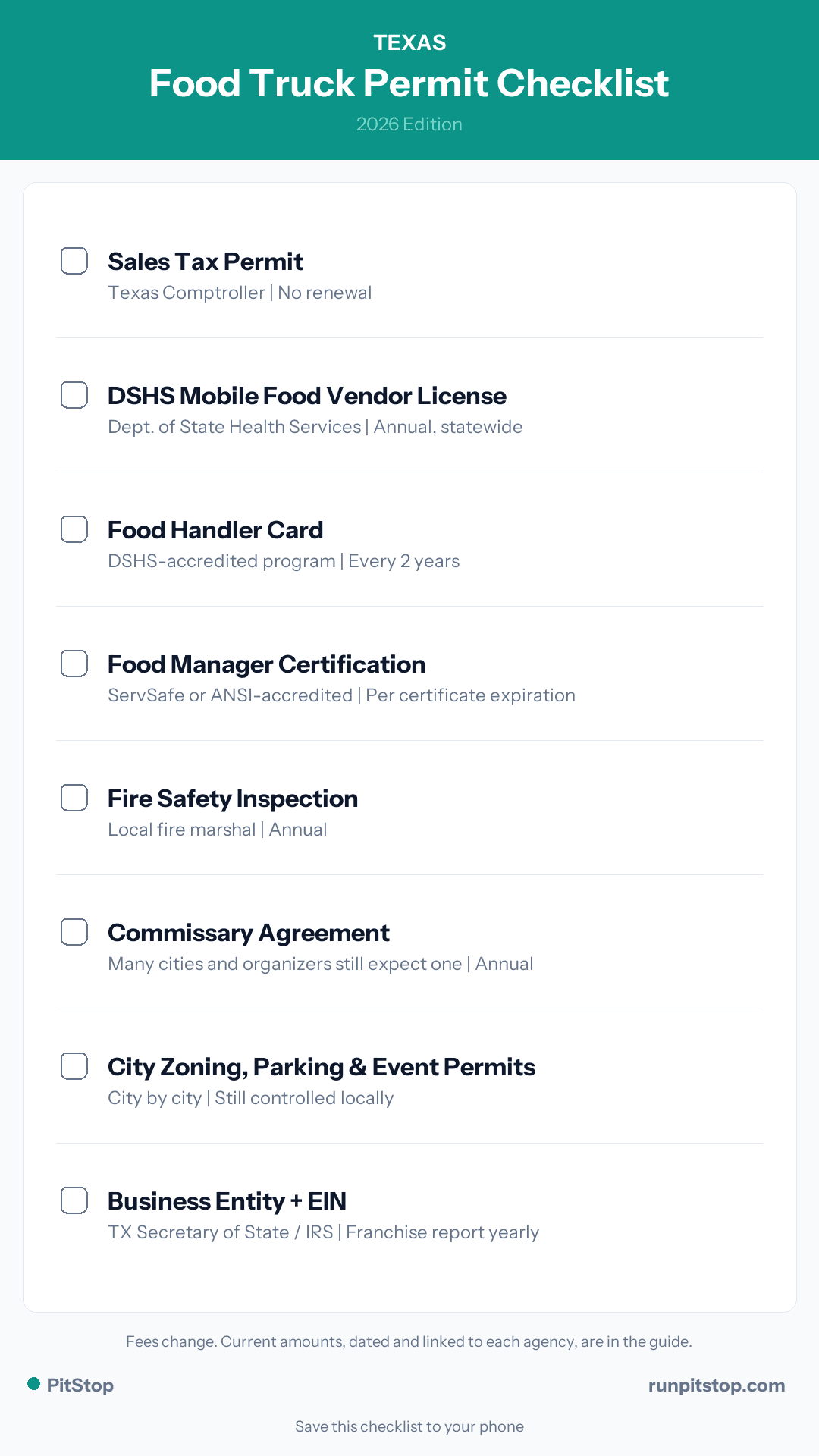
1. Texas Sales Tax Permit (Required)
Every food truck in Texas needs a sales tax permit from the Texas Comptroller of Public Accounts. This is free to obtain and allows you to collect and remit sales tax (6.25% state + up to 2% local).
Where to apply: Texas Comptroller website or in person at a field office.
2. DSHS Mobile Food Vendor License
The Texas Department of State Health Services issues the statewide mobile food vendor license that replaced city and county mobile food permits on July 1, 2026. Three tiers, priced by what you do on board:
- Type I (prepackaged only): $309 flat, no pre-licensing or routine inspection fees
- Type II (limited prep): $618 application plus a $400 pre-licensing inspection, both due at submission
- Type III (full cooking): $876 application plus a $500 pre-licensing inspection, both due at submission, so $1,376 up front
- Where to apply: DSHS Online Licensing Services; tier definitions and the fee table are on the DSHS mobile food vendor page
- A city or county health permit issued before July 1, 2026 no longer authorizes operation
3. Food Handler Certifications
Texas requires that all food employees complete an accredited food handler training program. DSHS maintains a list of approved programs.
- Cost: Provider-priced; DSHS does not set a price (see the fee table)
- Renewal: Every 2 years
- Who needs it: Every person who handles, prepares, or serves food
- Statewide recognition: Any DSHS-accredited card is valid across all of Texas
Additionally, Texas requires at least one Certified Food Manager on-site during all operating hours. This requires passing a more rigorous exam (like ServSafe Manager or equivalent ANSI-accredited program).
- Exam cost: Provider-priced; DSHS does not set a price (see the fee table)
- Renewal: Per the certificate's printed expiration
4. What the DSHS Inspection Checks
Before July 1, 2026 your local health department inspected the truck and issued the permit. Now DSHS runs the pre-licensing inspection (included in the Type II and Type III fees above). Requirements generally include:
- Handwashing station with hot and cold running water
- Three-compartment sink for dishwashing
- Proper food storage temperatures (cold-holding below 41°F, hot-holding above 135°F)
- Adequate ventilation and fire suppression (if cooking with grease)
- Waste water holding tank
- Approved water supply
5. Commissary Requirement
HB 2844 removed the state-level commissary requirement, but most Texas cities still expect your food truck to operate out of an approved commissary kitchen - a licensed commercial kitchen where you prep food, clean equipment, and store supplies overnight. Keep a signed commissary agreement letter on hand; local inspectors and event organizers still ask for it.
6. Business Entity and EIN
The DSHS license, your sales tax permit, and your insurance are all issued in a legal name, so settle the entity before you apply. A Texas LLC is a $300 Certificate of Formation (Form 205) with the Secretary of State, per the SOS fee schedule, Form 806, checked September 11, 2026. There is no annual report fee, but every LLC files a franchise tax report by May 15: no tax is due below the Comptroller's $2,650,000 no-tax-due threshold for 2026, though the Public Information Report is still required. An LLC that trades under a different truck name files a $25 assumed name certificate with the SOS (Form 503, same fee schedule); a sole proprietor files the assumed name with the county clerk instead. The full comparison, with filing fees for six states, is in food truck LLC vs sole proprietorship. Either way, get a free EIN from the IRS before you open the business bank account.
Form your LLC
Set up the LLC most operators file for liability protection. A few minutes; the provider shows the cost plus state fees.
Start your LLCAffiliate partner. PitStop may earn a commission at no extra cost to you. How this works
City-Specific Requirements
Since July 1, 2026 no Texas city issues its own mobile food health permit. What is left at the city level is fire, zoning, parking, and events - and those still differ from city to city.
Austin
- City mobile food vendor health permit abolished July 1, 2026 (Austin stopped issuing on June 30, 2026); the old Austin Public Health permit fees no longer apply
- Fire inspection: Austin Fire Department, $222/year, required if you use propane or grease-vapor equipment
- Trucks must operate from a permitted site (not just any curb)
- Right-of-way vending requires a separate Special Event Closure permit from Austin Transportation Dept
- Restroom facility agreement for any location where you vend more than two hours (a restroom within 150 feet, no fee)
- Commissary arrangement still expected locally
- Full guide: Food Truck Permits in Austin
Houston
- City of Houston Health Department mobile food unit permit no longer issued; the DSHS license covers health
- Houston Fire Marshal inspection for propane, grease, or open-flame cooking
- No brick-and-mortar restaurant distance rule; most operations run on private property with landowner permission
- Special event permits from the City of Houston Special Events Office for large gatherings
- Full guide: Food Truck Permits in Houston
Dallas
- Dallas County Health & Human Services mobile food establishment permit and plan review are no longer the gateway; apply to DSHS instead
- Dallas Fire-Rescue inspects trucks with cooking equipment
- Zoning applies site by site; suburbs (Plano, Garland, Irving, Addison, Richardson) keep their own zoning and parking rules
- Full guide: Food Truck Permits in Dallas
San Antonio
- San Antonio Metro Health mobile food unit permit replaced by the DSHS license
- San Antonio Fire Department inspection if using open flames or deep fryers
- Display your DSHS license visibly on the truck
- River Walk and historic districts (King William, Main Plaza) carry their own zoning and vending rules - verify permitted operating areas
- Full guide: Food Truck Permits in San Antonio
Fire Safety
If your truck uses propane, deep fryers, or open flame cooking, you'll need:
- A fire suppression system (hood and Ansul system) - required in most Texas cities
- Fire extinguisher (typically Class K for kitchen fires)
- Fire safety inspection - conducted by the local fire marshal
- Propane tank certification
Cost for fire suppression system: Varies significantly - get multiple quotes from certified installers. Verify requirements with your local fire marshal.
Common Pitfalls for Texas Operators
Renewal Timeline at a Glance
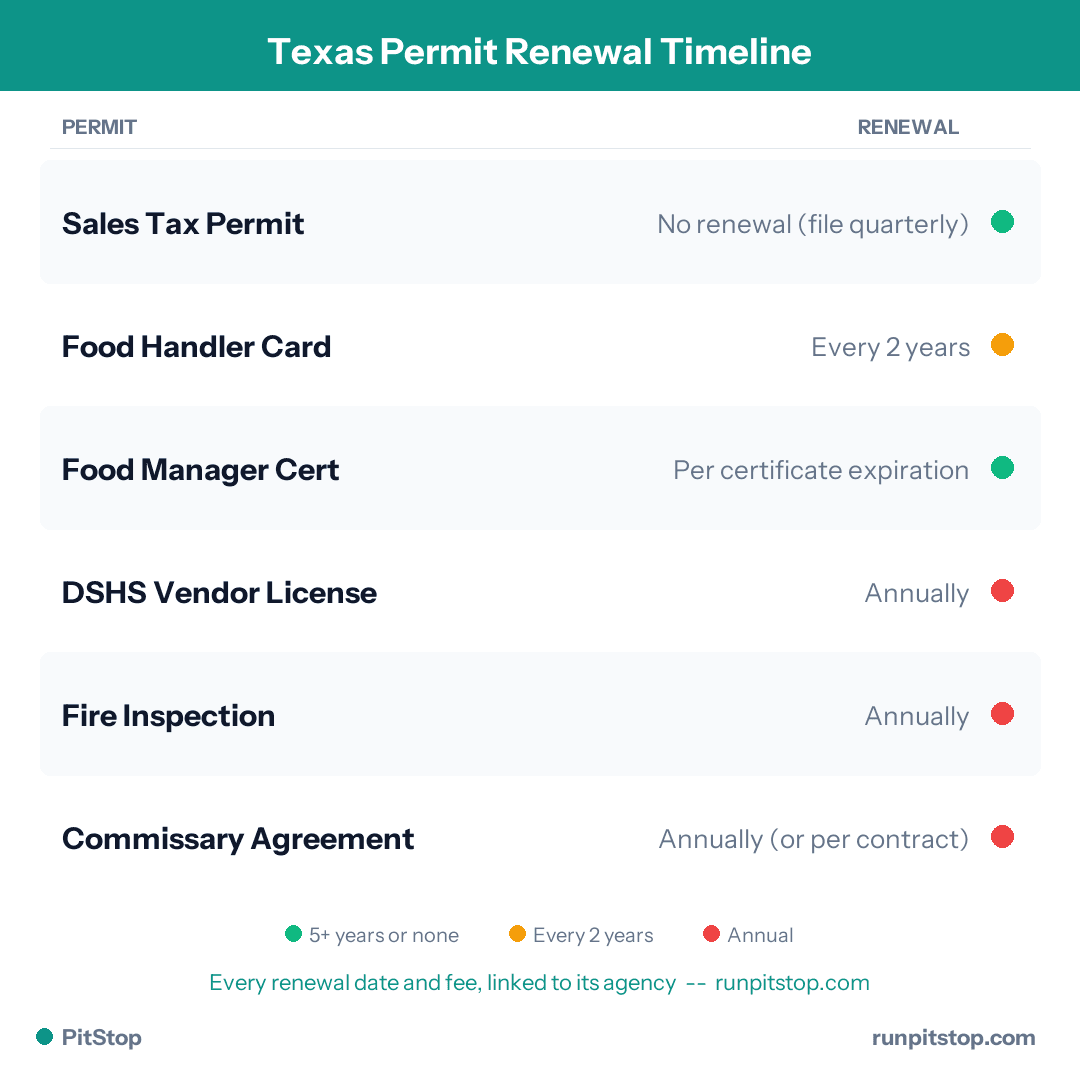
| Permit | Typical Renewal |
|---|---|
| Sales Tax Permit | No renewal (ongoing, file returns quarterly) |
| Food Handler Card | Every 2 years |
| Food Manager Cert | Per the certificate's printed expiration |
| DSHS Mobile Food Vendor License | Annually (routine inspection $400 Type II / $500 Type III) |
| Fire Inspection | Annually |
| Commissary Agreement | Annually (or per contract) |
Before you apply
Verify every fee in this guide with the issuing agency before you pay it; fee schedules change mid-year and the agency's own page is the only number that counts. Run your first few events through the per-event profit calculator, and start the paperwork 3–4 months before opening day: inspection slots, commissary letters and certifications take longer than the application itself.