TL;DR: Oregon Food Truck Permits in 2026
To operate a food truck or cart in Oregon in 2026 you need: an Oregon Health Authority food handler card per employee ($10, valid 3 years), an ODA-or-county food service license, a county health department mobile food unit permit, a business registration with the Oregon Secretary of State and a BIN from the Oregon Department of Revenue, and (in most counties) a commissary agreement. Oregon has no state sales tax, which is a significant operator advantage. Total first-year permit cost: $500-$1,000. Portland's food cart pod model lowers startup costs further if you start with a cart instead of a full truck.
Quick Facts (2026)
| Fact | Value |
|---|---|
| State sales tax | None (Oregon) |
| State licensing agency | Oregon Health Authority + ODA |
| Portland pod lot rent | $400-$1,200/month |
| Cart startup cost (used) | $15,000-$50,000 |
| Truck startup cost | $50,000-$200,000 |
| Operating-season reality | 6 month rainy season, Oct-April |
Oregon's Food Cart Culture
Oregon - especially Portland - is famous for its vibrant food cart scene. Portland's food cart pods are a defining part of the city's identity. The permitting process in Oregon is generally more accessible than states like California or New York.
Your next steps
Most operators sort these out before their first event.
Get food truck insurance
General liability is what most events require. Get a quote in a few minutes.
Get a quoteFinance your truck or equipment
Compare equipment and working-capital options, with a soft check to start.
See financing optionsAffiliate partners: PitStop may earn a commission at no extra cost to you. How this works.
Verify everything with your local authorities. This guide is a starting point for your research.
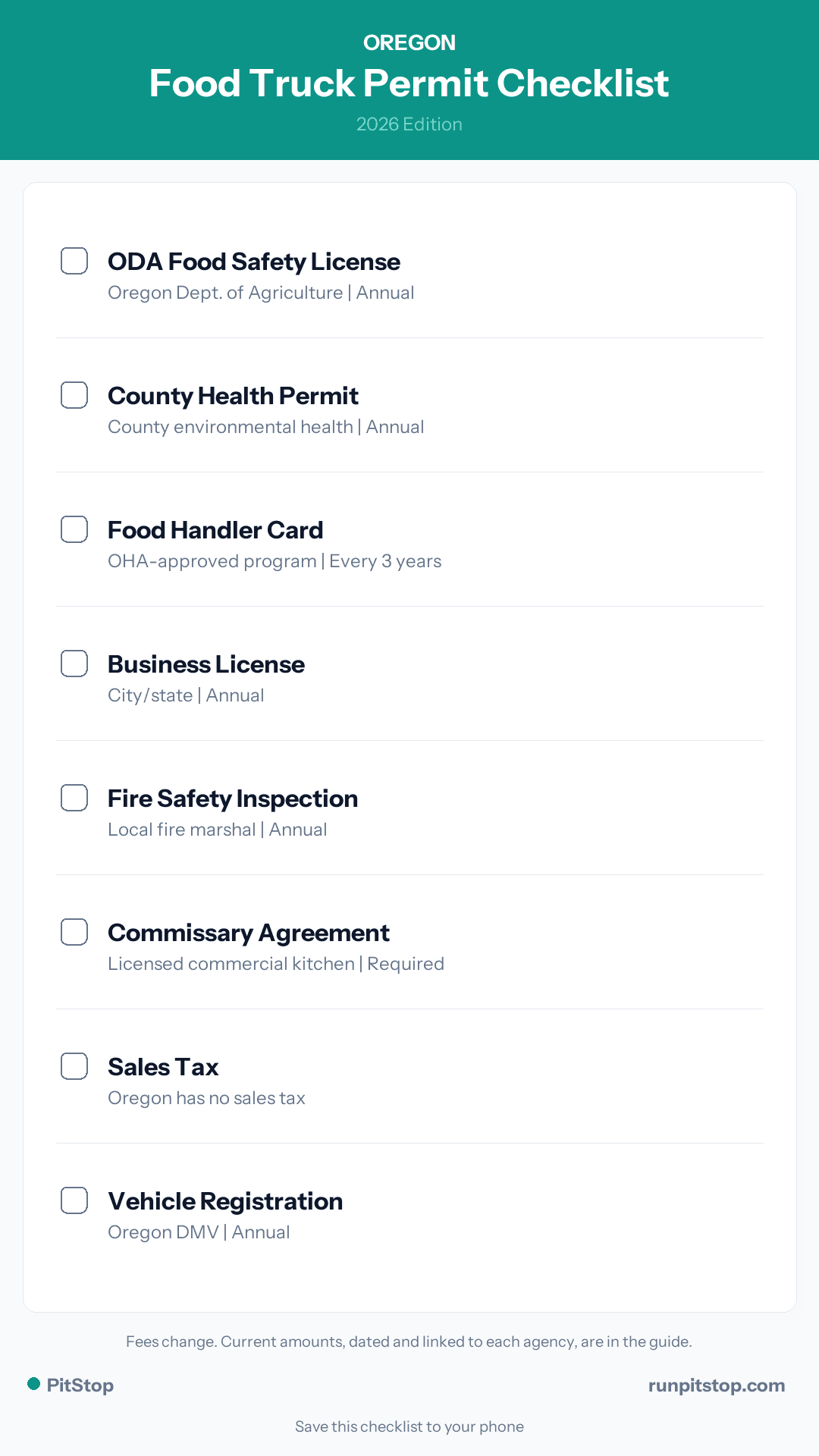
Why Oregon is Great for Food Trucks
Oregon is one of the best states for food truck operators:
- No state sales tax - Operators keep more of every dollar and customers see lower prices
- Food cart pod culture - Start with a cart for $15,000-$50,000 instead of a full truck at $50,000-$200,000
- Strong local food movement - Oregon consumers actively support small, local food businesses
- Lower startup costs - Permitting fees, commissary costs, and operating expenses are lower than CA or NY
- Straightforward permitting - Most counties have simple processes without heavy bureaucracy
The biggest downside: Oregon's rainy season (October through April) significantly reduces foot traffic. Smart operators build cash reserves during summer, pursue catering in winter, or work from covered pod locations.
State-Level Requirements
1. Oregon Food Handler Card
Oregon requires all food handlers to obtain an Oregon Food Handler Card from the Oregon Health Authority (OHA) or an approved local health department program.
- Cost: Typically around $10 (verify with OHA)
- Renewal: Every 3 years
- Where to get it: Online through OHA or county health department programs
2. Oregon Department of Agriculture (ODA) License
Depending on what you're serving, you may need a license from the Oregon Department of Agriculture:
- Food Service License - for mobile units that prepare and serve food
- Issued by ODA or delegated to county health departments depending on your location
Check with ODA to determine which agency handles licensing in your operating area.
3. Business Registration
- Register with the Oregon Secretary of State if operating as an LLC or corporation
- Obtain a Business Identification Number (BIN) from the Oregon Department of Revenue for tax purposes
4. Sales Tax
Oregon has no state sales tax, which is a significant advantage for food truck operators. However, you still need to handle federal tax obligations and may have local business taxes.
County & City Requirements
Portland / Multnomah County
Portland is the food cart capital of the United States, with hundreds of carts operating in organized pods and standalone locations.
#### What Are Food Cart Pods?
A food cart pod is a lot where 5-30 carts cluster together, sharing outdoor seating, lighting, and sometimes restrooms. Pods give operators a built-in customer base without standalone location costs.
#### Portland Permitting Process
- Multnomah County Health Department issues health permits for all food carts and trucks
- Plan review required - submit layout, equipment list, menu, and water/waste plans
- Health inspection before permit issuance, annual re-inspection for renewal
- City of Portland business license also required
#### Zoning: Cart Pods vs. Mobile Trucks
- Cart pods operate on private lots with site-specific zoning. The pod operator handles the site permit, but each cart needs its own health permit
- Mobile trucks have additional parking and time limit rules - verify with the city
#### Portland Fire and Rescue
- Portland Fire and Rescue inspects carts and trucks with cooking equipment
- Fire suppression required for grease-producing equipment; propane must meet fire code
#### Commissary in Portland
- Multnomah County requires a commissary for food storage, cleaning, and overnight parking
- Some pods have shared commissary facilities on-site, saving operators money
- Otherwise, arrange your own agreement with a licensed commercial kitchen
#### Portland Startup Costs
- Food cart: $15,000-$50,000 (lower if buying used)
- Food truck: $50,000-$200,000 depending on new vs. used
- Pod lot rent: set by each pod; quote two before you commit
- Commissary: set by the kitchen (some pods include it); get two written quotes
- Permits and licenses: $500-$1,000 for the first year
Salem (Marion County)
- Marion County Health Department issues mobile food unit permits
- Standard plan review and health inspection process
- Regular food truck events downtown and at the Oregon State Capitol
Bend (Deschutes County)
- Deschutes County Health Department handles food truck permits
- Plan review and health inspection required
- Seasonal market - Peak demand June through September. Winter brings ski visitors but less food truck traffic
- Plan for seasonal revenue swings; growing food cart pod presence downtown
Eugene (Lane County)
- Lane County Environmental Health issues mobile food unit permits
- Health inspection and plan review required
- University of Oregon campus drives demand during the academic year (September-June)
- Lane County Farmers Market and Saturday Market are popular venues - separate vendor applications may apply
Each county handles permitting independently - contact your local county health department for specific requirements and fees.
Commissary Requirements
Oregon's commissary requirements vary by county:
- Many counties require a commissary for food storage, prep, and truck cleaning
- Portland's pod model sometimes provides on-site facilities that satisfy commissary requirements
- Verify requirements with your county health department before signing any lease
Fire Safety
Oregon's fire safety requirements differ for enclosed trucks versus open carts.
Enclosed Food Trucks
- Commercial fire suppression system (hood and Ansul system) required for grease-producing equipment
- Class K fire extinguisher required for cooking oil and grease fires
- Annual inspection from the local fire marshal; proper ventilation required
- Propane: Tanks must be in a ventilated compartment with accessible shut-off valves
Open Food Carts
- Fire extinguishers required (Class K for grease-producing equipment)
- Propane tanks must be secured and positioned away from customers
- Suppression requirements may be less stringent for open-air carts - confirm with your fire authority
- Canopy materials must be fire-resistant
General
- Fire inspection before operations and annually thereafter
- Keep fire extinguishers serviced and maintain clear access to exits
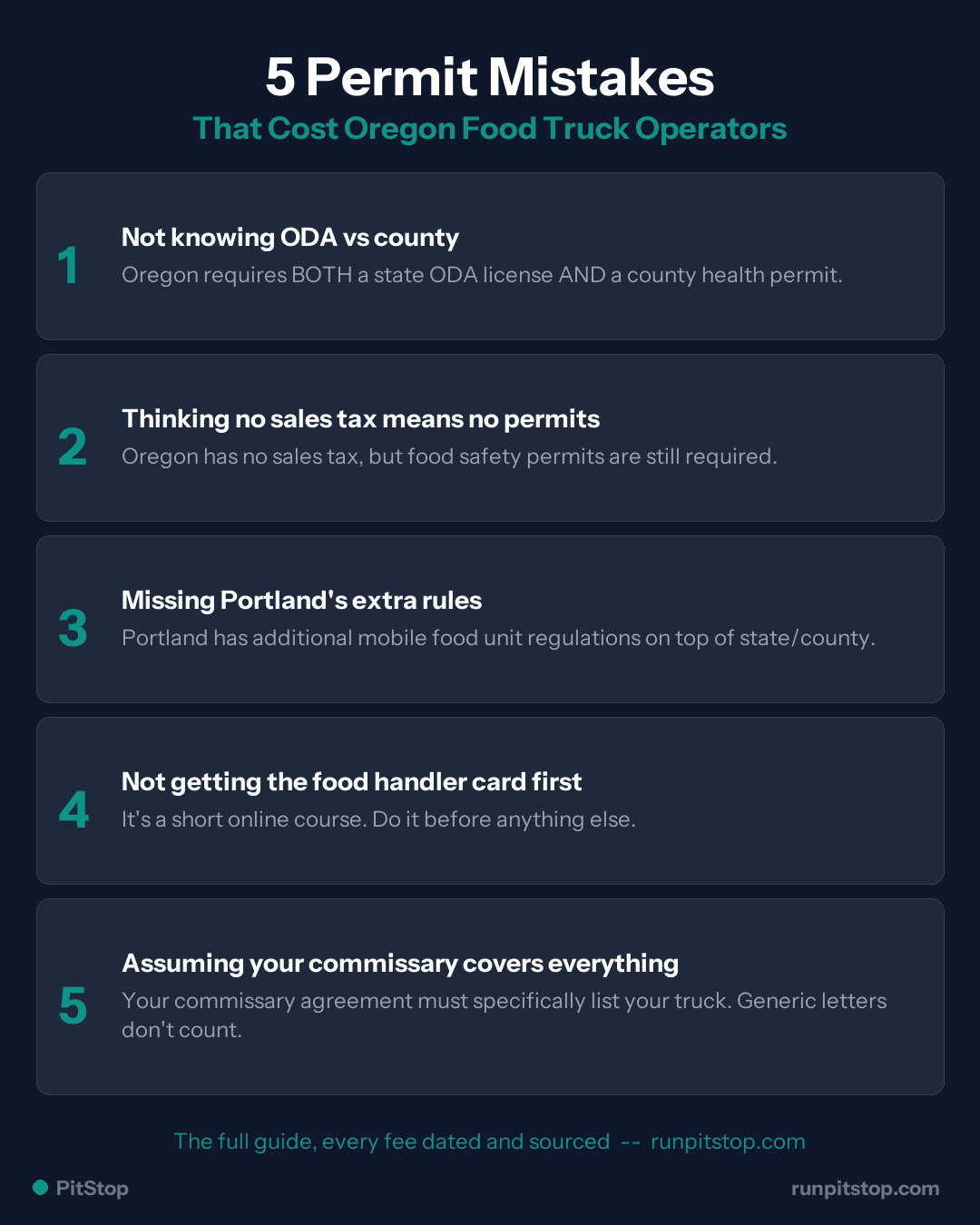
Common Pitfalls for Oregon Operators
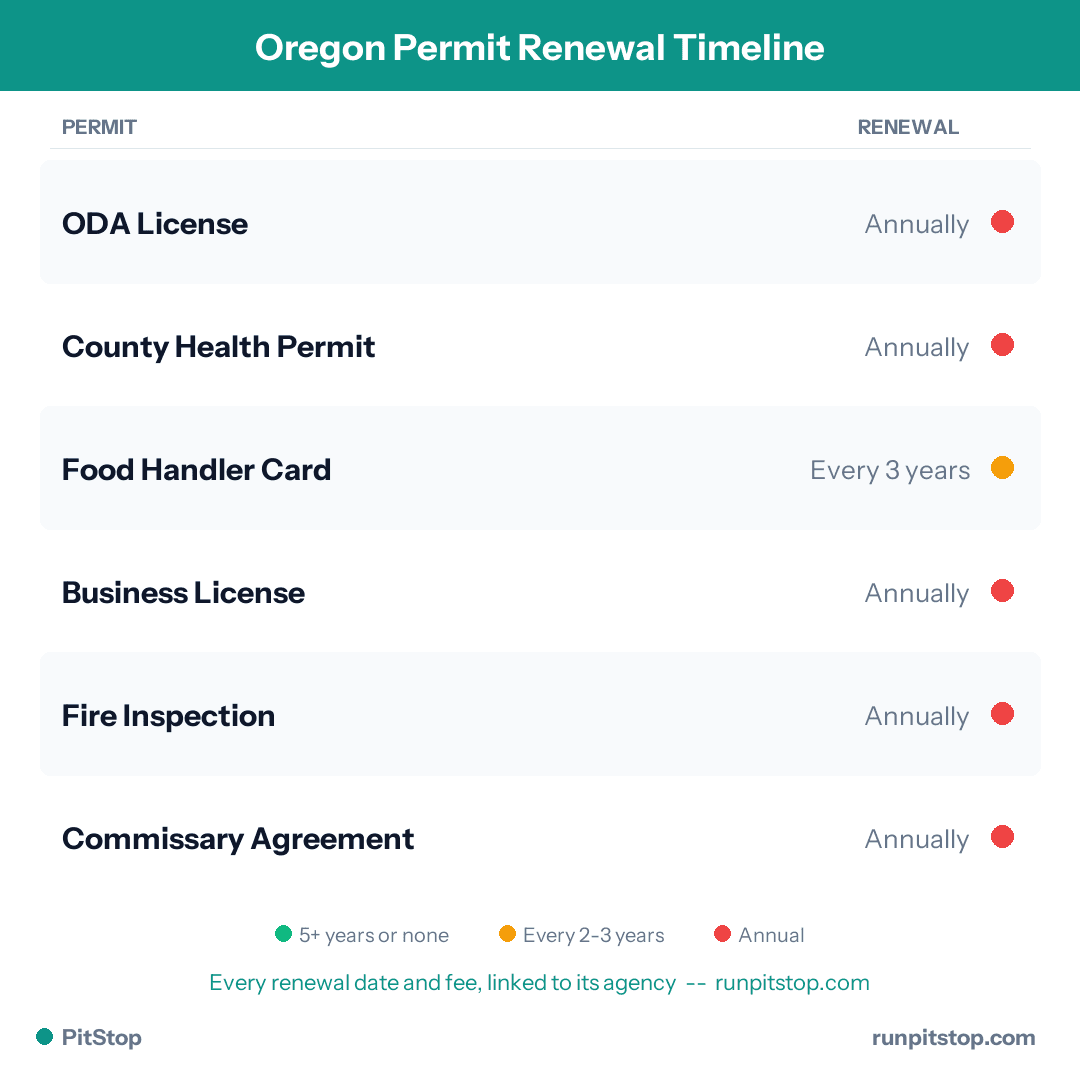
Renewal Timeline at a Glance
| Permit | Typical Renewal |
|---|---|
| Oregon Food Handler Card | Every 3 years |
| Health/Food Service License | Annually (verify with county/ODA) |
| Fire Inspection | Annually |
| Business License | Annually |
Before you apply
Verify every fee in this guide with the issuing agency before you pay it; fee schedules change mid-year and the agency's own page is the only number that counts. Run your first few events through the per-event profit calculator, and start the paperwork 3–4 months before opening day: inspection slots, commissary letters and certifications take longer than the application itself.