Food Trucks in the Empire State
New York's food truck scene is iconic, especially in New York City. But the permitting landscape is notoriously complex - particularly in NYC, where permits have historically been limited and in high demand.
Outside of NYC, the process is more straightforward and handled at the county level.
As always: Verify all requirements and fees directly with the relevant agencies. This guide is informational, not legal advice.
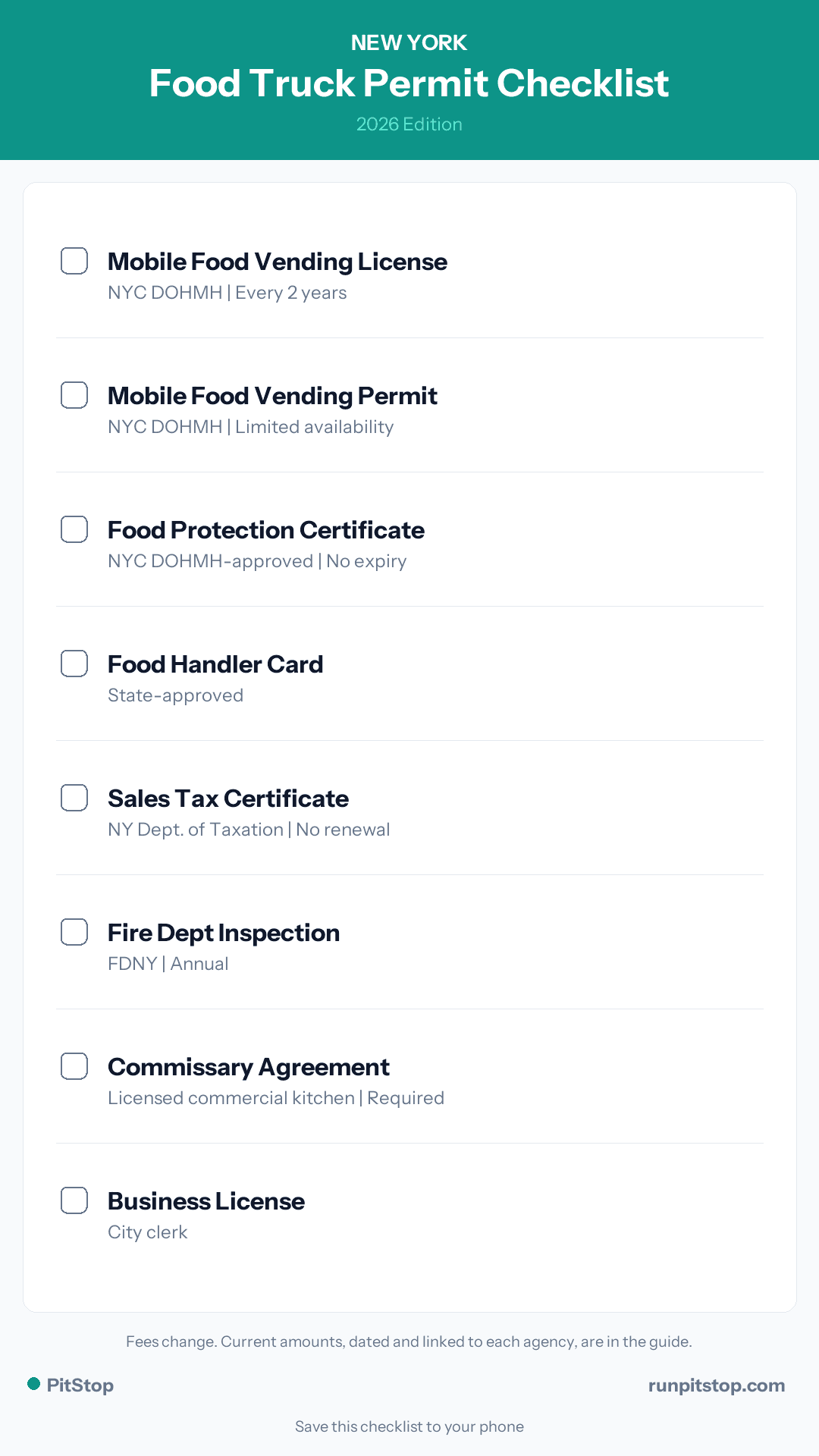
New York City (NYC)
NYC has one of the most regulated food truck environments in the country.
Your next steps
Most operators sort these out before their first event.
Get food truck insurance
General liability is what most events require. Get a quote in a few minutes.
Get a quoteFinance your truck or equipment
Compare equipment and working-capital options, with a soft check to start.
See financing optionsAffiliate partners: PitStop may earn a commission at no extra cost to you. How this works.
Mobile Food Vending License & Permit
To operate a food truck or cart in NYC, you need two things from the NYC Department of Health and Mental Hygiene (DOHMH):
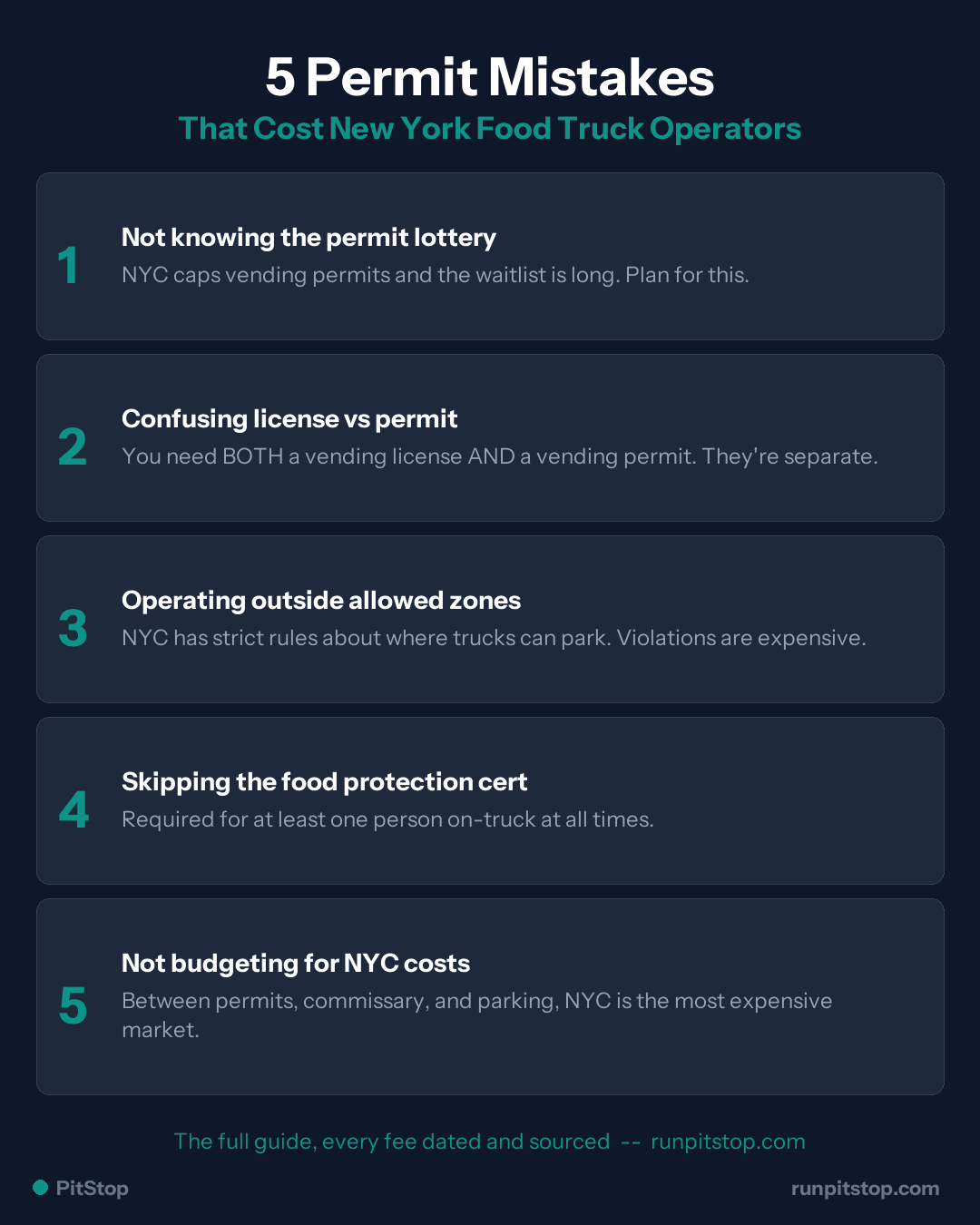
NYC has a limited number of permits available, and the waitlist has historically exceeded 11,000 applicants for a handful of openings. But that's changing. Starting July 1, 2026, NYC will issue 2,200 new supervisory licenses per year for 5 years (11,000 total new permits). Waiting list applications must be postmarked by April 28, 2026. Veterans and their surviving spouses/domestic partners are exempt from license fees.
#### The Permit Lottery and Waitlist
The NYC permit system operates as a lottery with demand far exceeding supply. Key points:
- Temporary permits are available for special events, street fairs, and festivals - no lottery required
- Third-party permit leasing is common (though grey-market) at $15,000-$25,000 per year. The city has tried to crack down, but it remains widespread
- The 2026 expansion is the largest increase in decades - a real opportunity for new operators
- Apply early - demand will likely exceed the 2,200 annual slots
Food Protection Certificate
NYC requires at least one supervisor per unit to hold a Food Protection Certificate during ALL operating hours.
- Free online course through NYC Health Academy (15 self-paced lessons, available in English, Spanish, and Chinese)
- In-person course: $16 (15 hours over 5 days); Final exam: $24
- The certificate does not expire - no renewal required
- More rigorous than a basic food handler card
Health Inspections
- The DOHMH conducts unannounced inspections of mobile food units
- Letter-grading system similar to restaurants
- Violations can result in fines or permit suspension
Commissary Requirement
NYC food trucks must operate from an inspected and approved commissary facility where the truck is stored, cleaned, and provisioned.
Operating Restrictions
- Parking restrictions near schools, hospitals, and parks (rules vary)
- Time limits on how long you can remain in one spot
- Metered parking rules apply to food trucks
- Verify current rules with DOHMH and the Department of Transportation
New York State (Outside NYC)
Requirements outside NYC are more typical and handled at the county level:
County Health Department Permit
- Apply to your county health department for a mobile food service permit
- Plan review and truck inspection required
- Annual renewal
Food Handler Requirements
- New York State requires food safety training but the specifics can vary by county
- At least one certified food protection manager is recommended and may be required depending on your county
Sales Tax
- Register for a Certificate of Authority from the New York State Department of Taxation and Finance
- NYS sales tax is 4% plus county/city surcharges
Business Registration
- Register your business with the NY Department of State if operating as an LLC or corporation. New York also has a newspaper publication requirement for new LLCs; food truck LLC vs sole proprietorship covers the filing fee, the publication step, and when a sole prop is enough
Buffalo (Erie County)
- Erie County Department of Health issues mobile food service permits
- Plan review, vehicle inspection, and commissary agreement required
- Increasingly food-truck-friendly, with events like Food Truck Tuesdays downtown
- Permit fees significantly lower than NYC - verify rates with Erie County
Rochester (Monroe County)
- Monroe County Department of Public Health handles mobile food permits
- Health inspection and plan review required
- Food-truck-friendly downtown; Rochester Public Market is a popular venue
- Seasonal permits available for spring-through-fall operators
Albany (Albany County)
- Albany County Department of Health issues mobile food service permits
- Standard plan review and inspection process
- State government events create consistent weekday demand; Empire State Plaza is a high-traffic spot
Fire Safety Requirements
New York has strict fire safety rules, especially in NYC where the FDNY enforces them aggressively.
NYC Fire Safety (FDNY)
- Certificate of Fitness (COF) - Required for any operator using propane. You must pass an FDNY exam specific to your equipment type
- Fire suppression system - Commercial hood and Ansul system required for grease-producing cooking equipment
- Class K fire extinguisher - Required for trucks with deep fryers, griddles, or grills
- Annual fire inspection - FDNY inspects mobile food units. Failing can mean fines or an order to cease operations
- Propane storage - NYC allows a maximum of 2 tanks (up to 100 lbs each). Tanks must be secured, ventilated, and stored per FDNY regulations. Violations can result in criminal court summons
- Typical costs: $100-$400 for inspection and COF exam fees
FDNY Propane and Open Flame Permits
If your food truck uses propane, natural gas, or any open flame cooking in New York City, you need an FDNY Certificate of Fitness (COF). This is separate from your health permit and is one of the most commonly missed requirements for NYC food truck operators.
- Certificate of Fitness G-60 -- Required for handling and storage of combustible gases (propane). You must pass a written exam at FDNY headquarters.
- FDNY Inspection -- Your truck's propane system, ventilation, and fire suppression must pass FDNY inspection before operating.
- Annual renewal -- The COF must be renewed annually. Operating without a valid COF can result in fines of $1,000+ and immediate shutdown.
- Where to apply: FDNY Certificate of Fitness -- study materials and exam scheduling.
- Exam cost: $25 per attempt.
- Tip: Schedule your FDNY exam before your health permit appointment. The COF can take 2-4 weeks to process, and you cannot operate without it even if your health permit is approved.
Most mobile food vending unit operators in NYC need both the FDNY COF G-60 and a valid DOH mobile food vending permit. Do not assume your health permit covers fire safety -- it does not.
Upstate Fire Safety
Outside NYC, fire safety is handled by your local fire marshal:
- Fire suppression system required for grease-producing equipment
- Class K fire extinguisher recommended for kitchen fires
- Propane system inspection and certification
- Requirements are generally less stringent than NYC - contact your local fire marshal for specifics
Common Pitfalls for New York Operators
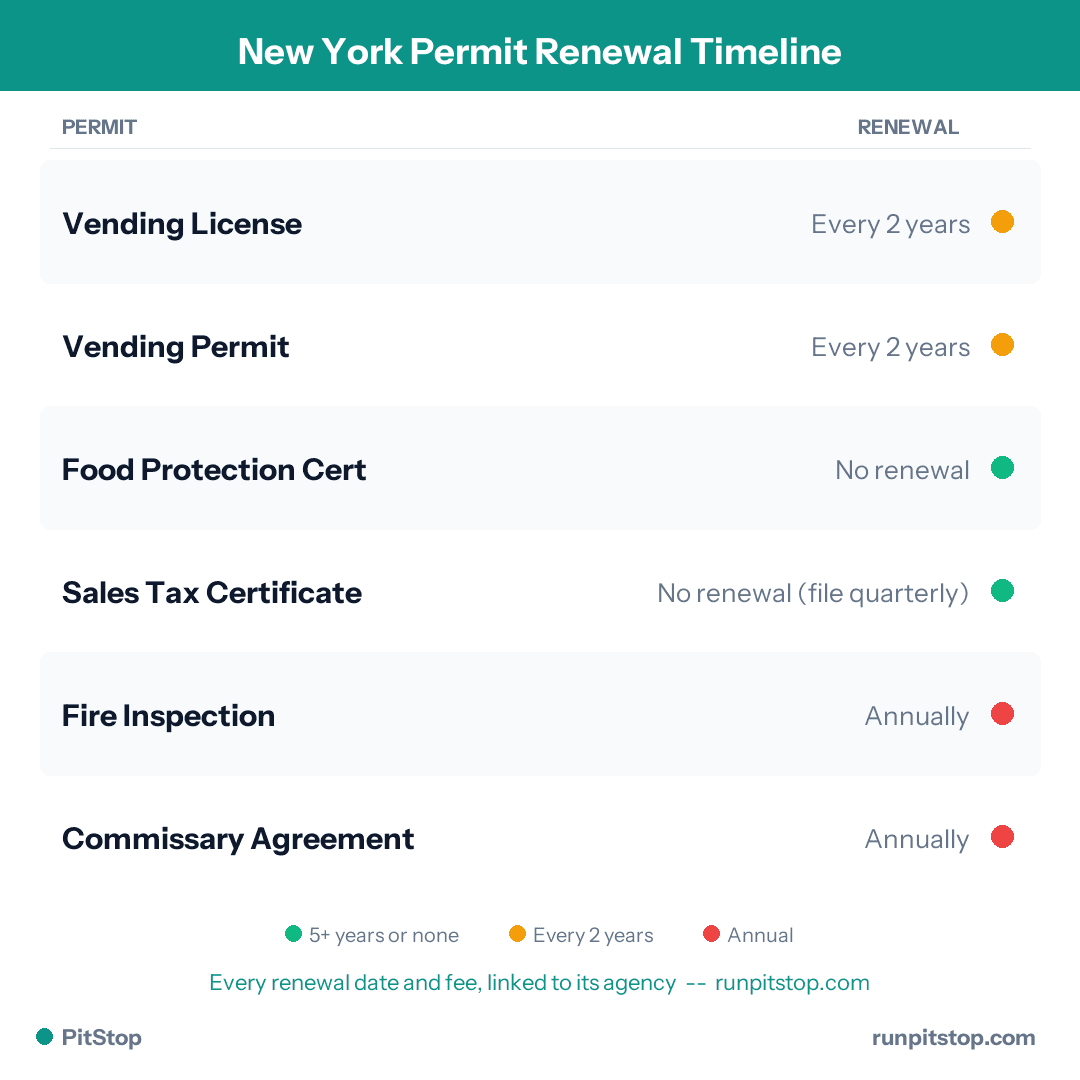
Renewal Timeline at a Glance
| Permit | Typical Renewal |
|---|---|
| NYC Mobile Food Vending License | Verify with DOHMH |
| NYC Unit Permit | Verify with DOHMH |
| County Health Permit (outside NYC) | Annually |
| Food Protection Certificate | Verify with issuing authority |
| Sales Tax Certificate | No renewal (ongoing) |
| Business Registration | Varies by entity type |
Before you apply
Verify every fee in this guide with the issuing agency before you pay it; fee schedules change mid-year and the agency's own page is the only number that counts. Run your first few events through the per-event profit calculator, and start the paperwork 3–4 months before opening day: inspection slots, commissary letters and certifications take longer than the application itself.