TL;DR: Illinois Food Truck Permits in 2026
To operate a food truck in Illinois in 2026 you need: an IDPH retail food establishment certificate, a Chicago BACP Mobile Food license ($700 Dispenser / $1,000 Preparer, 2-year term) or downstate county equivalent, IDPH food sanitation manager certification (one per truck), a sales tax registration (Illinois 6.25% + Cook County 1.75% + Chicago 1.25% in Chicago), and a commissary agreement. Chicago is the strictest market in Illinois due to its 200-foot brick-and-mortar restaurant exclusion zone and GPS tracking mandate. Total first-year permit cost in Chicago: $1,500-$2,500. Downstate: $500-$1,200.
Quick Facts (2026)
| Fact | Value |
|---|---|
| Governing state agency | Illinois Department of Public Health (IDPH) |
| Chicago city license | BACP Mobile Food license, $700 (Dispenser) / $1,000 (Preparer), 2-yr |
| Chicago distance rule | 200 ft from brick-and-mortar restaurants |
| GPS tracking mandate | Required for Chicago trucks |
| Combined Chicago sales tax | 10.25% |
| Commissary rent | Set by the kitchen (Chicago requires one inside city limits); get two quotes |
Deep Dish Regulations: What Illinois Operators Face
Illinois is a top-five state for food trucks, driven almost entirely by Chicago's massive street food culture. But Illinois is really two regulatory worlds: Chicago (which has its own detailed licensing system) and everywhere else (which follows county-level health department rules under state oversight).
The good news: Illinois streamlined food truck rules significantly in the last decade. The bad news: Chicago's regulations are still among the most detailed in the Midwest.
Verify all fees and requirements with the relevant agencies before applying. This guide is a research starting point, not legal advice.
Your next steps
Most operators sort these out before their first event.
Get food truck insurance
General liability is what most events require. Get a quote in a few minutes.
Get a quoteFinance your truck or equipment
Compare equipment and working-capital options, with a soft check to start.
See financing optionsAffiliate partners: PitStop may earn a commission at no extra cost to you. How this works.
State-Level Requirements
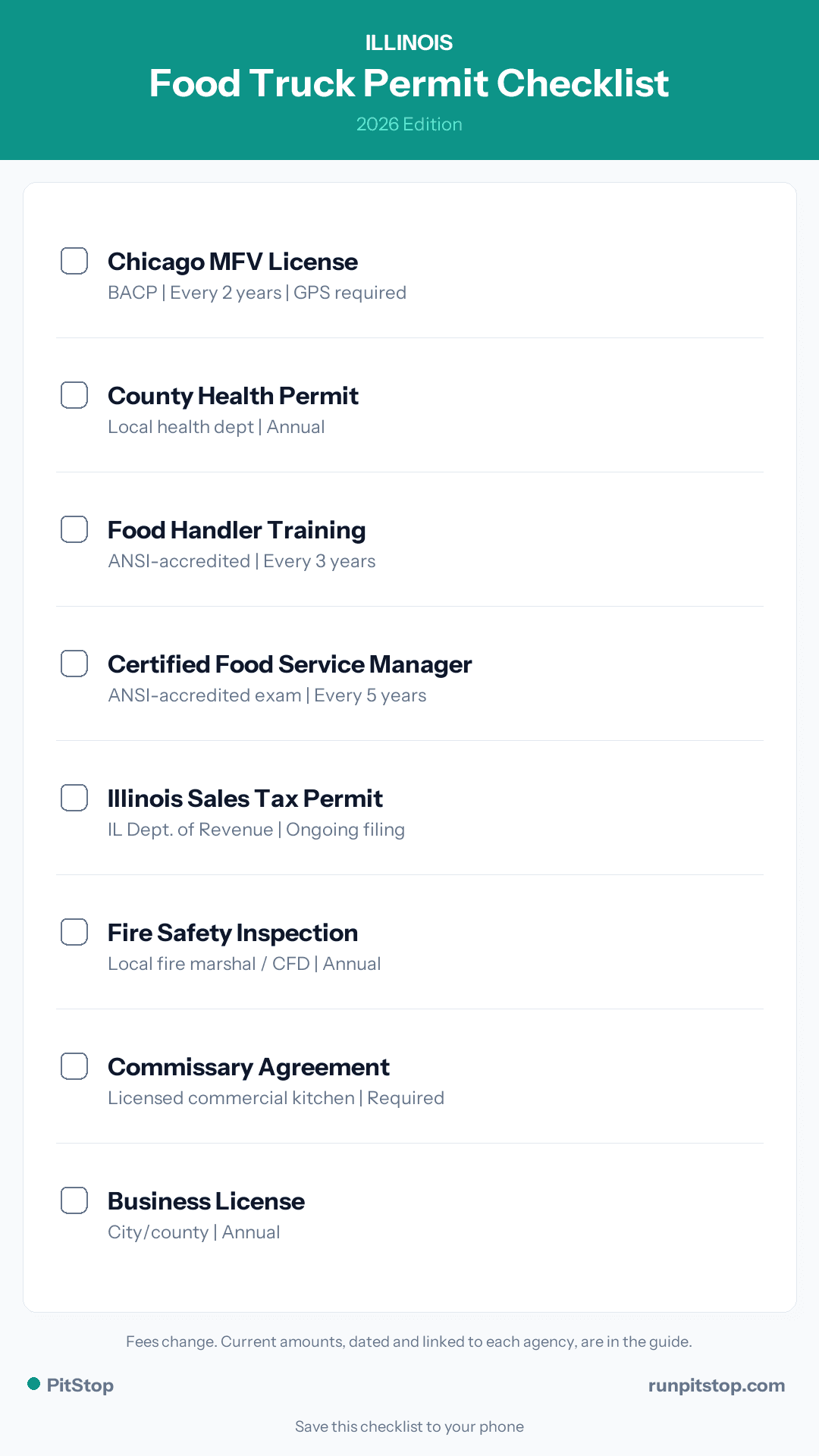
1. Illinois Business Registration
Before you do anything food-related, get your business entity set up:
- LLC or Corporation: File Articles of Organization with the Illinois Secretary of State - $150 to file Articles of Organization (form LLC 5.5) and $75 a year for the annual report (form LLC 50.1) (Illinois SOS LLC fees, checked September 11, 2026)
- Sole Proprietorship: Register your assumed business name (DBA) with the county clerk - Cook County charges $50 plus a newspaper notice you publish within 15 days of registering (Cook County Clerk, checked September 11, 2026); other counties set their own fee
- Federal EIN: Free from the IRS - required for tax filing, hiring employees, and opening a business account
- Which one? Food truck LLC vs sole proprietorship covers liability, taxes, and when a sole prop is genuinely enough
2. Illinois Department of Public Health (IDPH) Food Service Sanitation
Illinois food safety is overseen by the Illinois Department of Public Health (IDPH), but day-to-day permitting is delegated to local health departments (county or city). IDPH sets the statewide standards through the Illinois Food Code (based on FDA Model Food Code).
Key statewide rules:
- All mobile food vehicles must meet Illinois Food Code requirements for equipment, water supply, waste water, handwashing, and food temperature control
- Your local health department conducts inspections and issues your food service license
- License fees vary by jurisdiction - typically $100–$500 annually for a mobile food vehicle
3. Food Handler Training
Illinois requires all food service employees to complete an ANSI-accredited food handler training program.
- Cost: $10–$15 per person online
- Timeline: Within 30 days of employment
- Renewal: Every 3 years
- Statewide recognition: Any ANSI-accredited certificate is valid across Illinois
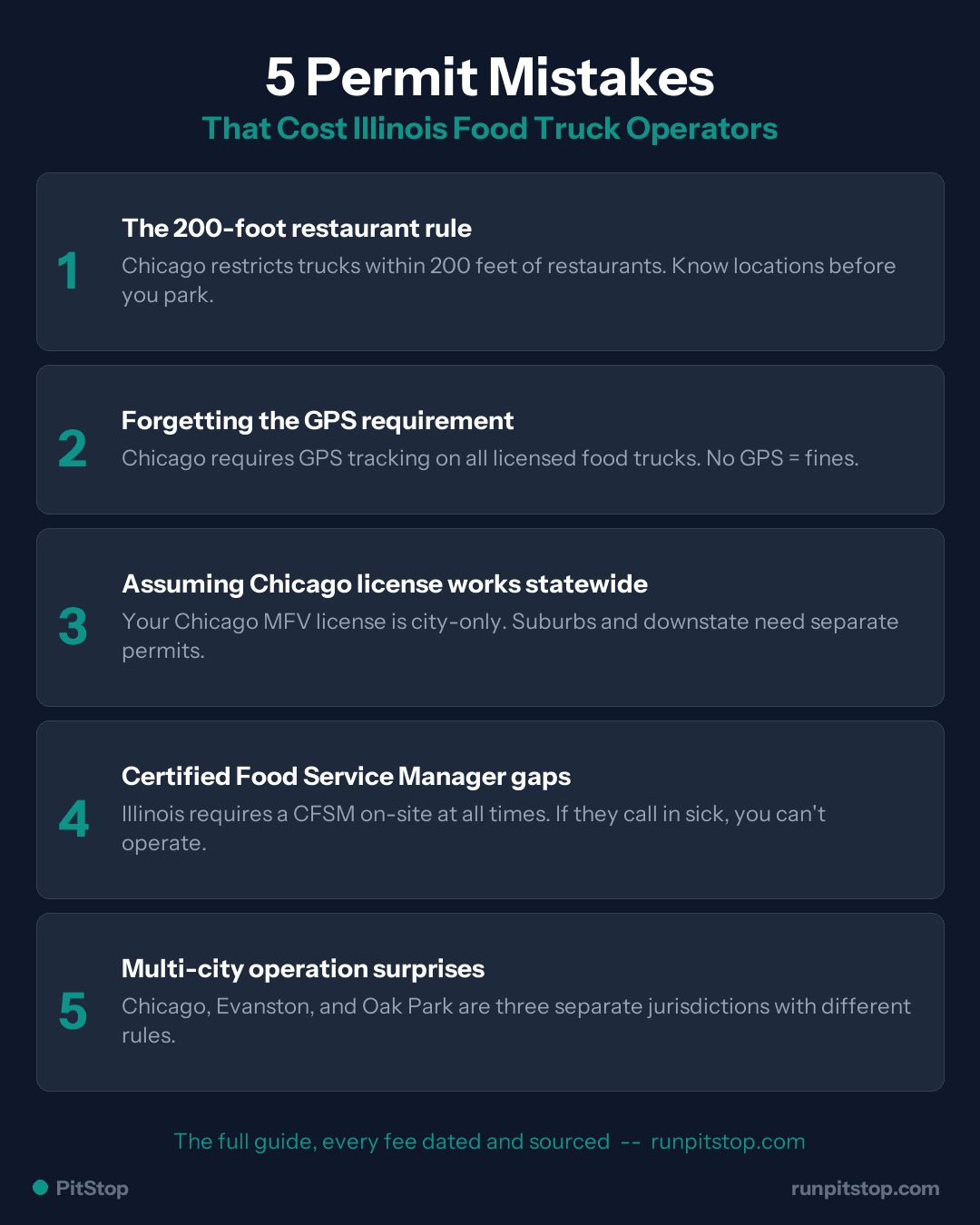
4. Certified Food Service Manager (CFSM)
Illinois requires that food service establishments (including food trucks) have a Certified Food Service Manager on duty during hours of operation. This is a more advanced certification than the basic food handler card.
- Approved exams: ServSafe Manager, National Registry of Food Safety Professionals (NRFSP), Prometric, or other ANSI-CFP accredited exams
- Cost: $80–$180 depending on provider
- Renewal: Every 5 years
- Who needs it: At least one person per truck, present during all operating hours
5. Illinois Sales Tax
Register for a Certificate of Registration with the Illinois Department of Revenue (IDOR).
- State sales tax on food: Illinois generally taxes food for immediate consumption (prepared food) at 6.25% state rate plus local additions - total typically 8.5%–11% depending on municipality
- Filing: Monthly, quarterly, or annually depending on your volume - determined by IDOR
- Cost to register: Free
6. Vehicle Requirements
Your food truck must be registered and insured as a commercial vehicle:
- Illinois Secretary of State - commercial vehicle registration
- Commercial auto insurance - required; verify minimum coverage with your insurance agent
- General liability insurance - most events and commissaries require $1 million minimum
Chicago - The Big One
Chicago has its own licensing system administered by the Chicago Department of Business Affairs and Consumer Protection (BACP). The city-level walkthrough, with the BACP application steps, the two-year fee, the GPS mandate and the 200-foot rule, is in Food Truck Permits in Chicago; the summary below is what a statewide reader needs.
Mobile Food Vehicle (MFV) License
- License type: Mobile Food License from BACP - Mobile Food Dispenser (no onboard cooking) or Mobile Food Preparer (cooks onboard)
- License fee: about $700 (Dispenser) or $1,000 (Preparer) for a 2-year term (verify current fee with BACP - fees have been adjusted in recent years)
- Application process: Apply through the City of Chicago eCLIPSE portal (online business licensing system)
- Requirements before applying:
- Valid Illinois business registration
- Certificate of insurance (general liability, minimum $300,000 per occurrence and $100,000 property damage - verify current minimums with BACP)
- Approved vehicle inspection from the Chicago Department of Public Health (CDPH)
- Commissary agreement with a licensed Chicago commissary
- Valid food service manager certification
Chicago Health Inspection
The Chicago Department of Public Health (CDPH) conducts the health inspection of your truck:
- Plan review of your truck layout and equipment
- On-site inspection before license issuance
- Unannounced inspections during operation - Chicago is aggressive about enforcement
- Must meet all Chicago Food Code requirements (based on Illinois Food Code with additional city rules)
Chicago Operating Restrictions
Chicago has specific rules about where and when food trucks can operate:
- 200-foot rule: Food trucks cannot operate within 200 feet of the entrance of a restaurant that holds a retail food license (this has been a major point of contention and subject to ongoing legal challenges - verify current status)
- No operation on the same block face for more than 2 hours at a time (verify current rule)
- GPS tracking: Chicago requires all licensed MFVs to have an active GPS unit, and operators must provide real-time location data to the city
- Late-night restrictions: Operating hours may be limited in certain zones - check current BACP rules
- Metered parking: Food trucks must pay for parking at metered spaces
- No operation in certain zones: Parks, the Loop, and areas near schools have specific restrictions
Chicago Fire Safety
The Chicago Fire Department (CFD) has separate requirements:
- Fire suppression system required for all grease-producing cooking (commercial hood with Ansul system)
- Class K fire extinguisher for cooking oil fires
- CFD inspection before license issuance and annually thereafter
- Propane: Must meet CFD code for storage, connection, and ventilation
Downstate Illinois (Outside Chicago)
Outside Chicago, food truck permitting follows a more typical county-level pattern.
Springfield (Sangamon County)
- Sangamon County Department of Public Health issues mobile food vendor permits
- Health inspection and plan review required
- Commissary agreement typically required
- State Capitol area and downtown events provide solid weekday demand
Peoria (Peoria County)
- Peoria City/County Health Department handles mobile food permits
- Standard plan review and inspection process
- Growing food truck presence at festivals and downtown events
Champaign-Urbana (Champaign County)
- Champaign-Urbana Public Health District issues permits
- University of Illinois campus drives significant demand during the academic year
- Verify specific rules for operating near campus
Rockford (Winnebago County)
- Winnebago County Health Department issues mobile food service permits
- Plan review, vehicle inspection, and annual renewal required
General Downstate Pattern
- Apply to your county health department for a mobile food establishment permit
- Submit a plan review (truck layout, equipment list, menu, water/waste plans)
- Pass a health inspection
- Provide a commissary agreement
- Obtain a local business license from the city where you primarily operate
- Fees: Generally $100–$400 annually for the health permit, plus city business license fees
Commissary Requirements
Illinois generally requires food trucks to operate from a licensed commissary kitchen:
- Chicago: Commissary must be a licensed food establishment within Chicago city limits. You must return to the commissary daily for cleaning, food storage, and restocking
- Downstate: Most counties require a commissary agreement. Some smaller counties may have more flexible requirements - verify with your local health department
- What you need from your commissary:
- Signed commissary agreement letter (required for your permit application)
- A location to prep food not prepared on the truck
- Equipment and vehicle cleaning area
- Food and supply storage
- Waste water disposal
Commissary costs in Chicago: the kitchen sets the price, and it moves with location, access hours, storage, and whether truck parking is included; downstate kitchens generally charge less, but the only number that counts is the one on a written quote. Get two before you sign, and ask what the health department needs on the agreement.
Fire Safety
For All Illinois Food Trucks
- Fire suppression system: Required for trucks with grease-producing equipment (fryers, griddles, grills). Commercial hood and Ansul system are standard
- Fire extinguisher: Class K for kitchen/grease fires, plus a Class ABC for general fires
- Propane: Tanks must be properly secured, ventilated, and inspected. Follow NFPA 58 standards
- Fire inspection: Required before initial permit and annually thereafter - conducted by local fire marshal (or CFD in Chicago)
Chicago-Specific
- CFD is one of the most thorough fire inspection departments in the country
- Propane system must meet Chicago Fire Code (may be stricter than state code)
- Keep all fire suppression maintenance records on the truck - inspectors may ask for them
Common Pitfalls for Illinois Operators
Renewal Timeline at a Glance
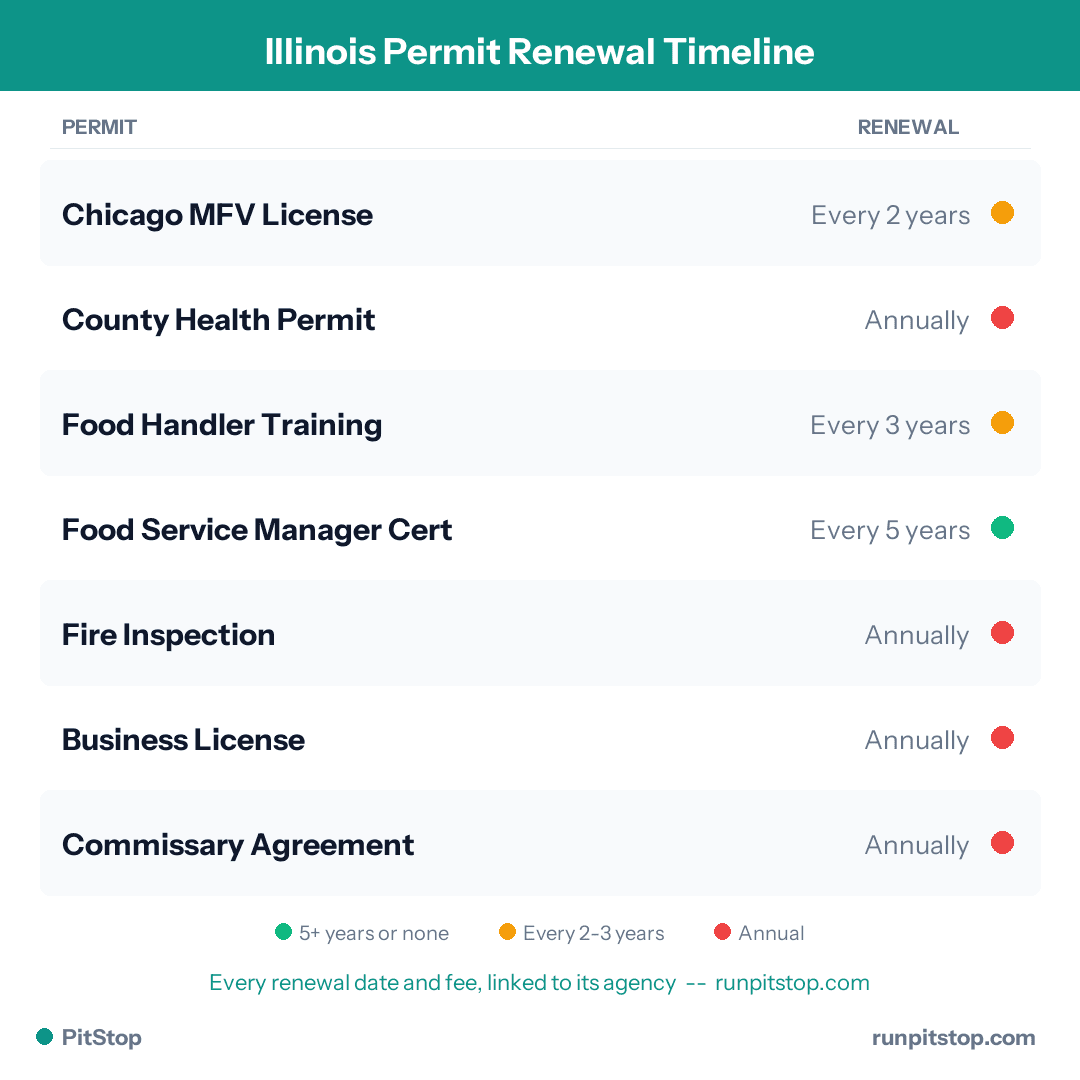
| Permit | Typical Renewal |
|---|---|
| Chicago MFV License | Every 2 years |
| County Health Permit | Annually |
| Food Handler Training | Every 3 years |
| Food Service Manager Cert | Every 5 years |
| Fire Inspection | Annually |
| Sales Tax Registration | No renewal (ongoing, file returns per schedule) |
| Business License (city) | Annually |
| Commissary Agreement | Annually (or per contract) |
Before you apply
Verify every fee in this guide with the issuing agency before you pay it; fee schedules change mid-year and the agency's own page is the only number that counts. Run your first few events through the per-event profit calculator, and start the paperwork 3–4 months before opening day: inspection slots, commissary letters and certifications take longer than the application itself.