TL;DR: Georgia Food Truck Permits in 2026
To operate a food truck in Georgia in 2026 you need: a Georgia DPH Mobile Food Service permit (via county health department), a county business license (in Atlanta, both Fulton County and City of Atlanta), a Georgia Tax Center sales tax registration (4% state + 4-5% local in Atlanta = 8.9%), an ANSI-accredited Certified Food Protection Manager, and a commissary agreement letter. Total first-year permit cost in metro Atlanta: $700-$1,500. Atlanta has a 150-foot brick-and-mortar restaurant distance rule. Atlanta is the deepest food truck commissary market in the southeast outside Houston.
Quick Facts (2026)
| Fact | Value |
|---|---|
| Governing state agency | Georgia Department of Public Health (DPH) |
| Atlanta restaurant distance rule | 150 ft from brick-and-mortar |
| Combined Atlanta sales tax | 8.9% |
| Commissary rent | Set by the kitchen; see the Georgia commissary guide and get two quotes |
| Application timeline | 6-8 weeks |
| Fulton/DeKalb permit overlap | Need both county + city if in Atlanta |
Peach State, Real Permits
Georgia's food truck industry has exploded in the last five years - especially in Atlanta, Savannah, and the fast-growing suburbs north of the city. Georgia's regulatory framework is relatively straightforward compared to states like California or New York, but there are a few quirks you need to know.
The key thing to understand: Georgia's Department of Public Health (DPH) sets the statewide rules, but your county health department is the one issuing your permit and conducting inspections. And cities often layer on their own business license and zoning requirements.
Your next steps
Most operators sort these out before their first event.
Get food truck insurance
General liability is what most events require. Get a quote in a few minutes.
Get a quoteFinance your truck or equipment
Compare equipment and working-capital options, with a soft check to start.
See financing optionsAffiliate partners: PitStop may earn a commission at no extra cost to you. How this works.
Always verify fees and requirements directly with your local health department and city government. This guide is a starting point, not legal advice.
State-Level Requirements
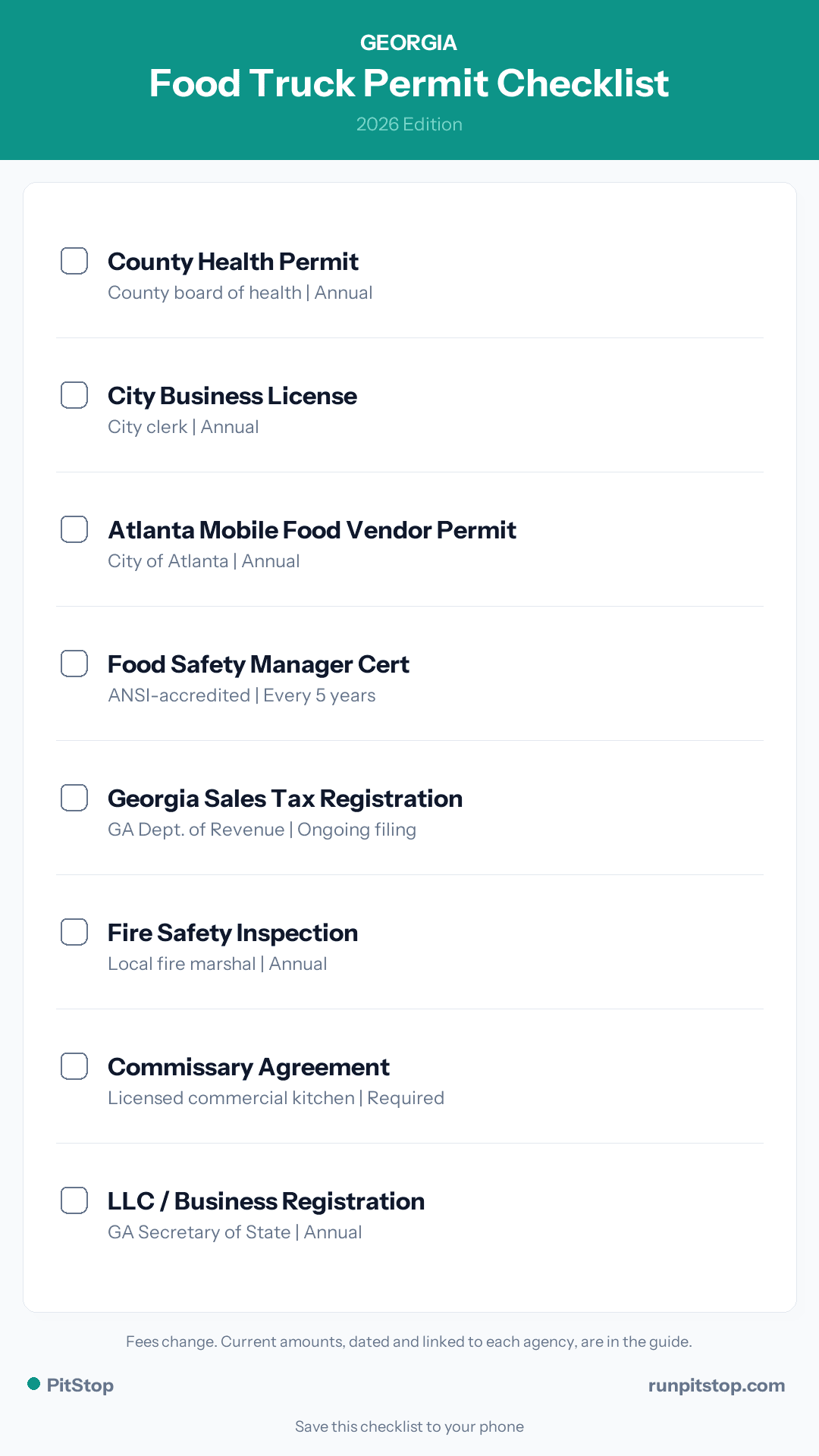
1. Georgia Business Registration
Get your business entity in order first:
- LLC: File Articles of Organization with the Georgia Secretary of State - $100 online or $110 by mail (Georgia.gov - Register an LLC, checked September 11, 2026); the $60 annual registration is due January 1 to April 1 each year, with a $25 penalty if late (Georgia SOS - annual registration, checked September 11, 2026)
- Sole Proprietorship / DBA: Register your trade name with the county Superior Court Clerk - the fee is set by each county (Fulton's clerk page could not be fetched on September 11, 2026), so verify with your clerk
- Federal EIN: Free from the IRS
- Which one? Food truck LLC vs sole proprietorship covers liability, taxes, and when a sole prop is genuinely enough
2. Georgia Department of Public Health (DPH) - Food Service Rules
The Georgia Department of Public Health (DPH) administers statewide food safety regulations through its Food Service Rules and Regulations (Chapter 511-6-1). Mobile food service units fall under these rules.
Key requirements set by DPH:
- Mobile food service units must meet all equipment, sanitation, water supply, waste water, handwashing, and temperature control requirements in the DPH food service rules
- Your county health department (operating under DPH authority) conducts inspections and issues your food service permit
- Permit fees vary by county - typically $200–$600 annually for a mobile food service unit
3. County Health Permit (Food Service Permit)
This is your primary food-related permit. Apply through your county environmental health department (part of the county board of health, operating under DPH):
- Plan review: Submit your truck layout, equipment list, menu, water supply system, and waste water plan
- Health inspection: Your truck must pass inspection before permit issuance
- Annual renewal: With re-inspection
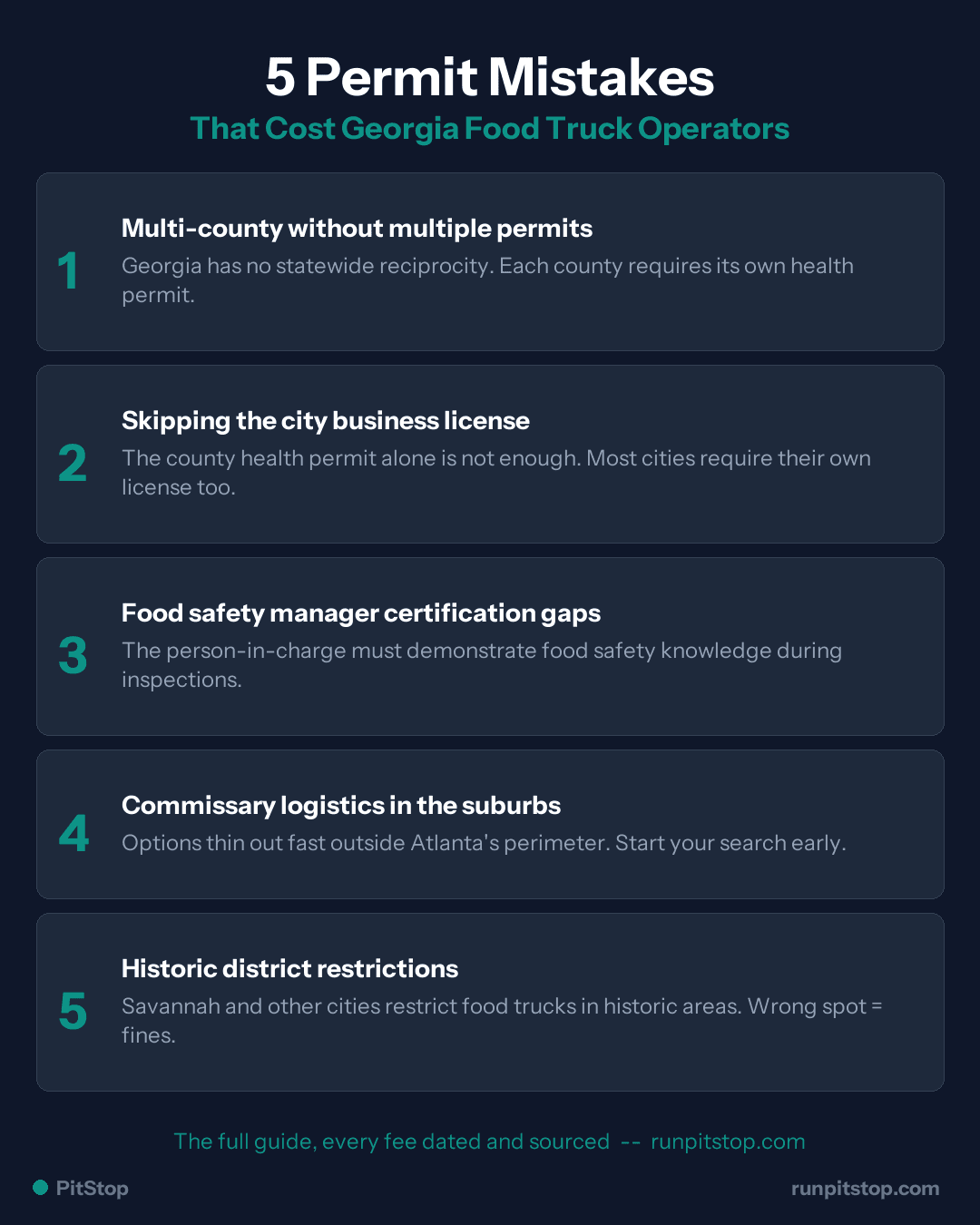
- Separate permit per county: If you operate in multiple counties, you need a permit from each one. Georgia does not have statewide reciprocity for mobile food service permits
4. Food Handler Certifications
Georgia does not have a statewide mandatory food handler card requirement for all employees (unlike some states). However:
- The person-in-charge (PIC) of a food service operation must demonstrate food safety knowledge - this can be through a Certified Food Safety Manager certification or by answering the health inspector's questions during inspection
- Many counties and cities strongly recommend or require that at least one person per shift hold a food safety manager certification
- Best practice: Get a Certified Food Protection Manager certification (ServSafe or equivalent ANSI-CFP accredited exam)
Certified Food Safety Manager:
- Exams: ServSafe, NRFSP, Prometric, or equivalent
- Cost: $80–$180
- Renewal: Every 5 years
Basic food handler training (voluntary but recommended):
- Cost: $10–$15 per person online
- Available from various ANSI-accredited providers
5. Georgia Sales Tax
Register for a Sales and Use Tax Number with the Georgia Department of Revenue.
- State sales tax: 4%
- County/city tax: Additional 2%–4% depending on jurisdiction (total typically 6%–8%)
- Prepared food: Taxable in Georgia
- Registration: Free
- Filing: Monthly, quarterly, or annually depending on volume
6. Georgia Department of Agriculture
If you sell certain items (pre-packaged foods, acidified foods, bottled beverages), you may need a separate license from the Georgia Department of Agriculture (GDA). Most traditional food trucks preparing and serving food on-site are covered by DPH, not GDA - but verify if your menu includes any pre-packaged products.
City-Specific Requirements
Atlanta
Atlanta is the state's biggest food truck market and has a dedicated permitting process:
- City of Atlanta Business License: Required from the Atlanta Department of Finance, Office of Revenue. Apply through the city's online portal
- Annual business license fee: Based on gross revenue - verify current fee schedule with the city
- Mobile Food Vendor Permit: Atlanta requires a specific mobile food vendor permit in addition to your Fulton County health permit
- Fulton County Health Permit: Apply through the Fulton County Board of Health for your food service permit - plan review, inspection, and annual renewal
- Zoning: Atlanta has designated areas where food trucks can operate. Check with the City of Atlanta Department of City Planning for current zoning maps
- Commissary: Required - must be a licensed food service establishment in the Atlanta metro area
- Fire inspection: Required for trucks with cooking equipment - contact the Atlanta Fire Rescue Department
- Special events: Separate temporary event permits may be required for festivals and events - apply through the city or event organizer
Savannah
Savannah's historic downtown is a popular food truck destination:
- City of Savannah Business License: Required from the City of Savannah Revenue Department
- Chatham County Health Permit: Apply through the Chatham County Board of Health - plan review and inspection required
- Operating restrictions: Savannah has specific rules about operating in the Historic District - verify current permitted zones and time restrictions with the city
- Special event permits: Required for operating at events on city property
- Commissary: Required by Chatham County
Augusta
- City of Augusta Business License: Required from the Augusta-Richmond County Planning and Development Department
- Richmond County Health Permit: Apply through the East Central Health District (Richmond County)
- Growing food truck scene around downtown Augusta and the Augusta National area during Masters week
Marietta / Cobb County
- City of Marietta Business License required
- Cobb & Douglas Public Health issues mobile food service permits
- One of the fastest-growing food truck markets in the Atlanta suburbs
- Marietta Square is a popular vending location - check city rules for specific requirements
Athens (Clarke County)
- Athens-Clarke County Unified Government issues business licenses
- Northeast Health District (Clarke County) handles food service permits
- University of Georgia campus drives strong demand during the academic year
- Verify rules about operating near campus
Commissary Requirements
Georgia counties generally require food trucks to operate from a licensed commissary kitchen:
- Your commissary must hold its own valid food service permit
- You must have a signed commissary agreement specifying:
- Food storage
- Equipment and vehicle cleaning
- Waste water disposal
- Overnight food storage
- The commissary agreement is required as part of your health permit application
- Costs: $300–$800/month in Atlanta metro; $150–$400/month in smaller cities
Some shared commercial kitchen spaces have emerged in Atlanta specifically for food truck operators - these can be more affordable than a standalone commissary arrangement.
Fire Safety Requirements
General Requirements
If your truck has cooking equipment (grills, fryers, ovens, griddles):
- Fire suppression system: Commercial hood and Ansul system (or equivalent UL 300-listed system) required for grease-producing equipment
- Fire extinguisher: Class K for kitchen/grease fires; Class ABC for general fires
- Fire inspection: Conducted by your local fire marshal before initial permit and annually thereafter
- Propane: Tanks must be properly secured in a ventilated compartment with accessible shut-off valves; comply with NFPA 58
Atlanta-Specific
- Atlanta Fire Rescue Department conducts fire inspections for food trucks operating within city limits
- Must pass fire inspection before your mobile food vendor permit is issued
- Annual re-inspection required
Cost Estimates
- Fire suppression system installation: $3,000–$6,000+ depending on your truck setup and equipment
- Fire extinguishers: $50–$150 each
- Annual fire suppression maintenance: $200–$500
- Fire inspection fees: Vary by jurisdiction - typically $50–$200
Common Pitfalls for Georgia Operators
Renewal Timeline at a Glance
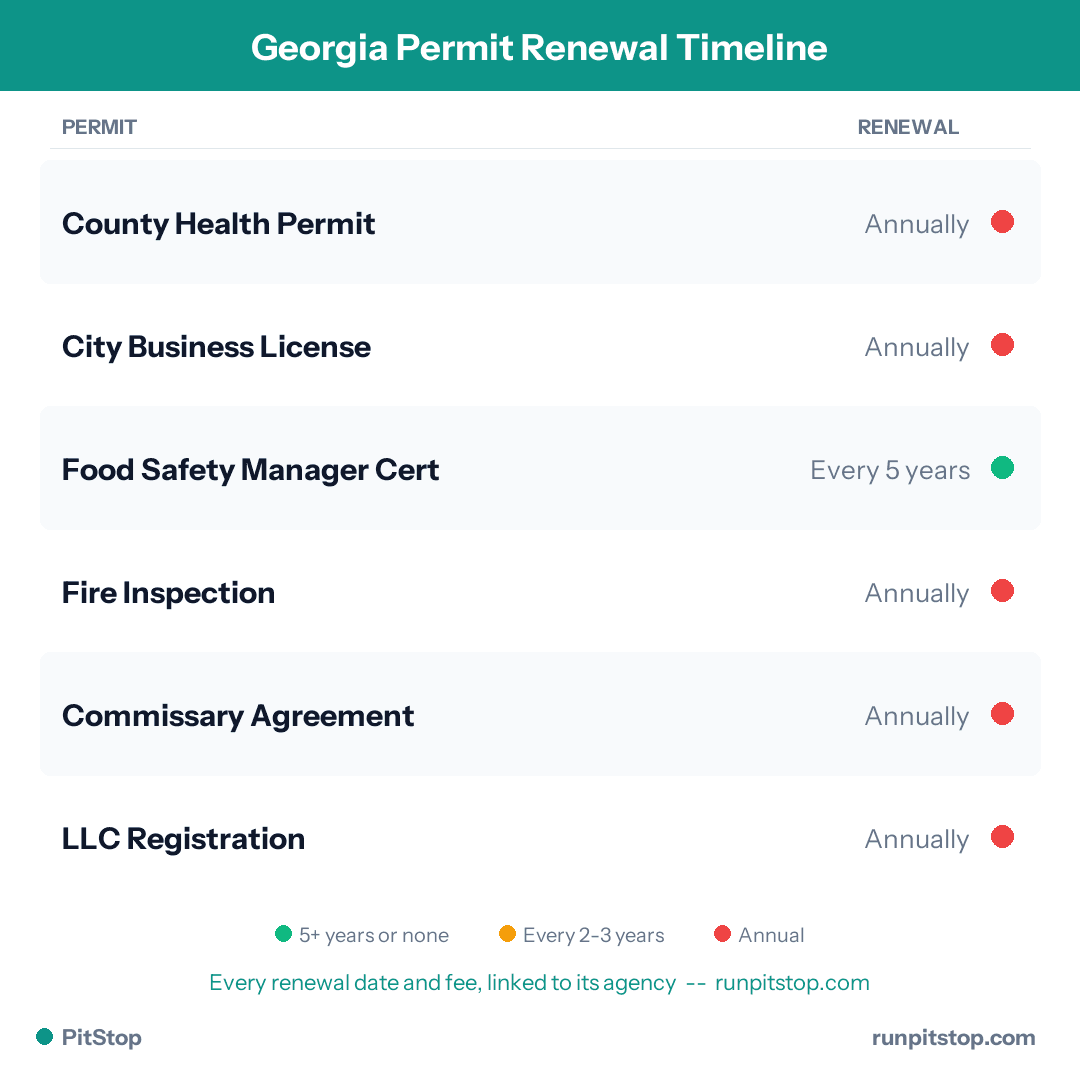
| Permit | Typical Renewal |
|---|---|
| County Health Permit | Annually |
| City Business License | Annually |
| Food Safety Manager Cert | Every 5 years |
| Fire Inspection | Annually |
| Sales Tax Registration | No renewal (ongoing, file returns per schedule) |
| Commissary Agreement | Annually (or per contract) |
| LLC / Business Registration | Annually (Georgia annual registration with Secretary of State) |
Before you apply
Verify every fee in this guide with the issuing agency before you pay it; fee schedules change mid-year and the agency's own page is the only number that counts. Run your first few events through the per-event profit calculator, and start the paperwork 3–4 months before opening day: inspection slots, commissary letters and certifications take longer than the application itself.