TL;DR: Florida Food Truck Permits in 2026
Florida is the simplest big state to license a food truck in, and most guides get it backwards. Since July 1, 2020, one state license - the DBPR Mobile Food Dispensing Vehicle (MFDV) license - is the only license, permit, or registration any government in Florida can require to operate a food truck. It costs $50 to apply plus $347 a year ($178.50 for a half-year license), plan review is free, and DBPR asks for about 21 days of lead time. Counties and cities still decide where and when you can operate (zoning, hours, parking, property permission, fire safety, event permits), and some still ask for a business tax receipt. A commissary is required only if your truck is not self-sufficient.
One License, Statewide: F.S. 509.102
In 2020 the Legislature passed HB 1193, now F.S. 509.102, which preempts the regulation of mobile food dispensing vehicles "involving licenses, registrations, permits, and fees" to the state. In plain terms:
- The DBPR MFDV license under s. 509.241 is the only license you need to operate.
- A county or city cannot require a second license, registration, or permit, or charge a second license fee, as a condition of operating.
- A county or city cannot ban food trucks from its entire jurisdiction.
- A county or city can still regulate the operation itself: zoning and land use, hours, parking, proximity rules, property-owner permission, fire safety, and noise.
- The preemption does not apply to airports, seaports, or port authorities (MCO, Orlando Sanford, and Port Canaveral run their own rules).
So the real work in Florida is zoning and property, not collecting a stack of permits. Source: F.S. 509.102.
Your next steps
Most operators sort these out before their first event.
Finance your truck or equipment
Compare equipment and working-capital options, with a soft check to start.
See financing optionsAffiliate partners: PitStop may earn a commission at no extra cost to you. How this works.
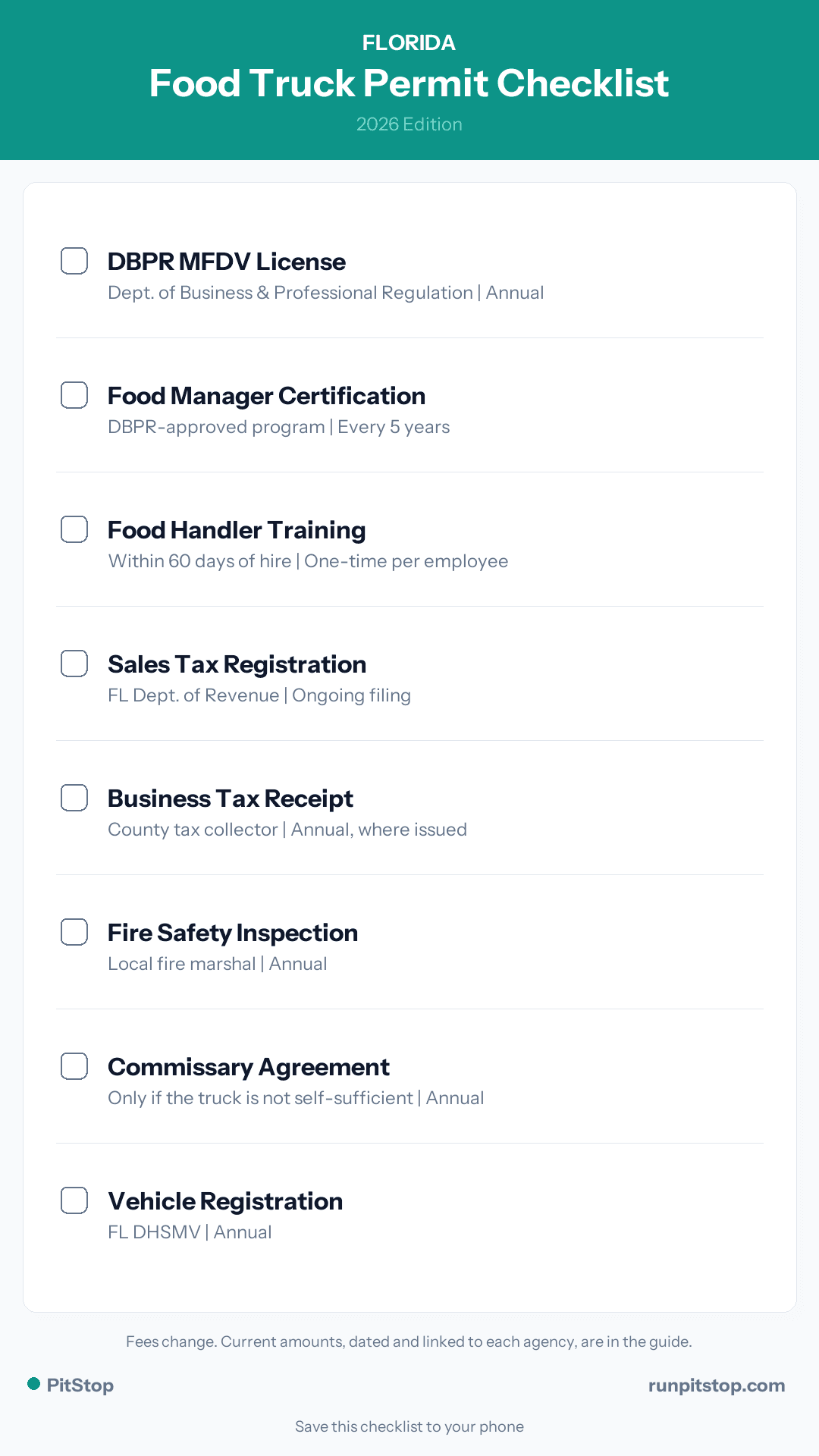
Steps: State-Level Requirements
1. DBPR Mobile Food Dispensing Vehicle License
Florida's Department of Business and Professional Regulation (DBPR) Division of Hotels and Restaurants licenses all mobile food dispensing vehicles.
- Where to apply: DBPR online portal
- License type: Mobile Food Dispensing Vehicle (MFDV). Hot dog carts serving frankfurters and prepackaged food only fall under the HTDG category; temporary commercial kitchens are TECK.
- Application fee: $50 (new license or change of ownership)
- License fee: $347 (full year) or $178.50 (half-year)
- Plan review: No charge. Required for new builds, major remodels, or units closed 18+ months (DBPR form HR-7031)
- Timeline: Apply at least 21 days before your planned opening date
- Renewal: Annual, with inspection
- What DBPR checks: VIN or portable structure documentation, a side photo showing the wheels, protection from the elements, handwashing and dishwashing facilities, temperature control, a portable power source, plumbing, and either commercial water and sewer access or a commissary connection
Fees verified against the DBPR food service fee schedule. Note: if you sell only raw or prepackaged foods, you may need a permit from the Florida Department of Agriculture and Consumer Services (FDACS) instead of or in addition to DBPR.
2. Food Manager Certification
Florida requires at least one certified food manager responsible for each mobile food dispensing vehicle. This person must complete an approved food safety training program and pass a certification exam.
- Approved exams: ServSafe, Prometric, or other DBPR-approved providers
- Renewal: Every 5 years
- Who needs it: At least one person per truck who is designated as the certified food manager
3. Food Employee Training
All food service employees must complete basic food handler training within 60 days of employment.
- Cost: Set by the DBPR-approved provider; a small online fee
- Approved providers: Listed on the DBPR website
4. Sales Tax Registration
Register with the Florida Department of Revenue for a sales tax certificate (no cost). Florida's state sales tax is 6%, plus county discretionary surtax (varies).
5. EIN and Business Registration
- Federal EIN from the IRS (free)
- Register your business with SunBiz (Florida Division of Corporations) if operating as an LLC or corporation. A Florida LLC costs $125 to file ($100 filing fee plus the $25 registered agent designation) and $138.75 a year for the annual report; a sole proprietor trading under a truck name registers a fictitious name with Sunbiz for $50 instead. All three figures are from the Sunbiz fee schedule, checked September 11, 2026
- Not sure which form to pick? Food truck LLC vs sole proprietorship walks through liability, taxes, and why the DBPR license and your insurance should carry the same legal name
Form your LLC
Set up the LLC most operators file for liability protection. A few minutes; the provider shows the cost plus state fees.
Start your LLCAffiliate partner. PitStop may earn a commission at no extra cost to you. How this works
6. Insurance
- Insurance required: general liability (organizers and commissaries typically ask for $1M/$2M and a certificate of insurance, or COI). DBPR itself does not ask for a policy - see the Insurance and COI section below for what the application actually checks
Get food truck insurance
General liability is what most events require. Get a quote in a few minutes.
Get a quoteAffiliate partner. PitStop may earn a commission at no extra cost to you. How this works
- Commercial auto coverage for the truck itself, and workers' compensation once you have employees
- Most event organizers will not book you without a COI naming them as additional insured, so get this in place before you chase gigs
Insurance and COI: what the application actually asks for
- Statutory minimum for the license: none. The DBPR MFDV application, checked September 11, 2026 against the DBPR MFDV guide, asks for the online application, the license fees, the commissary form (HR 7022) when one applies, and plan-review materials for new builds (a labeled vehicle plan, a sample menu, a side photo showing the wheels and service window, and water/sewer or commissary documentation). It does not ask for a liability policy or a certificate of insurance, and F.S. 509.102 sets no insurance requirement. The limits come from the people you sell through - event organizers, commissaries, food truck parks, breweries, and private landlords - and they write them into the vendor agreement. $1 million per occurrence / $2 million aggregate general liability is the figure most Florida organizers ask for; a few ask for more.
- The truck itself is a motor vehicle, and that part is required by law. Florida's financial-responsibility statute applies the moment the truck is on the road: F.S. 324.022 requires at least $10,000 of property damage liability per crash (checked September 11, 2026), plus personal injury protection under the no-fault law. A personal auto policy excludes commercial use, so this means a commercial auto policy in the business's name.
- What a COI is and how fast you can get one. A certificate of insurance is a one-page summary your agent issues from a bound policy, naming the organizer or commissary as certificate holder and, when the contract asks, as additional insured. Once the policy is in force, agents typically turn a COI around within a business day or two. Binding the policy is the slow part - underwriting a truck with fryers can take a week or more - so quote insurance before you book gigs, not the week of your first festival.
- What drives the premium: whether you fry or cook over open flame, the truck's value and age, miles driven and driver records, employee headcount (workers' compensation), the limits your organizers demand, and prior claims. Quote in the entity's legal name so the COI matches the name on your DBPR license and event contracts.
Commissary: Only If Your Truck Is Not Self-Sufficient
Do not assume Florida requires a commissary. Fla. Admin. Code 61C-4.0161 requires one only for MFDVs that are not self-sufficient. DBPR's own guidance says a self-sufficient MFDV is not required to have a commissary, though it may choose one to add prep, storage, or warewashing capacity.
Your truck counts as self-sufficient (61C-1.001) when it carries:
- A three-compartment sink and a separate handwash sink
- Adequate refrigeration and storage capacity
- Its own power utilities
- A potable water holding tank
- A liquid waste disposal system
If your build falls short on any of those, you need a commissary agreement with a licensed kitchen, and DBPR will want it referenced at plan review. Commissary rent varies widely by kitchen; Food Truck Commissary Requirements in Florida covers ranges and how to compare.
What Counties and Cities Still Control
The preemption removed local licensing, not local rules. Expect to deal with:
- Zoning and land use: which districts allow mobile vending, minimum lot sizes, one-truck-per-site rules, proximity to schools or restaurants
- Property-owner permission: most counties want written (sometimes notarized) consent for private property, and a separate encroachment or right-of-way permit for public streets
- Hours and noise: county and city ordinances set closing times
- Fire safety: the local fire marshal inspects cooking equipment, hoods, suppression, and propane
- Temporary event permits: festivals, markets, and street closures still run through the city or county events office
- Business tax receipt (BTR): issued under Chapter 205, F.S. Some counties and cities still require one from food trucks; others are silent or offer an exemption affidavit. Whether a BTR can be required as a condition of operating after 509.102 is unsettled - no appellate decision or Attorney General opinion has resolved it - so ask your county tax collector what they do in practice and keep the receipt if they issue one
County-by-County: What Operators Actually Run Into
Miami / Miami-Dade County
- No county food truck license or license fee - preempted by F.S. 509.102
- Zoning is the constraint: Miami-Dade's mobile vending rules have historically limited trucks to one per site on larger lots, restricted alcohol sales, and limited promotional signage. Rules differ between the City of Miami, Miami Beach, and unincorporated Miami-Dade, so confirm the site's zoning with the municipality before you sign a lease
- Business tax receipt from the city where you primarily operate (see the BTR note above)
- Fire inspection for cooking equipment
- See Food Truck Permits in Miami
Orlando / Orange County
- No county health permit for food trucks; the DBPR license covers it
- Orange County business tax receipt (Orange County Tax Collector), valid through September 30 each year; eleven municipalities including Orlando, Winter Park, and Apopka require their own city receipt first. The county's business tax page does not mention food trucks, and an exemption affidavit process exists
- Fire inspection from Orange County Fire Rescue or Orlando Fire Department depending on location
- Osceola County (Kissimmee, US-192) handles trucks through zoning: a mobile food sales permit on private property ($135 application fee per the county's Mobile Food Sales Application, revised February 2026, checked September 14, 2026), a notarized property-owner letter, a copy of your business tax receipt, and set closing hours (10 p.m. Sunday-Thursday, midnight Friday-Saturday)
- See Food Truck Permits in Orlando
Tampa / Hillsborough County
- No county mobile food unit permit; the DBPR license covers it
- Hillsborough's Land Development Code allows mobile vendors in commercial and light-industrial zones (CG, CI, ML); residential is off limits except under a special event permit
- Written consent from the property owner for private property; a county encroachment permit for public right-of-way
- City of Tampa business tax receipt; fire inspection from Tampa Fire Rescue
- See Food Truck Permits in Tampa
Jacksonville / Duval County
- No county health permit for food trucks
- City of Jacksonville business tax receipt
- Zoning restrictions apply - check with the city planning office before committing to a site
- Fire inspection for cooking equipment
Fire Safety Requirements
If your truck has cooking equipment (grills, fryers, ovens), you'll generally need:
- Commercial kitchen fire suppression system (hood and Ansul system for grease-producing equipment)
- Class K fire extinguisher
- Fire safety inspection from the local fire marshal
- Proper ventilation
- Propane system inspection (if applicable)
Contact your local fire marshal's office for specific requirements - these vary by jurisdiction.
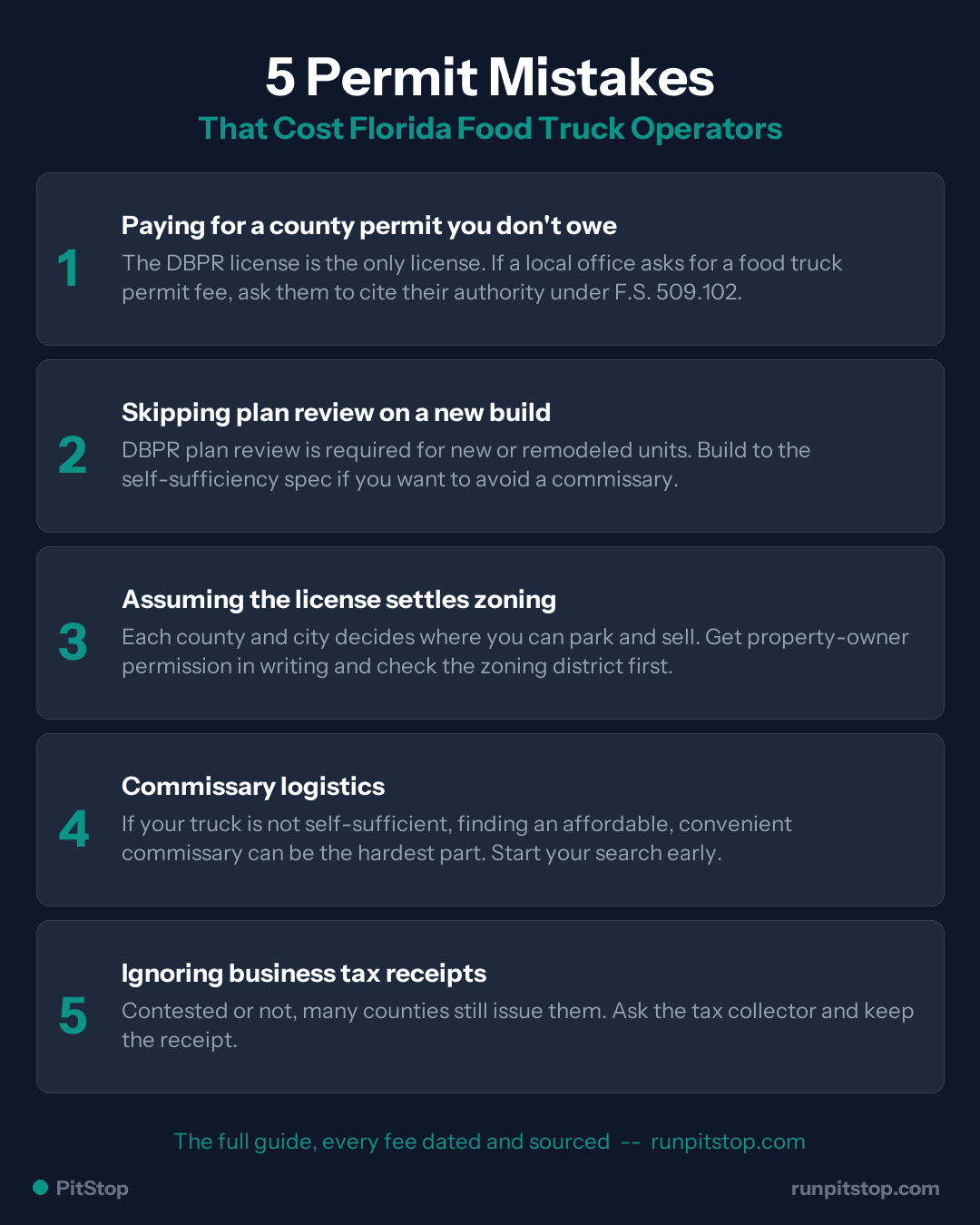
Common Pitfalls for Florida Operators
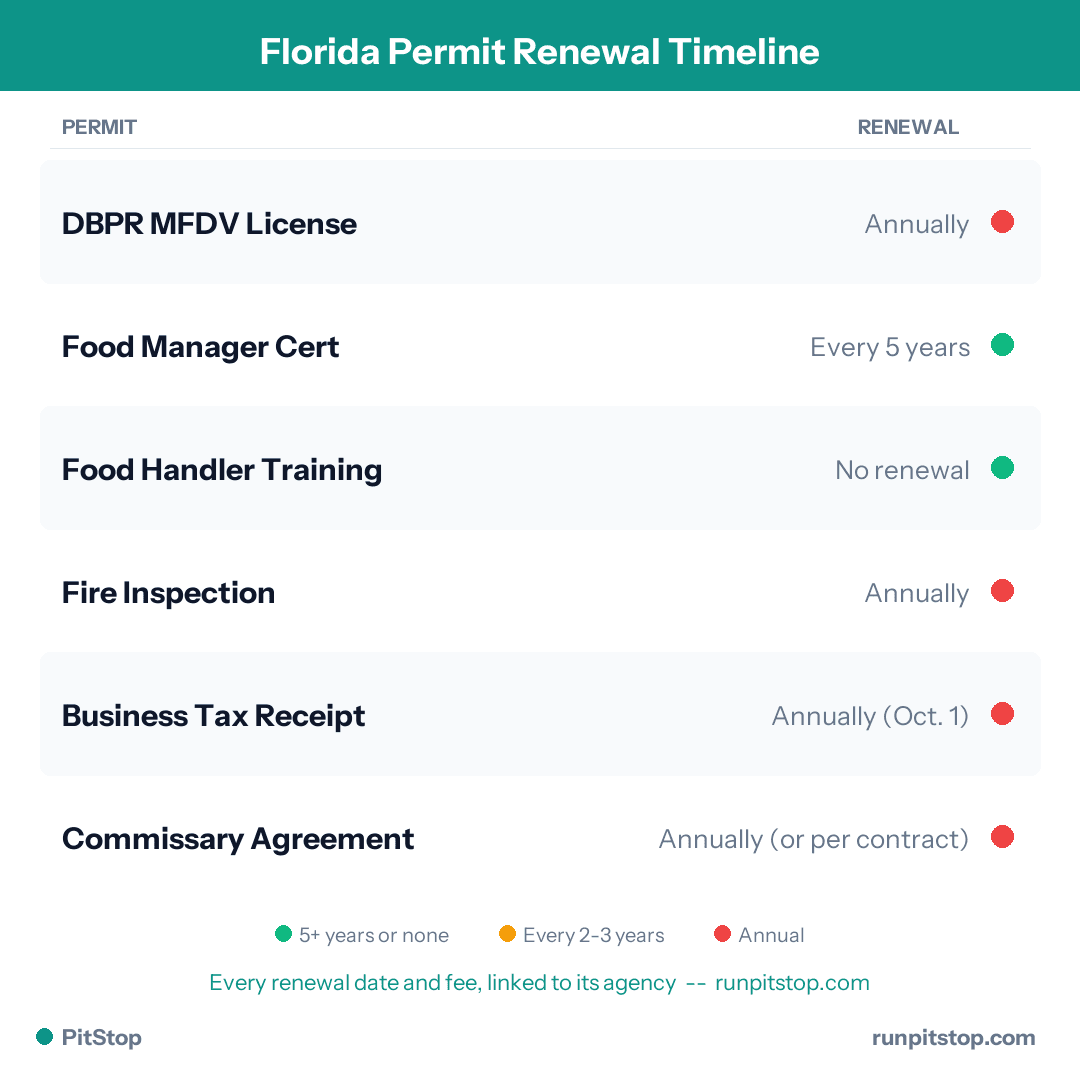
Renewal Timeline at a Glance
| Permit | Typical Renewal |
|---|---|
| DBPR MFDV License | Annually |
| Food Manager Cert | Every 5 years |
| Food Handler Training | No renewal (one-time per employee, but verify with your provider) |
| Fire Inspection | Annually |
| Business Tax Receipt (where issued) | Annually (October 1) |
| Commissary Agreement (if not self-sufficient) | Annually (or per contract) |
Before you apply
Verify every fee in this guide with the issuing agency before you pay it; fee schedules change mid-year and the agency's own page is the only number that counts. Run your first few events through the per-event profit calculator, and start the paperwork 3–4 months before opening day: inspection slots, commissary letters and certifications take longer than the application itself.