TL;DR: California Food Truck Permits in 2026
To operate a food truck in California in 2026 you need: a CDTFA seller's permit (free), an HCD Insignia vehicle inspection (required before MFF permit), a county Mobile Food Facility (MFF) permit ($500-$1,200+/year, separate permit per county you operate in regularly), a California Food Handler Card per employee ($10-$15, valid 3 years), and a commissary agreement under CalCode's daily-return rule. Total first-year permit cost typically lands $1,200-$3,500 in major metros. New-build truck timeline from plan review to first service: 3-6 months.
Quick Facts (2026)
| Fact | Value |
|---|---|
| Governing state code | California Retail Food Code (CalCode) |
| Daily-return commissary rule | Required for nearly all MFFs |
| Permit reciprocity across counties | None: separate permit per county |
| Commissary rent | Set by the kitchen; see the California commissary guide and get two quotes |
| Application timeline | 3-6 months for new builds |
| CA-specific gotcha | HCD Insignia required before MFF permit |
The Golden State of Food Trucks (and Paperwork)
California has one of the largest food truck industries in the country - and one of the most complex permitting environments. Requirements vary significantly between counties, and cities often layer on additional rules.
Your next steps
Most operators sort these out before their first event.
Get food truck insurance
General liability is what most events require. Get a quote in a few minutes.
Get a quoteFinance your truck or equipment
Compare equipment and working-capital options, with a soft check to start.
See financing optionsAffiliate partners: PitStop may earn a commission at no extra cost to you. How this works.
This guide is a starting point. California's regulations are among the most detailed in the country, so we strongly recommend verifying everything with your county environmental health department before investing in equipment.
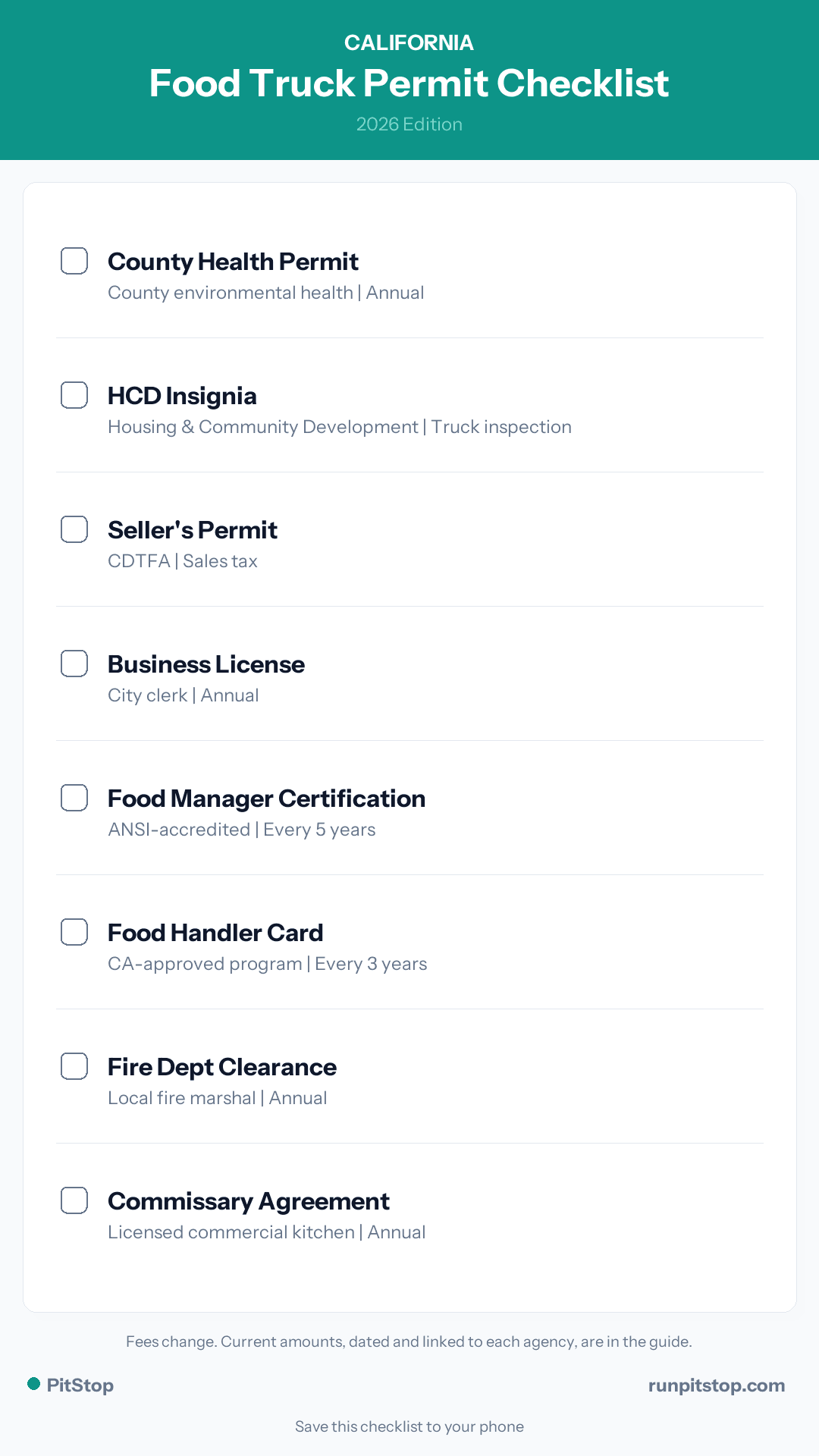
State-Level Requirements
1. California Retail Food Code (CalCode)
All mobile food facilities in California must comply with the California Retail Food Code (CalCode, Health & Safety Code sections 113700-114437). This is the statewide standard that county health departments enforce.
Mobile food facilities are categorized as:
- Type 1 (MFF): Pre-packaged, non-potentially hazardous food only (lowest complexity)
- Type 2 (MFF): Limited food prep, may include hot dogs, tamales, etc.
- Type 3 (MFF): Full cooking, most traditional food trucks fall here
The type determines your equipment requirements and inspection standards.
2. Health Permit (County-Issued)
Your county environmental health department issues the health permit for your mobile food facility. This involves:
- Submitting a plan review (truck layout, equipment, menu)
- Passing a health inspection
- Annual renewal with re-inspection
- Separate permit required for EACH county you operate in - there is no statewide reciprocity
Cost range: $500–$1,200+ annually, varies significantly by county. Verify with your county environmental health department.
3. HCD Insignia (California-Specific)
California requires an HCD Insignia from the Department of Housing and Community Development for any food truck the operator occupies. This inspection checks structural integrity, fire suppression, and emergency exits. This is a step many out-of-state operators miss - you need it before applying for your MFF permit. Allow 3–6 months for new builds from plan review through permit issuance.
4. California Seller's Permit
Required from the California Department of Tax & Fee Administration (CDTFA) to collect and remit sales tax. This is free to obtain.
Where to apply: CDTFA website
5. Food Handler Card (California Food Handler Certificate)
California requires all food handlers to obtain a California Food Handler Card from an ANSI-accredited program.
- Cost: Typically $10–$15 online
- Timeline: Must be obtained within 30 days of starting work
- Renewal: Every 3 years in California
6. Certified Food Protection Manager
California does not mandate a food protection manager certification at the state level for all mobile food facilities, but many counties require one. Check with your county environmental health department.
7. Business Entity and EIN
The county MFF permit, the CDTFA seller's permit, and your insurance are issued in a legal name, so decide on the entity before you apply. Food truck LLC vs sole proprietorship has the California Secretary of State filing fee, the annual LLC tax, the county DBA cost, and when a sole prop is enough. Get a free EIN from the IRS either way.
Commissary Requirement
California has a statewide commissary requirement for most mobile food facilities. Your truck must be associated with a permitted commissary (licensed commercial kitchen) where you:
- Return daily for cleaning and restocking
- Store food and supplies
- Dispose of waste water and garbage
- Prepare any food not prepped on the truck
You'll need to provide a signed commissary agreement as part of your permit application.
County & City-Specific Requirements
Los Angeles County
LA County has some of the most detailed food truck regulations in the state:
- Health permit from LA County Department of Public Health
- Plan check and inspection required
- Commissary agreement required
- Letter-grading system (A, B, C) - just like restaurants
- Specific parking restrictions and time limits in many areas
- Verify current requirements with the county
City of Los Angeles
On top of the county permit, operating within the City of LA may require:
- Business tax registration certificate
- Specific rules about vending near schools, parks, and residences (check with the LA Department of Public Health)
- Sidewalk vending permit if applicable
San Francisco
- Health permit from SF Department of Public Health
- Mobile Food Facility Permit - verify current application process with the city
- Fire Department inspection for cooking operations
- Specific zones and time restrictions - San Francisco has limited spots and the permitting process can be competitive
San Diego County
- Health permit from San Diego County Department of Environmental Health
- Plan review and inspection
- Commissary agreement required
- Fire inspection if cooking with oil/grease
Other Notable Counties
Most California counties (Sacramento, Orange, Alameda, etc.) follow similar patterns: county health permit + commissary + fire inspection. Always check with your specific county.
Fire Safety
For trucks with cooking equipment:
- Fire suppression system (Ansul or equivalent) for grease-producing equipment
- Class K fire extinguisher
- Fire inspection from local fire authority
- Proper ventilation system
- Propane system inspection and certification
California's AB 626 - Microenterprise Home Kitchen Operations
Worth noting: California's AB 626 created a pathway for home kitchen food operations, but this is separate from food truck permitting. If you're starting from your home kitchen, this may be relevant, but it doesn't apply to mobile food facilities.
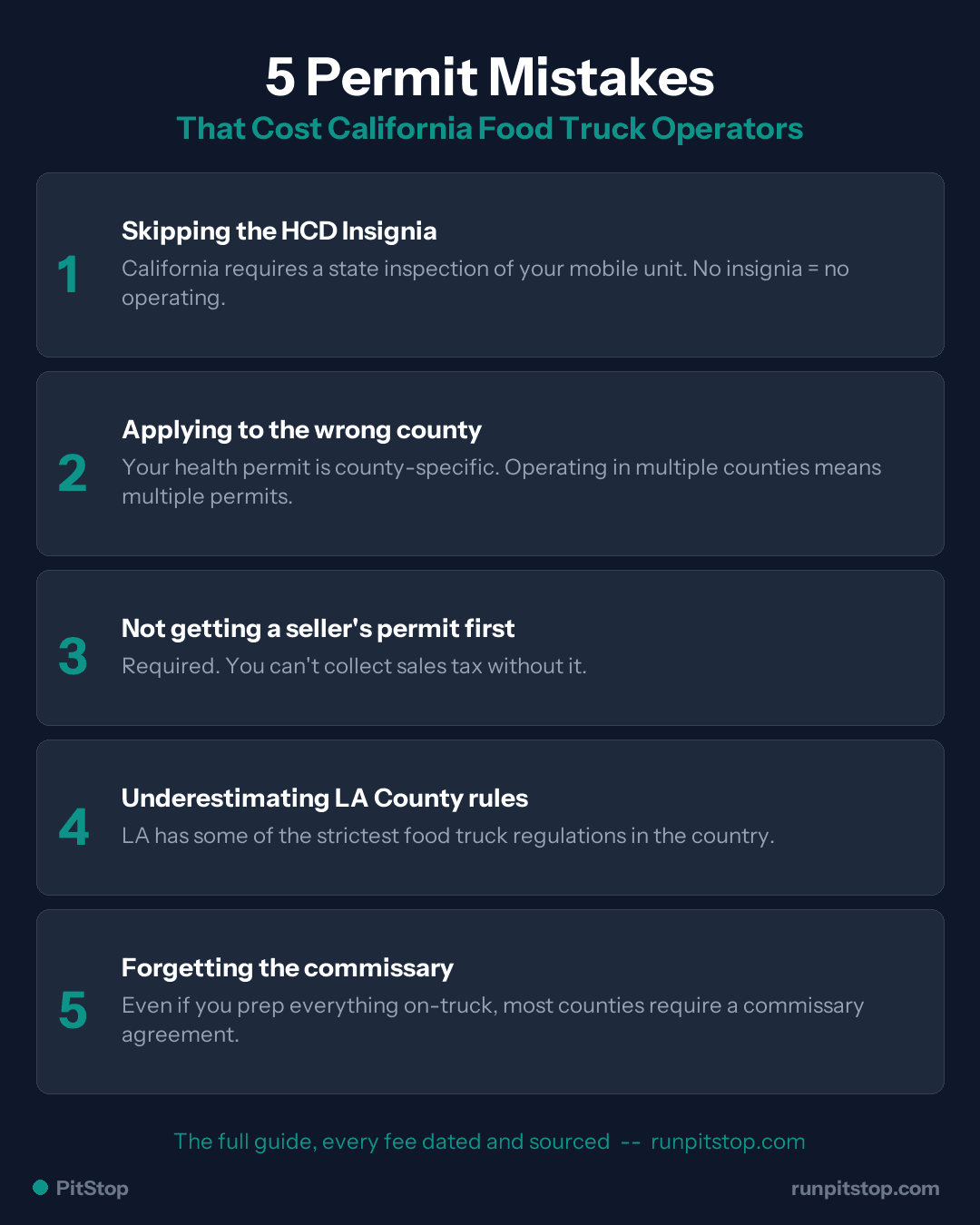
Common Pitfalls for California Operators
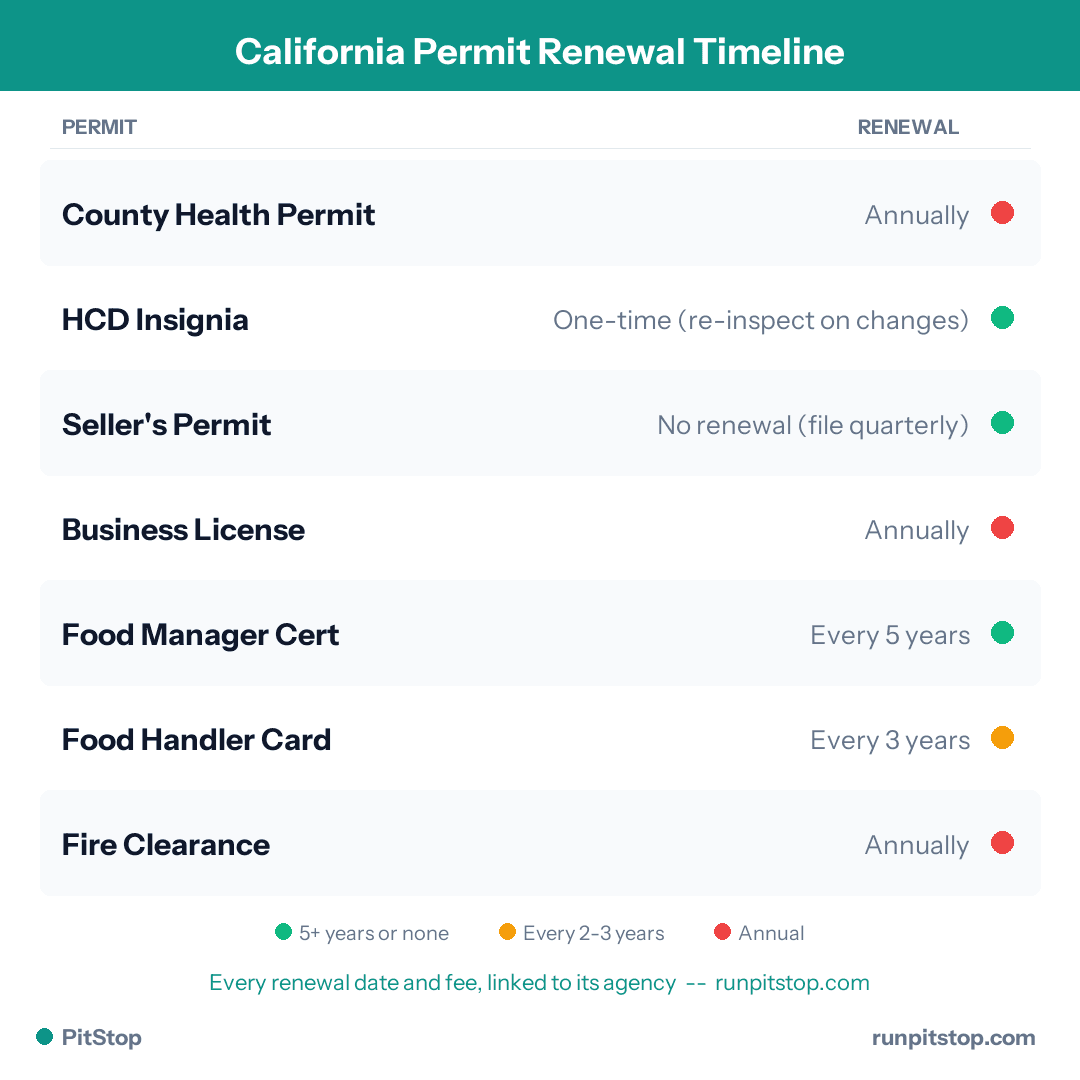
Renewal Timeline at a Glance
| Permit | Typical Renewal |
|---|---|
| County Health Permit | Annually |
| Seller's Permit | No renewal (ongoing, file returns as required) |
| Food Handler Card | Every 3 years |
| Fire Inspection | Annually |
| Business License | Annually (varies by city) |
| Commissary Agreement | Annually (or per contract) |
Before you apply
Verify every fee in this guide with the issuing agency before you pay it; fee schedules change mid-year and the agency's own page is the only number that counts. Run your first few events through the per-event profit calculator, and start the paperwork 3–4 months before opening day: inspection slots, commissary letters and certifications take longer than the application itself.