The Full Equipment List
Outfitting a food truck is one of the biggest expenses after the vehicle itself. The difference between spending $8,000 and $30,000 on equipment comes down to your menu, whether you buy new or used, and how much you really need on day one.
This is the complete list, organized by category, with realistic cost ranges.
Cooking Equipment
Swipe sideways for all columns
| Equipment | New Price | Used Price | Notes |
|---|---|---|---|
| Commercial flat griddle (36") | $1,200 - $2,500 | $600 - $1,200 | Essential for burgers, tacos, breakfast |
| Commercial deep fryer (double) | $800 - $2,000 | $400 - $1,000 | Required for fried items |
| Commercial charbroiler (24"-36") | $1,000 - $2,200 | $500 - $1,100 | For grilled meats and vegetables |
| Convection oven (half-size) | $1,500 - $3,500 | $700 - $1,800 | Baking, roasting, versatile |
| Commercial microwave | $300 - $800 | $150 - $400 | Quick reheat, not primary cooking |
| Steam table (3-5 well) | $400 - $1,200 | $200 - $600 | Holding hot items during service |
| Rice cooker (commercial) | $150 - $400 | $75 - $200 | If rice is a menu staple |
| Panini press / sandwich grill | $200 - $600 | $100 - $300 | Sandwich-heavy menus |
Your next steps
Things most food truck operators end up needing.
Working capital for a truck that is already open
Fora Financial offers business loans and revenue advances to operating small businesses. Applying uses a soft credit check. The lender shows your amount and terms, and approval is not guaranteed.
Check your optionsGet food truck insurance
General liability is what most events require. Get a quote in a few minutes.
Get a quoteAffiliate partners: PitStop may earn a commission at no extra cost to you. How this works.
You do not need every piece of cooking equipment on this list. A taco truck needs a griddle and a steam table. A fried chicken truck needs fryers and a warming cabinet. Buy only what your menu requires.
Refrigeration and Storage
Swipe sideways for all columns
| Equipment | New Price | Used Price | Notes |
|---|---|---|---|
| Commercial refrigerator (1-door) | $1,200 - $2,500 | $500 - $1,200 | Primary cold storage |
| Commercial freezer (1-door) | $1,500 - $3,000 | $600 - $1,500 | If you carry frozen items |
| Prep table with refrigerated base | $1,800 - $3,500 | $800 - $1,800 | Dual purpose - prep surface + cold storage |
| Countertop merchandiser / display cooler | $400 - $1,000 | $200 - $500 | Drinks display |
| Insulated food carriers | $50 - $150 each | $25 - $75 | Transport and holding |
For most trucks, a single refrigerator and a refrigerated prep table cover your needs. Add a freezer only if your menu requires frozen storage on the truck.
Generator
The generator is the heart of your truck. Get this wrong and nothing works.
Swipe sideways for all columns
| Type | Size Range | Cost (New) | Cost (Used) | Fuel Cost/Day | Best For |
|---|---|---|---|---|---|
| Portable (inverter) | 3kW - 7kW | $1,500 - $4,000 | $800 - $2,500 | $10 - $25 | Coffee, simple menus, backup |
| Mounted (open frame) | 7kW - 12kW | $3,000 - $7,000 | $1,500 - $4,000 | $20 - $40 | Standard food truck operations |
| Mounted (diesel) | 10kW - 20kW | $5,000 - $12,000 | $2,500 - $7,000 | $25 - $50 | Heavy equipment, full kitchens |
| Built-in (PTO/hydraulic) | 12kW - 25kW | $8,000 - $15,000 | $4,000 - $9,000 | Shares truck fuel | High-end custom builds |
How to Size Your Generator
Add up the starting wattage of every piece of equipment that could run simultaneously. Common loads:
- Refrigerator: 800-1,200W running / 2,400W starting
- Freezer: 1,000-1,500W running / 3,000W starting
- Flat griddle (electric): 3,000-5,000W
- Deep fryer (electric): 3,500-5,000W
- Steam table: 1,000-1,500W
- Lights and POS: 200-500W
Rule of thumb: Take your total running watts, multiply by 1.5, and that is your minimum generator size. Most food trucks need 7kW-12kW. If you run gas cooking equipment instead of electric, you can get by with a smaller generator since it only powers refrigeration, lighting, and the POS.
Prep and Service Equipment
Swipe sideways for all columns
| Equipment | New Price | Used Price | Notes |
|---|---|---|---|
| Stainless steel prep table(s) | $200 - $600 each | $100 - $300 | Buy at least two |
| Cutting boards (commercial, color-coded) | $40 - $100 set | N/A | Buy new - food safety |
| Commercial knife set | $100 - $300 | N/A | Buy new |
| Food pans (full, half, third, sixth) | $5 - $20 each | $2 - $10 | Buy a mix of sizes, minimum 20 pans |
| Squeeze bottles, portion cups, utensils | $50 - $150 | N/A | Consumable, buy new |
| POS system (tablet + reader) | $50 - $800 | N/A | Square, Clover, Toast |
| Menu board | $50 - $500 | N/A | Chalkboard or printed |
| Serving window shelf / counter | $100 - $400 | $50 - $200 | External customer-facing |
Plumbing and Water
Swipe sideways for all columns
| Equipment | New Price | Notes |
|---|---|---|
| Fresh water tank (30-50 gal) | $100 - $300 | Size required by your health department |
| Waste water tank (50% larger than fresh) | $100 - $300 | Must be larger than fresh water tank |
| Water pump | $80 - $200 | 12V demand pump |
| Water heater (tankless or 6-gal) | $150 - $500 | Required for handwash and dishwash sinks |
| Three-compartment sink | $300 - $800 | Required by health code everywhere |
| Handwashing sink (separate) | $100 - $300 | Must be separate from dish sink |
| Plumbing lines and fittings | $100 - $400 | PEX or braided steel |
Every health department requires a handwashing sink separate from the dishwashing sink, hot and cold running water, and waste water containment. This is non-negotiable and the most common reason for failed inspections.
Fire Safety (Required)
Swipe sideways for all columns
| Equipment | Cost | Notes |
|---|---|---|
| Automatic fire suppression system (hood) | $2,000 - $4,500 | Required if cooking with grease/oil |
| Class K fire extinguisher | $100 - $250 | Kitchen fires (grease) |
| Class ABC fire extinguisher | $50 - $150 | General fires |
| First aid kit | $25 - $75 | Required in most jurisdictions |
| Fire blanket | $15 - $40 | Supplemental |
The fire suppression system is the single most expensive safety item and is required by virtually every health department if you have a hood/cooking with oils. Budget for it from day one.
Equipment by Cuisine Type
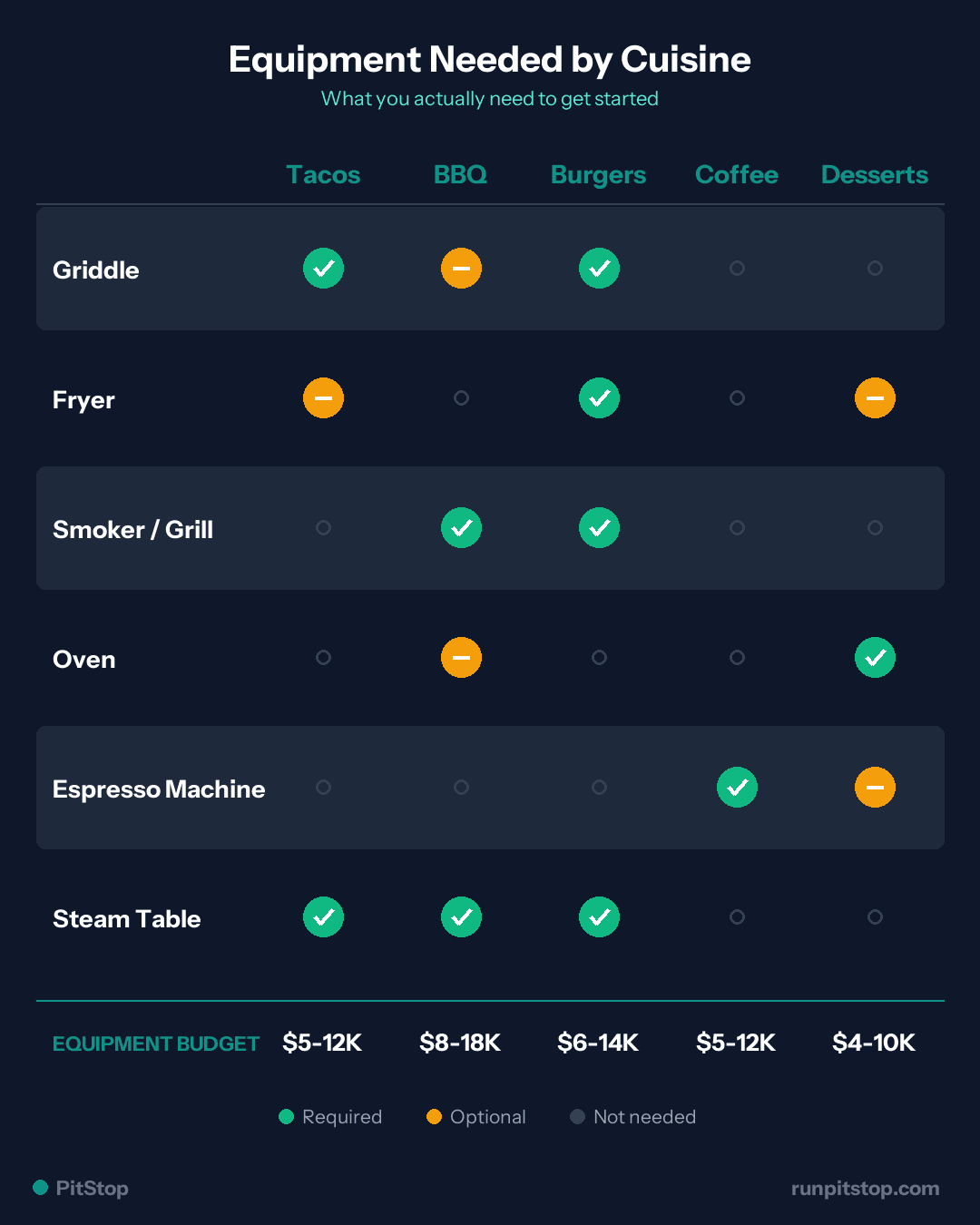
Swipe sideways for all columns
| Taco Truck | BBQ Truck | Dessert Truck | Burger/Fry Truck | Coffee Van | |
|---|---|---|---|---|---|
| Griddle | Yes | Optional | No | Yes | No |
| Fryer | Optional | No | Optional | Yes | No |
| Smoker/grill | No | Yes | No | Yes (charbroiler) | No |
| Oven | No | Optional | Yes | No | No |
| Espresso machine | No | No | Optional | No | Yes ($3K-$8K) |
| Steam table | Yes | Yes | No | Yes | No |
| Equipment budget | $5K-$12K | $8K-$18K | $4K-$10K | $6K-$14K | $5K-$12K |
Truck Sizes: What Fits Where
Swipe sideways for all columns
| Truck Length | Interior Work Space | Best For | Crew Size |
|---|---|---|---|
| 14 ft | ~80 sq ft | 1-2 person operation, limited menu | 1-2 |
| 16 ft | ~100 sq ft | Standard food truck, most common | 2-3 |
| 20 ft | ~130 sq ft | Full menu, room for multiple stations | 2-4 |
| 24 ft | ~160 sq ft | High-volume, catering-focused | 3-5 |
Bigger is not always better. A 24-foot truck costs more to fuel, is harder to park, and requires a CDL in some states. Most operators do well with 16-20 feet.
Where to Buy Equipment
Where to buy new: Refrigeration, fire suppression, POS. Where to buy used: Griddles, fryers, prep tables, sinks, steam tables - these items are built to last decades.
Use the per-event profit calculator to add up your equipment costs and see how they fit into your total startup budget and breakeven timeline.
Before you apply
Verify every fee in this guide with the issuing agency before you pay it; fee schedules change mid-year and the agency's own page is the only number that counts. Run your first few events through the per-event profit calculator, and start the paperwork 3–4 months before opening day: inspection slots, commissary letters and certifications take longer than the application itself.