The Quick Answer: $50,000 to $200,000
That is the total investment to go from zero to your first paying customer. Where you land in that range depends on three things: whether you buy used or new, how much your local permits cost, and how much cash reserve you set aside.
But knowing the range is not enough to make a decision. This guide helps you answer the real question: can you afford it, and is it worth it?
Can You Afford It? Self-Assessment
Before looking at truck prices, answer these honestly.
Your next steps
Most operators sort these out before their first event.
Finance your truck or equipment
Compare equipment and working-capital options, with a soft check to start.
See financing optionsGet food truck insurance
General liability is what most events require. Get a quote in a few minutes.
Get a quoteAffiliate partners: PitStop may earn a commission at no extra cost to you. How this works.
Swipe sideways for all columns
| Question | Red Flag | Green Flag |
|---|---|---|
| How much cash can you invest without borrowing? | Under $15,000 | $30,000+ |
| Credit score | Below 620 | 680+ |
| Monthly personal expenses (rent, bills, food) | Over $5,000 | Under $3,500 |
| Months of personal savings (beyond investment) | Under 3 | 6+ |
| Existing debt payments | Over $1,500/month | Under $500/month |
| Do you have a partner/spouse income? | No backup income | Yes, covers basics |
| Can you work your current job during build-out? | No, quitting immediately | Yes, overlap 2-3 months |
If you have more red flags than green flags, you are not ready yet. That is not a permanent no - it is a "save for 6-12 more months" or "keep your day job longer during build-out." Starting undercapitalized is the number one reason food trucks fail.
Three Real Scenarios
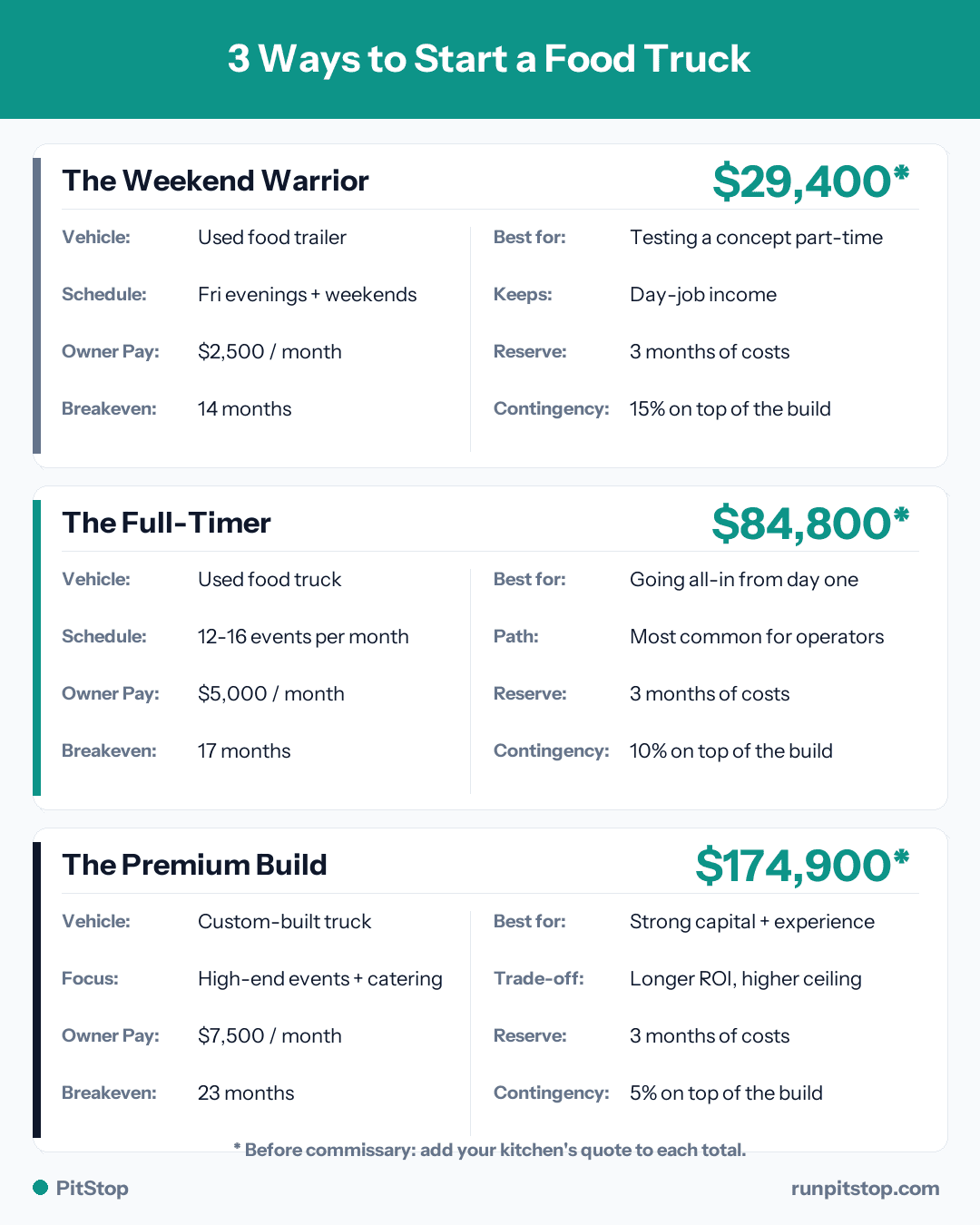
The Weekend Warrior - about $29,400 before commissary
Profile: Keeps their day job. Operates Friday evenings and weekends. Starts with a used food trailer, not a truck.
| Item | Cost |
|---|---|
| Used food trailer (equipped) | $12,000 |
| Tow vehicle (already owned) | $0 |
| Trailer repairs and upgrades | $3,000 |
| Permits and licenses | $1,200 |
| Insurance (first year) | $1,800 |
| Commissary (3 months) | 3 × your kitchen's quote |
| Branding/wrap (partial) | $1,500 |
| POS hardware | $50 |
| Initial inventory | $800 |
| Cash reserve (3 months) | $5,000 |
| Food handler/manager certs | $200 |
| Total (before commissary) | $25,550 |
| Contingency (15%) | $3,833 |
| Grand total (before commissary) | $29,383 |
This is the lowest-risk entry point. You keep your income, test your concept on weekends, and scale up only when the numbers prove it works. Many successful full-time operators started exactly this way.
The Full-Timer - about $84,800 before commissary
Profile: Going all-in. Buys a solid used food truck. Plans to work 12-16 events per month from day one.
| Item | Cost |
|---|---|
| Used food truck (equipped) | $45,000 |
| Truck repairs and upgrades | $5,000 |
| Additional kitchen equipment | $3,000 |
| Permits and licenses | $2,500 |
| Insurance (first year) | $3,500 |
| Commissary (3 months) | 3 × your kitchen's quote |
| Full truck wrap | $3,500 |
| POS hardware | $300 |
| Initial inventory | $1,500 |
| Cash reserve (3 months) | $12,000 |
| Food handler/manager certs | $250 |
| Website and marketing | $500 |
| Total (before commissary) | $77,050 |
| Contingency (10%) | $7,705 |
| Grand total (before commissary) | $84,755 |
This is the most common path for serious operators. A good used truck in the $40,000-$50,000 range gives you reliable equipment without the cost of a custom build.
The Premium Build - about $174,900 before commissary
Profile: Custom-built truck, premium brand, targeting high-end events and catering from day one.
| Item | Cost |
|---|---|
| Custom-built food truck | $120,000 |
| Premium kitchen equipment (upgrades) | $8,000 |
| Permits and licenses | $3,500 |
| Insurance (first year) | $4,500 |
| Commissary (3 months) | 3 × your kitchen's quote |
| Professional branding + premium wrap | $5,000 |
| POS hardware (full setup) | $800 |
| Initial inventory | $2,500 |
| Cash reserve (3 months) | $20,000 |
| Food handler/manager certs | $300 |
| Website, photography, marketing | $2,000 |
| Total (before commissary) | $166,600 |
| Contingency (5%) | $8,330 |
| Grand total (before commissary) | $174,930 |
This path makes sense only if you have strong capital, restaurant experience, and a clear high-end market to enter. The ROI takes longer, but the revenue ceiling is higher.
Food Truck vs. Food Trailer vs. Food Cart
Not sure which format is right? Here is the comparison.
Swipe sideways for all columns
| Factor | Food Cart | Food Trailer | Food Truck |
|---|---|---|---|
| Startup cost | $5,000 - $25,000 | $15,000 - $60,000 | $40,000 - $200,000 |
| Menu complexity | Very limited (1-3 items) | Moderate (5-8 items) | Full menu (8-15 items) |
| Mobility | Walk/tow to location | Requires tow vehicle | Self-contained |
| Permits | Simplest | Moderate | Most complex |
| Revenue potential | $500 - $1,500/event | $1,000 - $3,000/event | $1,500 - $5,000+/event |
| Best for | Testing concepts, low-traffic spots | Weekend warriors, farmers markets | Full-time operators, festivals |
A food cart is the lowest-risk way to test a concept. A trailer is the best value for weekend operators. A truck is the standard for anyone going full-time.
Hidden Costs Most Guides Skip
Opportunity Cost
If you leave a $60,000/year job to start a food truck, your real first-year cost includes $60,000 in lost wages plus your startup investment. A $85,000 food truck launch from someone earning $60,000 has a true cost of $145,000 in year one.
Lost Income During Build-Out
Buying a truck and getting it road-ready takes 10-16 weeks. If you quit your job at truck purchase, that is 3-4 months of zero income while spending money on permits, insurance, and prep.
Storage Before Launch
If your commissary arrangement does not include overnight parking, you need somewhere to store a 20-foot truck. Commercial parking is priced by the lot, so get that quote alongside your commissary quotes. Some operators park at home if local ordinances allow it.
First-Month Cash Flow Gap
Your first month of events will generate revenue, but expenses hit before income arrives. You buy food before you sell it. You pay staff before credit card deposits clear (2-3 business days). Event fees are due before you set up. Your first month may require $3,000-$5,000 more in working capital than your ongoing months.
Timeline: Idea to First Customer
Swipe sideways for all columns
| Phase | Duration | What Happens |
|---|---|---|
| Research and planning | 2-4 weeks | Market research, menu development, business plan |
| Financing | 2-6 weeks | Savings, loans, or investor conversations |
| Truck acquisition | 2-8 weeks | Finding, inspecting, purchasing truck |
| Build-out/repairs | 2-12 weeks | Equipment install, repairs, customization |
| Permits and licensing | 4-8 weeks | Applications, inspections, approvals |
| Branding and wrap | 2-4 weeks | Design, print, installation |
| Soft launch | 1-2 weeks | Test events, friends-and-family, menu testing |
| Total | 12-24 weeks | 3-6 months from decision to first sale |
Do not rush this timeline. Operators who cut corners during build-out spend more on fixes later.
Is It Worth It? ROI Analysis
Here is the breakeven math at three investment levels.
Swipe sideways for all columns
| Investment | Monthly Revenue | Monthly Profit (35% margin) | Monthly Owner Pay | Breakeven (months) |
|---|---|---|---|---|
| $35,000 | $10,000 | $3,500 | $2,500 | 14 |
| $85,000 | $20,000 | $7,000 | $5,000 | 17 |
| $175,000 | $30,000 | $10,500 | $7,500 | 23 |
Most food trucks break even on their initial investment in 12-24 months. After that, the business generates ongoing income with relatively low reinvestment requirements compared to restaurants.
The question is whether you can survive financially for 12-24 months while the business reaches breakeven. That is why the cash reserve line item is non-negotiable.
Model Your Costs Before You Spend a Dollar
The best time to run the numbers is before you write the first check. Use the per-event profit calculator to model your specific startup costs, projected revenue, and breakeven timeline.
Before you apply
Verify every fee in this guide with the issuing agency before you pay it; fee schedules change mid-year and the agency's own page is the only number that counts. Run your first few events through the per-event profit calculator, and start the paperwork 3–4 months before opening day: inspection slots, commissary letters and certifications take longer than the application itself.